Ertach Kernow - William Copeland Borlase archaeologist and author
Dr William Borlase rector of Ludgvan for fifty years until his death in 1772 was a Cornish antiquary, geologist and naturalist. He is well-known to those interested in Cornish archaeology and other historical aspects of Cornwall. Far less recognised is his great great grandson William Copeland Borlase, also an archaeologist, antiquarian and writer.
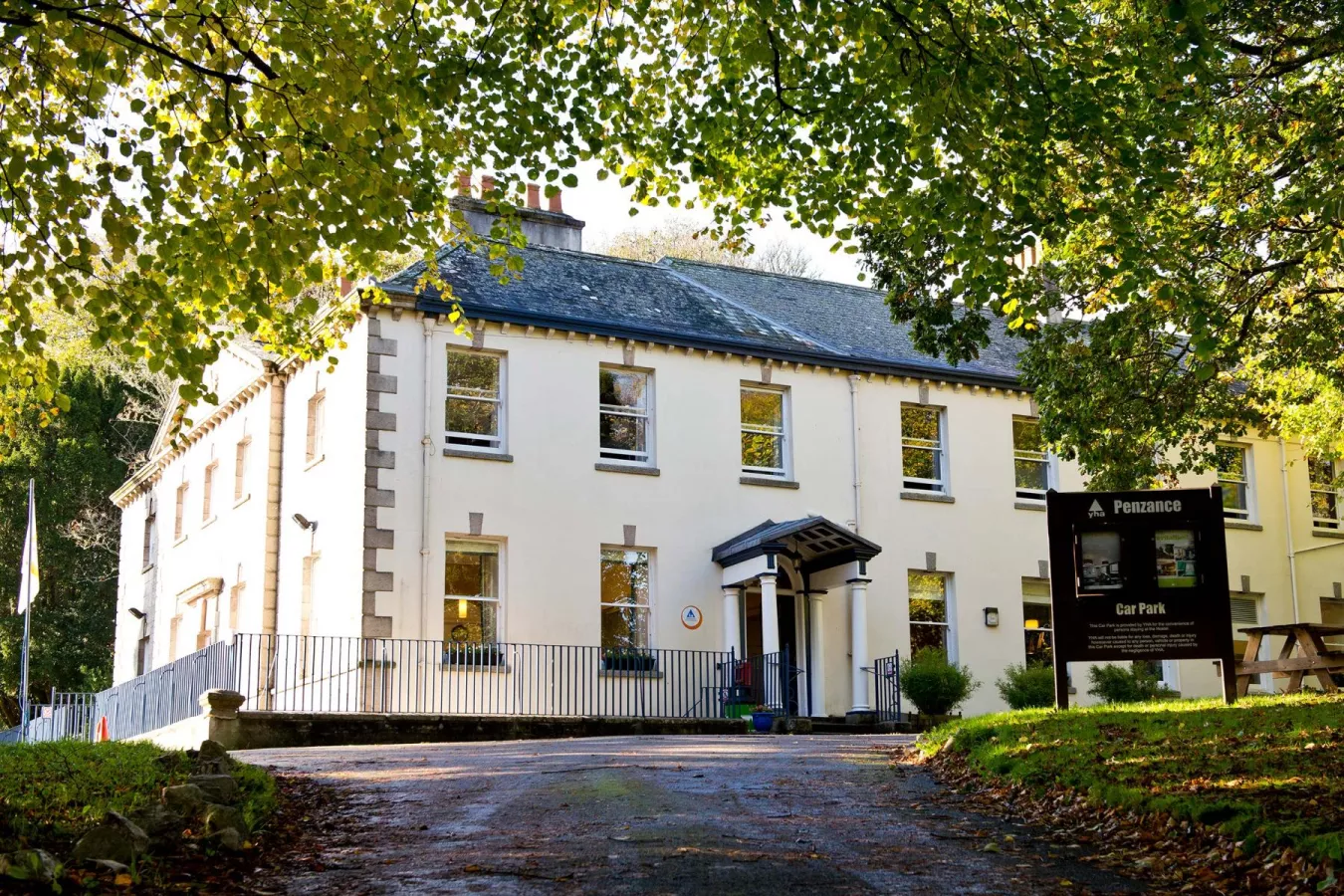
William Copeland Borlase the best known of the great antiquarians descendants was born at Castle Horneck now on the outskirts of Penzance. This historic house a Grade II listed building is presently run by the Youth Hostel Association and very well appointed with many original features. The first property was built on what was then part of the Manor of Alverton which itself dated from before Domesday in 1086. The Tyes family, later lords of the manor, built what is believed to be the first house in the 12th century. It later became the historic home of the Borlase family with the front of the house rebuilt around 1720 by Dr Walter Borlase, vicar of Madron for 55 years, the elder brother to W C Borlase’s ancestor Dr William Borlase.
Thank you for reading the online version of the Ertach Kernow weekly articles. These take some 12 hours each week to research, write and then upload to the website, and is unpaid. It would be most appreciated if you would take just a couple of minutes to complete the online survey marking five years of writing these weekly articles. Many thanks.
Click the link for survey: Ertach Kernow fifth anniversary survey link
As always click the images for larger view
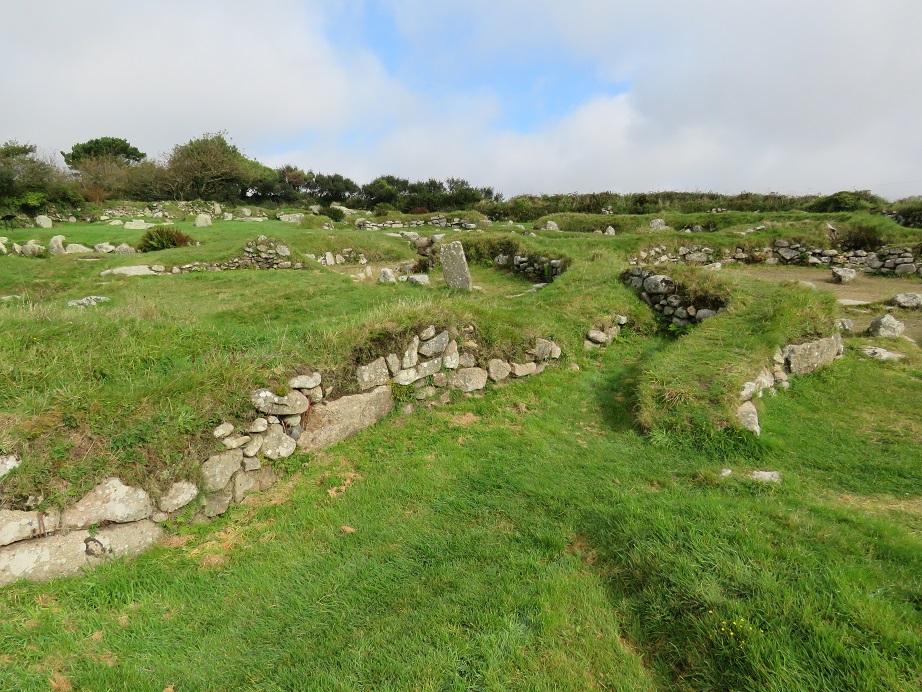
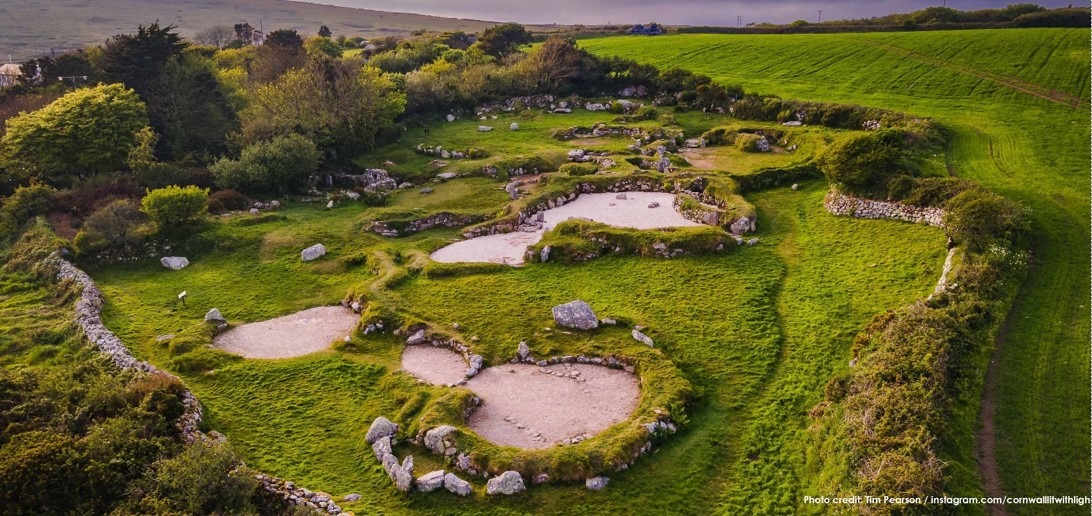
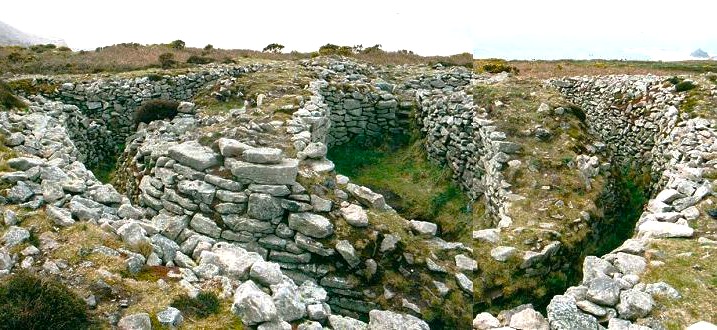
W C Borlase born there in 1848, the son of Samuel Borlase, was much influenced by his fathers interest in the work of Dr William Borlase. Samuel purchased his great grandfathers manuscripts in 1856. W C Borlase was well educated at Winchester and Trinity College, Oxford at the same time beginning his archaeological career. At age just fifteen he was supervising the excavations at Carn Euny. This ancient village now managed by Cornwall Heritage Trust dates from around 500BCE and discovered by tin prospectors early in the 19th century. Cornish architectural artist John Thomas Blight made corresponding engravings for the young Borlase’s excavation report.
Borlase continued his work on ancient sites with a great number of excavations and discoveries, including the barrow at Bollowall also known as Carn Gluze Barrow in 1878. His work on many sites throughout Cornwall provided him with information to publish ‘Naenia Cornubiae, A Descriptive Essay, Illustrative of the Sepulchres and Funereal Customs of the Early Inhabitants of the County of Cornwall’ in 1872. His career was rocketing and at age just 29 he became President of the Royal Institution of Cornwall. Other honours also included being elected a Fellow of the Society of Antiquaries.
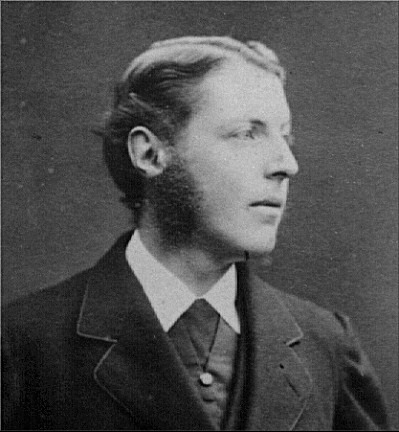
W C Borlase married Alice Lucy Kent at Coln St Aldwyn parish church in Gloucestershire in 1870. Alice was the daughter of a clergyman and a minor at the time of her marriage. In 1881 the census shows their marital home was Higher Largan House, not far from his ancestral home, where Borlase lived with his wife, mother and a maternal uncle and six servants. He was at the time of his marriage a lieutenant in the 1st Cornwall Rifle Corp and that year also saw him becoming a magistrate. Other honours and connections were made; in 1880 he was made a Freeman of the City of London also that year he was initiated into the Westminster & Keystone Lodge of the United Grand Lodge of England. In 1880 Borlase entered politics and was elected as a Liberal MP for the constituency of Eastern Cornwall. With the abolition of this constituency in 1885 he became the member of parliament for St Austell. In 1886 aged thirty-eight he was appointed Parliamentary Secretary to the Local Government Board. Politics would later help lead to his downfall.
Although an MP he was still continuing his archaeological work and it was at this time he worked with William Collings Lukis. They produced a wonderful work ‘Prehistoric Stone Monuments of the British Isles: Cornwall’. This is a volume which I have used many times in researching articles relating to Cornwall’s stone circles. The drawings have been accurately drawn to scale with forty tinted litho plates of stone circles around Cornwall. Published by the Society of Antiquaries in 1885 its drawing, like many from the past, help todays archaeologists and other interested parties understand how monuments have changed over the past centuries. An illustration of this can be found with the Boskednan stone circle which was sketched by Dr William Borlase in 1769. This shows thirteen standing stones with six fallen. When William Copeland Borlase drew it in 1872 the subsequent hundred years had seen changes with just seven standing stones and only four fallen could be located. Less valued than today, sadly many ancient monuments were used for building materials and agricultural use. W C Borlase had at the time been excavating a cairn close to the Boskednan stone circle.


Ultimately scandal and bankruptcy brought on by a lavish London lifestyle was to destroy him and his reputation forcing him to resign his parliamentary seat in 1887. His Portuguese former mistress, Madame de Quiros, exposed him, adding more fuel to the fire to his disgrace. Forced to sell assets including his library, he was ostracised by his family. Fortunately the works of Dr William Borlase were repurchased by the wealthy Borlase family and donated to the Royal Cornwall Museum. In poverty he was forced to work abroad and continued writing. These included ‘The Age of the Saints: a monograph of early Christianity in Cornwall’ in 1895 and ‘Tin-mining in Spain Past and Present’ published in 1897. Perhaps his greatest success was from Ireland when he completed his three-volume work ‘The Dolmens of Ireland’. This was published in 1897 when hailed a great success and is much valued especially in Ireland even today.
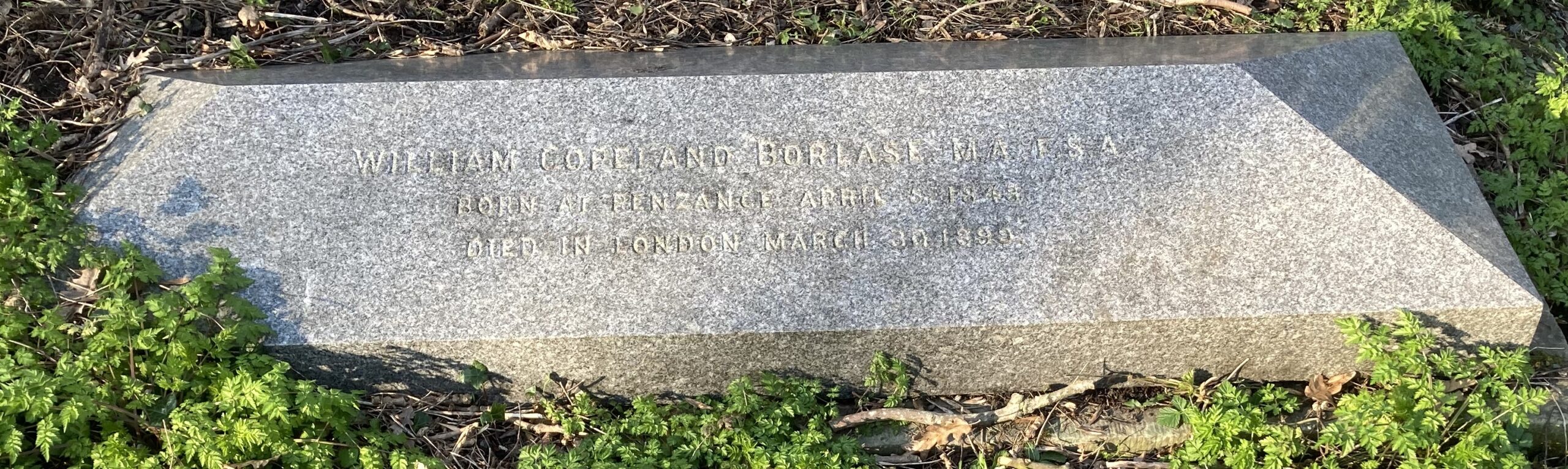
William Copeland Borlase died in 1899 at age 51 in London and buried on the east side of Highgate Cemetery. He left Henrietta Sarah Foote his entire estate of £1,130, worth about £127,000 today. His grave is marked by a simple low level granite inscribed stone. We should really remember him for his archaeology and numerous written works which add great value relating to Cornish and Irish archaeological sites. His later misfortunes and early death have perhaps robbed us of further valuable works.
This edition is shorter due to the Christmas holiday. Longer editions will appear again from 7th January article.