Ertach Kernow - Cornish golden hoards and treasure troves

Cornish treasure trove hoards date from the bronze age through to Anglo-Saxon times and recently often found by amateur metal detectorists or during archaeological digs. These may not as many assume consist of just gold and silver. Hoards may consist of jewellery, coins and other ancient and historic items, some considered hoards may even date back to Neolithic times.
Largely hoards are collections of valuable items, often buried with the intention of being retrieved later. They may be personal items, votive offerings or belonging to merchants buried for safekeeping and never recovered. Legally a hoard over 300 years old consisting of at least ten percent of gold or silver are considered a treasure trove. The importance of these hoards goes far beyond the intrinsic metal value, providing insight into historic and ancient cultures. Coins are usually quite easily dated, more often due to the inclusion of a rulers name or image. Thousands of coins from around three hundred sites have been found throughout Cornwall dating from the Iron Age, Roman and early Medieval periods.
Thank you for reading the online version of the Ertach Kernow weekly articles. These take some 12 hours each week to research, write and then upload to the website, and is unpaid. It would be most appreciated if you would take just a couple of minutes to complete the online survey marking five years of writing these weekly articles. Many thanks.
Click the link for survey: Ertach Kernow fifth anniversary survey link
As always click the images for larger view
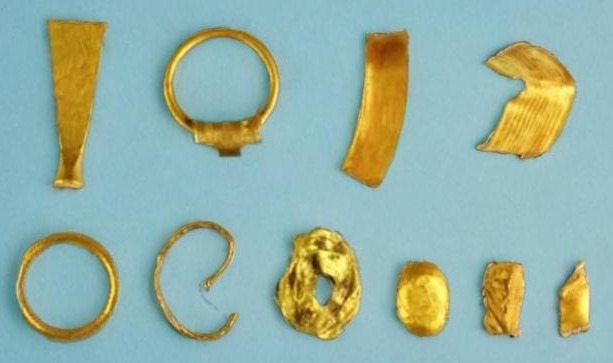
There have been some interesting recent discoveries again by metal detectorists. Fourteen objects described as ‘Viking’ were uncovered just three inches below the surface of a cauliflower field in 2020. Although not datable they are thought to be between 1300BCE and 1000BCE. If so unlikely to be Viking. A gold penannular Bronze Age ring was discovered in a ploughed field in February 2024 and was said by the Assistant Cornwall Coroner to be the first of its kind to be found in Cornwall. These belong to the Duchy of Cornwall with the Cornwall Museum paying the rewards to the finders and landowners.
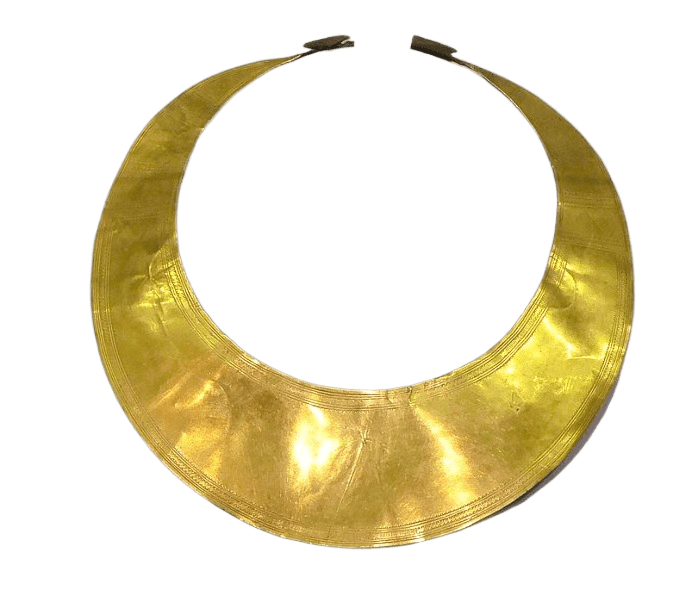
Hoards and treasure troves have been discovered in Cornwall long before the invention of metal detectors. Amongst the earliest treasures found can be seen at the Cornwall Museum in Truro. These are gold and what are termed lunulae dating from the early Bronze Age, named after their moonlike shape. The first lunulae found in Cornwall, was in 1783 in Penwith and held by the British Museum. Following its discovery by a farm labourer it was purchased by wealthy Cornishman John Price and later acquired by the British Museum in 1838.
A further lunulae was found around 1860 by a workman at Cargurra Farm in St Juliot parish. This passed through several hands before being purchased for the Royal Cornwall Museum in 1838 for two-hundred and fifty pounds. Shortly after in 1864 two further lunulae were discovered at Harlyn House, again by a workman digging a pond, along with a copper alloy flat axe. Not recognising them his children played with then until a glint of gold saw them taken to Mr C G Prideaux-Brune for his thoughts. The Duke of Cornwall, later King Edward VII, agreed that as treasure trove they should be deposited at the Royal Cornwall Museum. The Duke contributed the value of the gold as a price paid to the finder and landowner.
Although gold has been found in Cornwall and proved to have been exported through analysis relating to the Nebra Sky Disc. These lunulae are likely from Ireland as a number have been found in Wales, Brittany, Scotland as well as Cornwall suggesting some limited trading during the early Bronze Age.
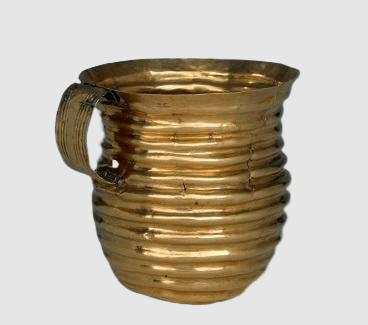
In 1837 during an excavation at Rillaton, beneath a cairn within a stone cist, a major gold find was made. Inside a pottery vessel was what is now known as the Rillaton Cup. This is dated around 1550 BCE some centuries later than the lunulae within the Bronze Age period. Presented to King William IV as it was found on Duchy of Cornwall land it is held within the Royal Collection but on loan to the British Museum. The Rillaton Cup is an extremely rare example of early Bronze Age gold metal work with only seven other known northern European examples.
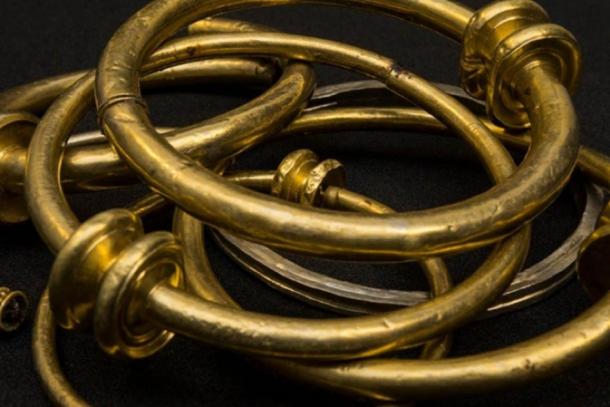
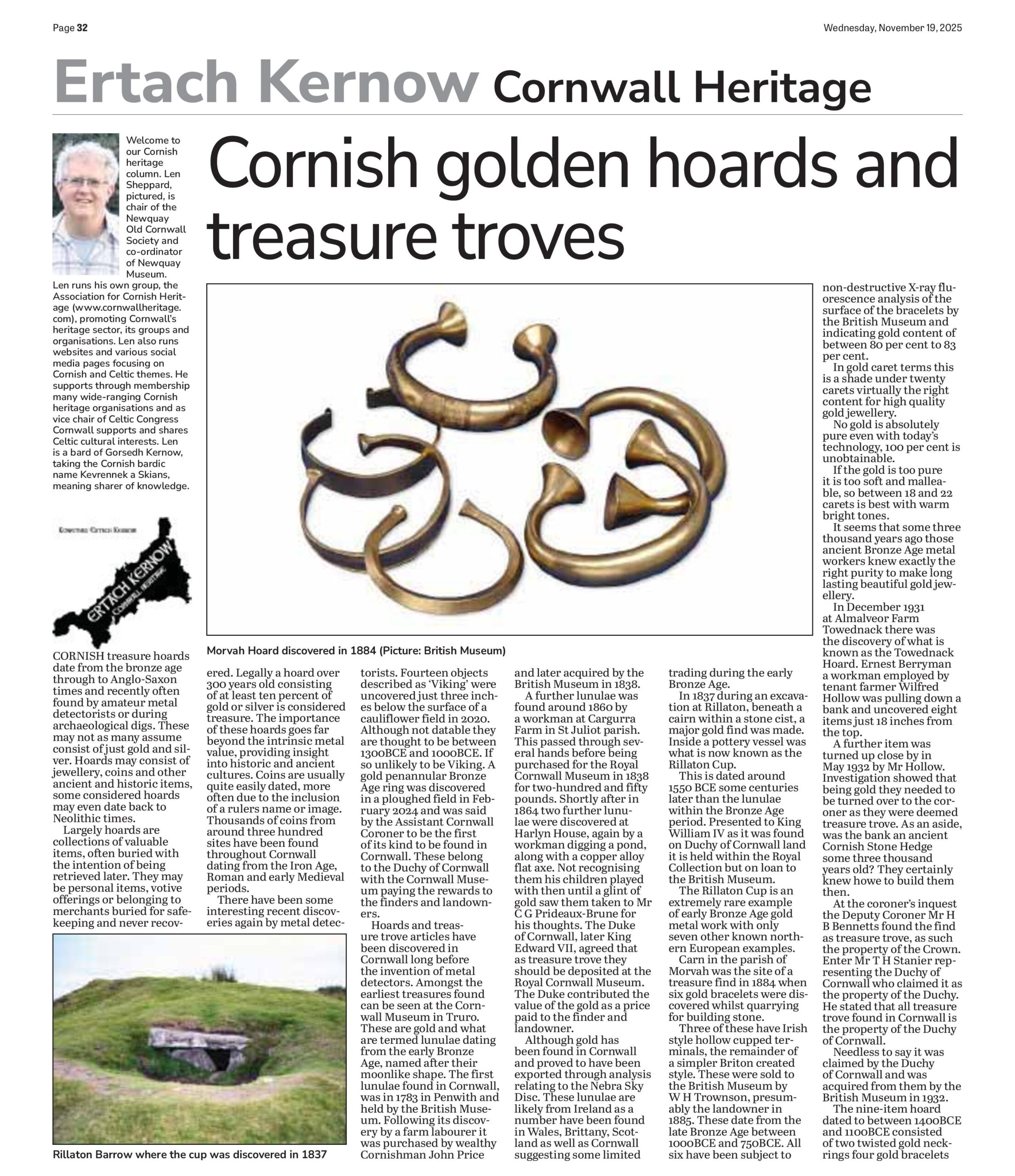
Carn in the parish of Morvah was the site of a treasure trove in 1884 when six gold bracelets were discovered whilst quarrying for building stone. Three of these have Irish style hollow cupped terminals, the remainder of a simpler Briton created style. These were sold to the British Museum by W H Trownson, presumably the landowner in 1885. These date from the late Bronze Age between 1000BCE and 750BCE. All six have been subject to non-destructive X-ray fluorescence analysis of the surface of the bracelets by the British Museum and indicating gold content of between 80% to 83%. In gold caret terms this is a shade under twenty carets virtually the right content for high quality gold jewellery. No gold is absolutely pure even with today’s technology, 100% is unobtainable. If the gold is too pure it is too soft and malleable, so between 18 and 22 carets is best with warm bright tones. It seems that some three thousand years ago those ancient Bronze Age metal workers knew exactly the right purity to make long lasting beautiful gold jewellery.
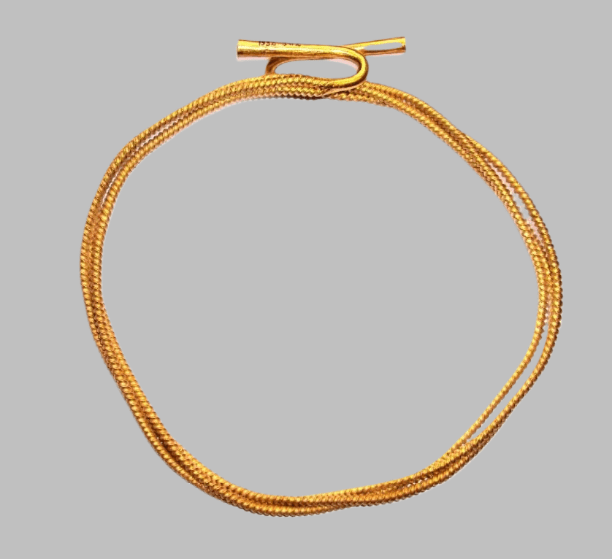
In December 1931 at Almalveor Farm Towednack there was the discovery of what is known as the Towednack Hoard. Ernest Berryman a workman employed by tenant farmer Wilfred Hollow was pulling down a bank and uncovered eight items just 18 inches from the top. A further item was turned up close by in May 1932 by Mr Hollow. Investigation showed that being gold they needed to be turned over to the coroner as they were deemed treasure trove. As an aside, was the bank an ancient Cornish Stone Hedge some three thousand years old? They certainly knew howe to build them then. At the coroner’s inquest the Deputy Coroner Mr H B Bennetts found the find as treasure trove, as such the property of the Crown. Enter Mr T H Stanier representing the Duchy of Cornwall who claimed it as the property of the Duchy. He stated that all treasure trove found in Cornwall is the property of the Duchy of Cornwall.
Needless to say it was claimed by the Duchy of Cornwall and was acquired from them by the British Museum in 1932. The nine-item hoard dated to between 1400BCE and 1100BCE consisted of two twisted gold neckrings four gold bracelets and three lengths of gold rod. The gold twisted bar torc is a particularly fine object, made from three bars of gold twisted from left to right then twisted round one another; it was soldered together at each end forming bent-back circular trumpet terminals. The Towednack Hoard was loaned to the Cornwall Museum in 2022 as part of their ‘Gathering light Spotlight’ exhibition as well as other English museums.
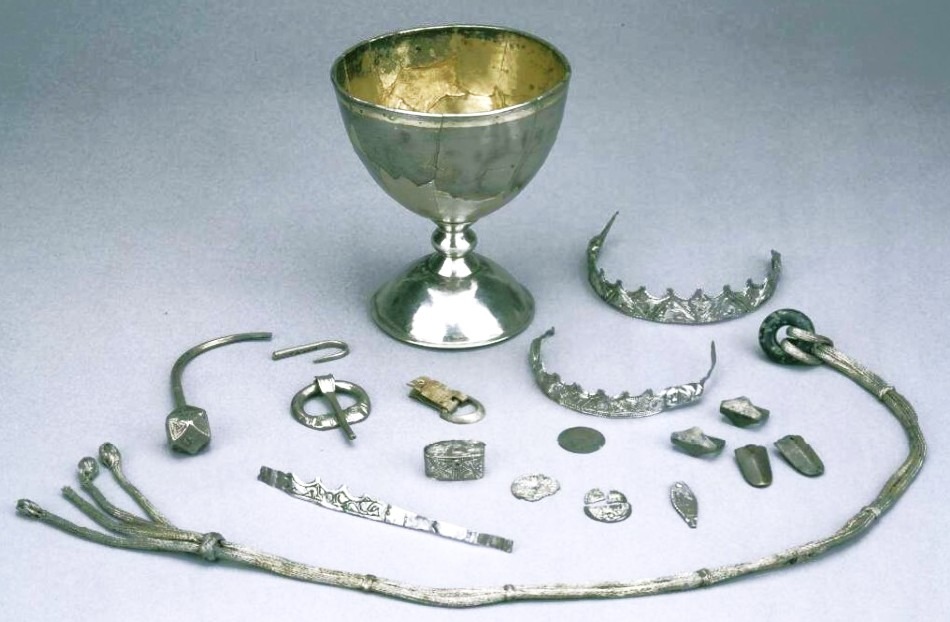
Moving on from the Bronze Age by over a thousand years we reach the Anglo-Saxon period. Although there were incursions into Cornwall as landowners and administrators the Anglo-Saxons did not affect the Cornish way of life to any major extent. Few places except in east Cornwall have names that reflect Anglo-Saxon language traits. There have been consequently little in the way of valuable hoards excepting the ‘Trewhiddle Hoard’ found at Trewhiddle near St Austell on 8th November 1774. Discovered by tin miners in an old tin-mine working stream bed, along with a number of other objects now lost, the age generally is dated to before 875CE based on the coins found with the hoard. There is a Celtic style brooch, which may be older, but the most important piece is the silver chalice with its internally gilded bowl. This is the only Anglo-Saxon silver chalice from Britain. The other metalwork is a mixture of ecclesiastical and secular material. Much of the hoard is abundantly decorated in interesting distinctive animalistic, plant and geometric motifs set in small fields. This has given rise to the term the Trewhiddle style. It's speculated that the hoard was hidden at a time when Viking attacks from the sea were frequent and destructive.
Following on from its discovery it passed through the hands of the Rashleigh and Rogers family and then donated to the British Museum by John Jope Rogers in 1880. What is unfortunate is that a good number of items from the hoard were lost including two gold ornamental objects. Of the hundred and fourteen coins originally secured thirty-nine have were lost before 1868. The oldest of the coins dated from Offa of Mercia 757CE-796CE.
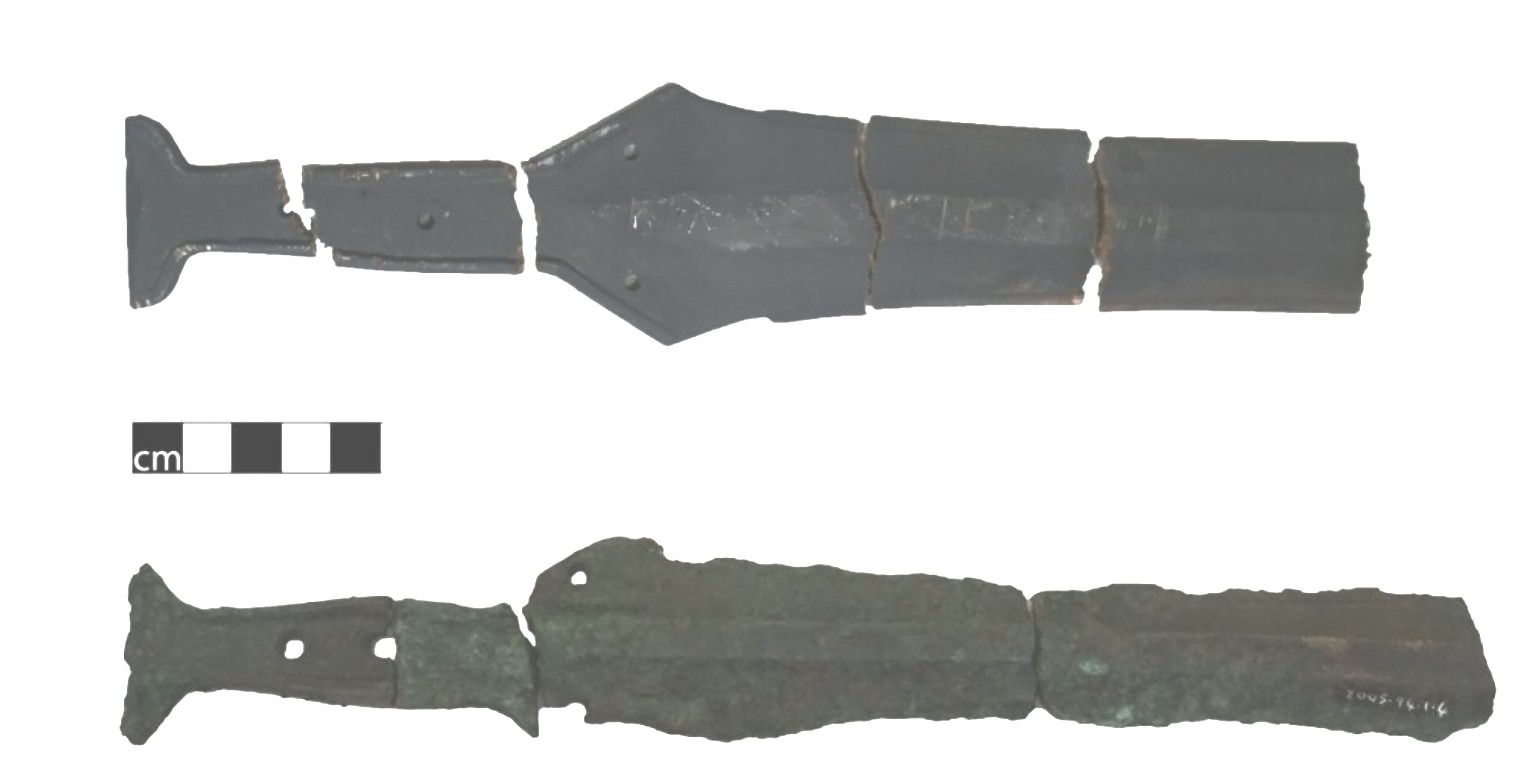
In 2002 a number of items were found buried on two separate occasions at St Erth. Although described as hoards they contained very little gold with just two fragments. The first hoard contains twenty-two incomplete objects broken into twenty-seven fragments included swords, axes and raw ingot metal. The second hoard included seventeen objects, consisting of broken ingots and a complete axe head of a type which is unusually rare in Cornwall, more commonly found in Brittany. The larger gold item when found was a folded strip of decorated Bronze Age gold some one-inch square, the smaller a mere fragment. Although not valuable through gold value these two hoards and many coin finds add to the history of Cornwall and its ancient people.
I’m sure that people throughout Cornwall interested in our Cornish historic and cultural heritage will agree the time has come for many of these artefacts to be returned home. With the vast enhancements made at the Cornwall Museum and Art Gallery through its professional improvements this is really the home for Cornish related artefacts. With calls for the return of artefacts from around the world surely the British Museum should heed the call from within the United Kingdom. Come on British Museum stop hoarding Cornwall’s treasures.
Heritage Column
Heritage in the News online links: