Ertach Kernow - Sennen, soft sands and wild cliffs of Land’s End
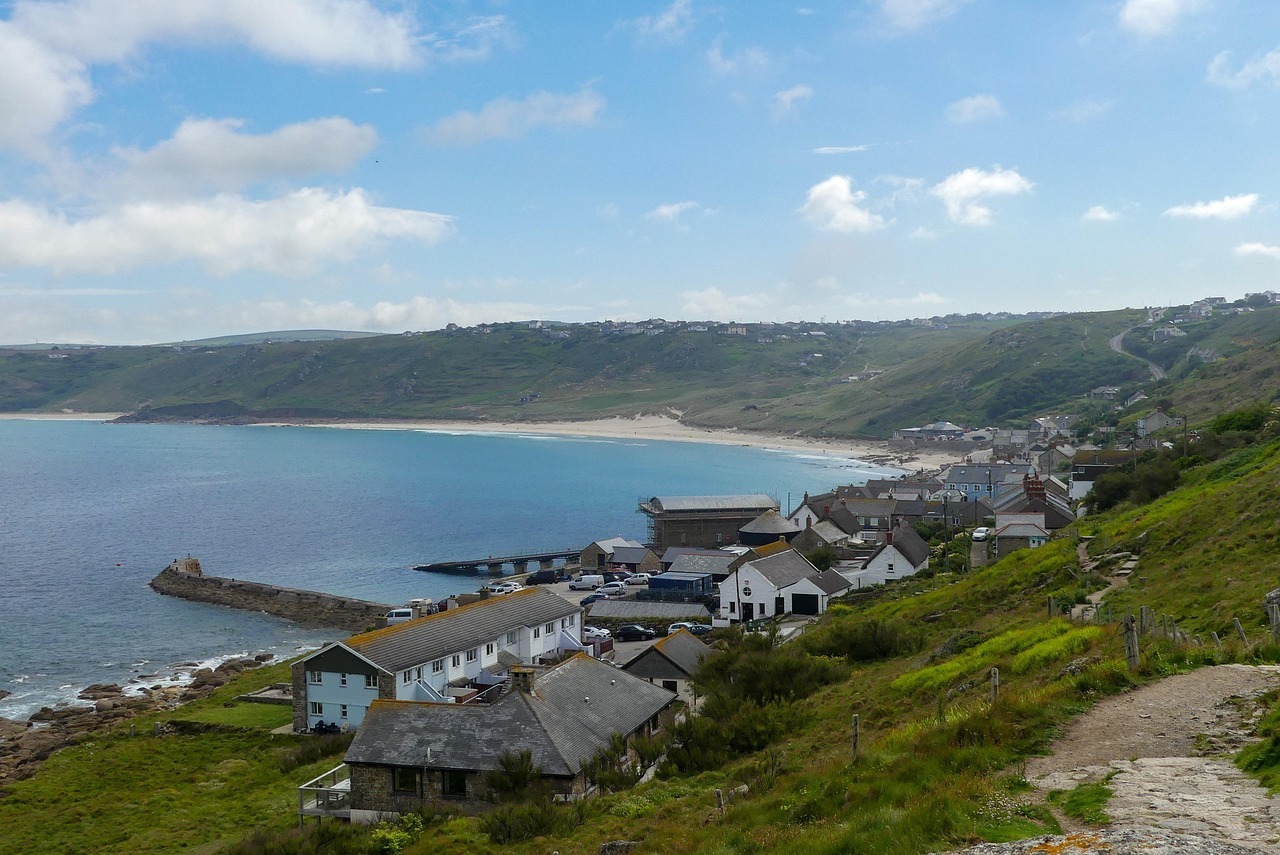
Sennen is perhaps best known to many people in the line ‘I’ve left childish footsteps in the soft Sennen sand’ as part of the now famous song by Harry Glasson, ‘Cornwall my Home’. The parish of Sennen is also famous for being that which includes Land’s End although many visitors to that most westerly part of mainland Britain may not know that.
As always click the images for larger view
The parish of Sennen is a wild place and may be considered a somewhat desolated place when winter storms lash this part of the coastline. It has a distinct lack of trees, perhaps due to the weather conditions but also brought about through the regions mining history. Consequently, it has a very moor like appearance and mainly farmland. The land has been improved considerably from the 19th century when the yields of some crops were considered poor. Surprisingly there is little in the way of mining within the Sennen parish although that is certainly not the case in the adjoining parish of St Just where one of Cornwall’s most famous mines, Botallack, can be found. The whole of the Sennen parish is located on one of the five major plutons which come to the surface from the Cornubian Batholith, the large mass of granite beneath much of Cornwall. This too has an effect on the landscape.
![Sennen Ordnance Survey Map 1880 [1]](https://www.cornwallheritage.com/wp-content/uploads/2026/03/Sennen-Ordnance-Survey-Map-1880-1.jpg "Sennen Ordnance Survey Map 1880 [1]")
![Sennen Ordnance Survey Map 1880 [2]](https://www.cornwallheritage.com/wp-content/uploads/2026/03/Sennen-Ordnance-Survey-Map-1880-2.jpg "Sennen Ordnance Survey Map 1880 [2]")
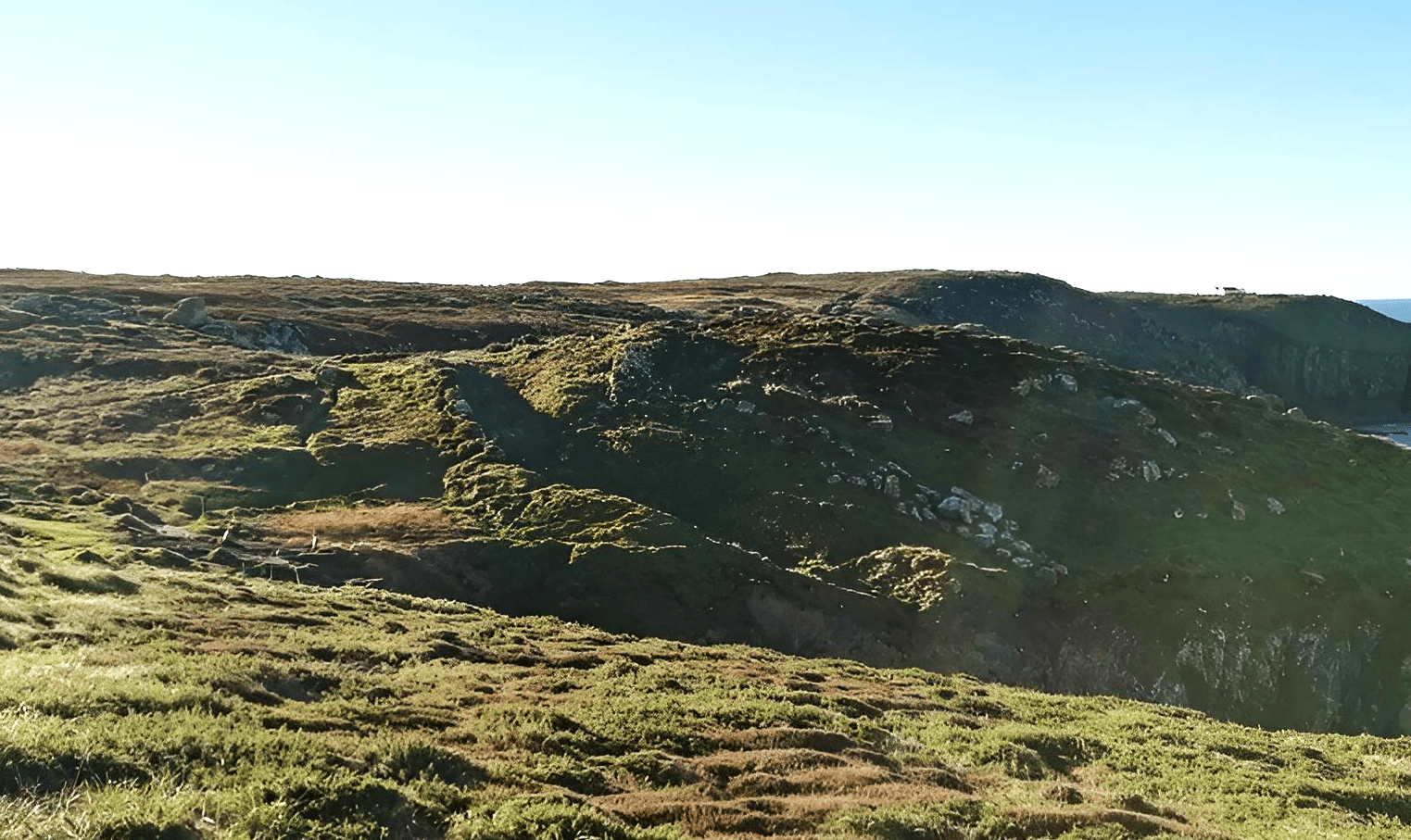
The various 19th century census shows how few men living in Sennen parish were involved in mining. Many would have perhaps walked to Botallack but a few maybe worked at the much lesser-known mine at Nangizell Cove on the very edge of the cliff. The Mining Gazette dated 8th of November 1845 included information about this mining operation. ‘Nangizell Cove is situate between Tol Pedn Penwith and the Land’s End; on the very edge of the cliff is a stamping-mill for pulverising tin ore, worked by a water wheel. On looking around the cove, and the hills which bound it, the visitor discovers no appearance of a mine in all the neighbourhood; he soon perceives, however, two spots on the slope of the hill, where small heaps of rubbish intimate that an attempt at mining may have been made, but there is no shaft, no adit, no machinery of any kind. At the most eastern spot an excavation has been made in the side of the hill, having the appearance of a stone quarry.’
The heritage map of the area and other maps show no record of this mining operation which illustrates how much about Cornwall’s mining past is still unknown today. For some a discovery is unfortunately when a shaft opens up in their front garden.
Besides the churchtown of Sennen the other settlements include the villages and hamlets of Treave, Maen (Mayon), Sennen Cove, Escalls and Trevescan. The population is small, not surprising for a parish so distantly removed from railway lines and larger towns, and now numbers around 900 persons in the last census.
One of the most important ancient features of the Sennen coastline are the remains of Maen Castle, a promontory cliff fort dating from prehistoric times. Dated to the Iron Age it is only one of two cliff forts where pottery sherds have been discovered. It has a stone rampart, ditch and counterscarp built across the neck of the headland. However, one has to consider that this U-shaped defence may have been much larger, even circular and further inland, than now given coastal erosion over the past three thousand years. It is thought that the site may have been occupied even earlier in the Bronze Age.
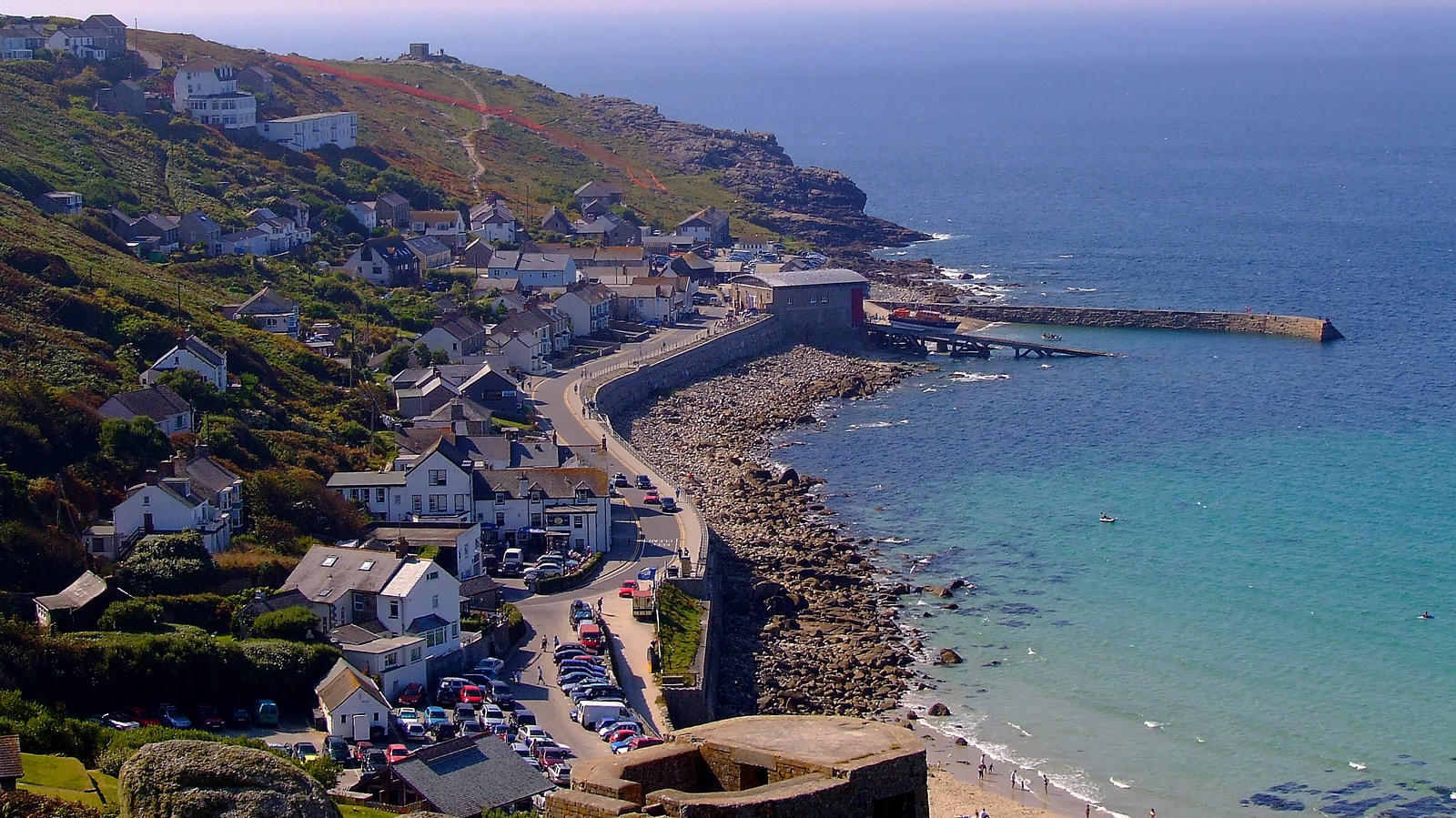
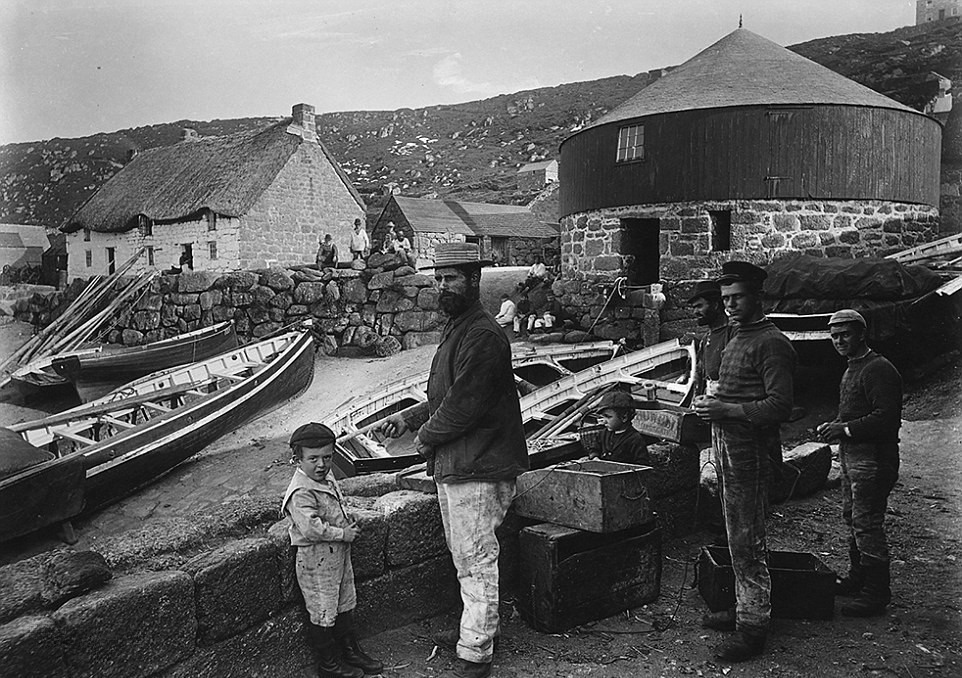
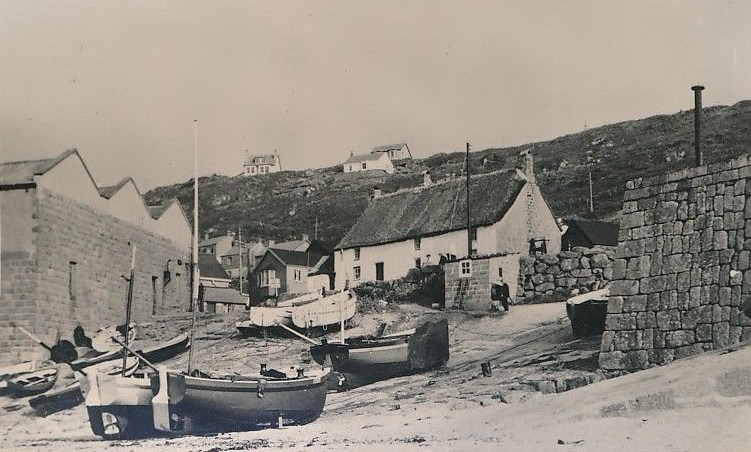
The harbour at Sennen Cove is somewhat different from the many small harbours around the Cornish coastline. It was established as a ‘Trust Port’ by Parliamentary Order in 1907 and built in 1908. Trust ports are statutory bodies, controlled by local independent boards which govern through their own unique statutes. With no shareholders or owners any surplus income is reinvested for the benefit of its stakeholders. Within the area protected by the projecting seawall there is the lifeboat slip and area where small boats can be beached. The village is protected by a seawall, some 400 metres long behind the beach, which prevents flooding.
Within the harbour area is a rather strange round building. This is thought to have been first constructed in the 18th century with a winch to haul boats up the beach. It was heightened and a roof added around 1876 with the capstan on the ground floor and space for fishermen to use as stores and nets above. Although no longer used for its original purpose this is now a Grade II* listed building with a much unaltered interior. The eight barred capstan remains in outstanding condition and was initially used in a tin mine before it converted to a steam engine. The Round House has evolved to become a gallery on the upper floor in 1983 and an art gallery downstairs in 1997.
The position of Sennen Cove jutting out into the ocean means it’s close to the location of countless potential shipping losses through storms. This led it to be an early recipient of a Peake class lifeboat in 1853 and although unnamed this lifeboat served until 1864. This was the third RNLI lifeboat stationed in Cornwall after Bude and Penzance. A James Beeching lifeboat, designed on behalf of the RNLI, was improved by James Peake, a master shipwright at the Royal Woolwich Dockyard. This was a self-righting vessel 37 feet long with an iron keel and light enough to be transported on a trailer. A similar vessel the ‘Cousins William and Mary Ann of Bideford’ replaced Sennen Cove’s earlier lifeboat in 1864. Many of the features of the Peake design were continued in lifeboats until 1916. The first motor lifeboat ‘The Newbons’ was stationed at Sennen Cove between 1922 and 1948 when replaced by the Watson class lifeboat ‘Susan Ashley’ between 1948 and 1973. This vessel then served elsewhere and is now preserved as part of the RNLI's historic lifeboat collection and bears the inscription Sennen Cove lifeboat. Since 2010 Sennen Cove has had a Tamar Class lifeboat stationed there, the ‘City of London III’ and an inshore D-Class inflatable lifeboat the Arangy. A D-Class lifeboat was first deployed at Sennen Cove in 1994. The station and its crew have received many awards from 1868 onwards including recognition from Iceland and France.
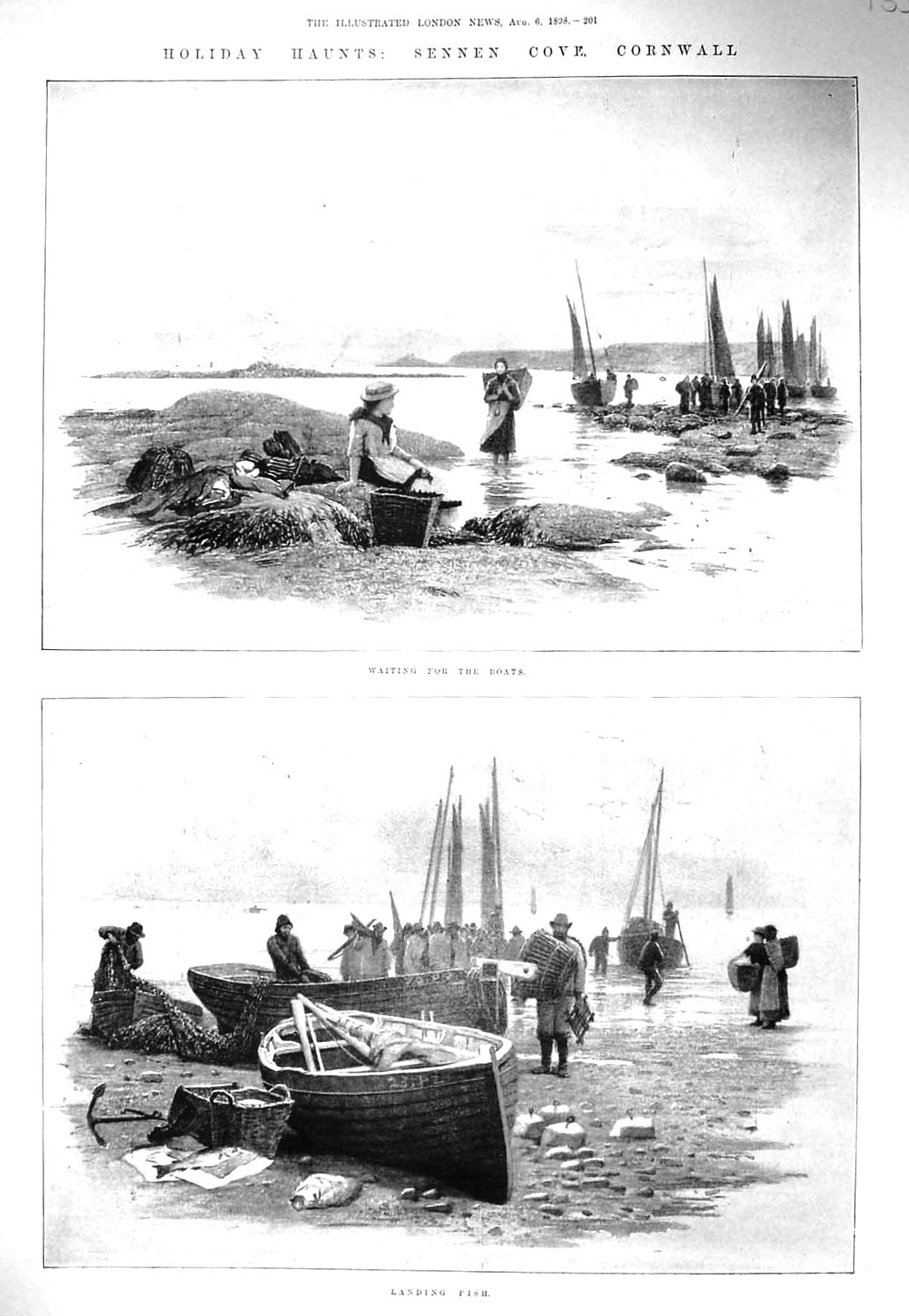
Today Land’s End continues to be an attraction with its rugged cliffs and views, although commercialisation has perhaps cheapened its appeal. It has been a destination for many early travellers who were exploring and writing about Cornwall from the 17th century with the area continually included in news magazines during the 19th century. The well-known Cornish archaeological artist and writer John Thomas Blight visited Sennen before 1861 and this is an opportunity to share his views on some of the area from the mid-19th century.
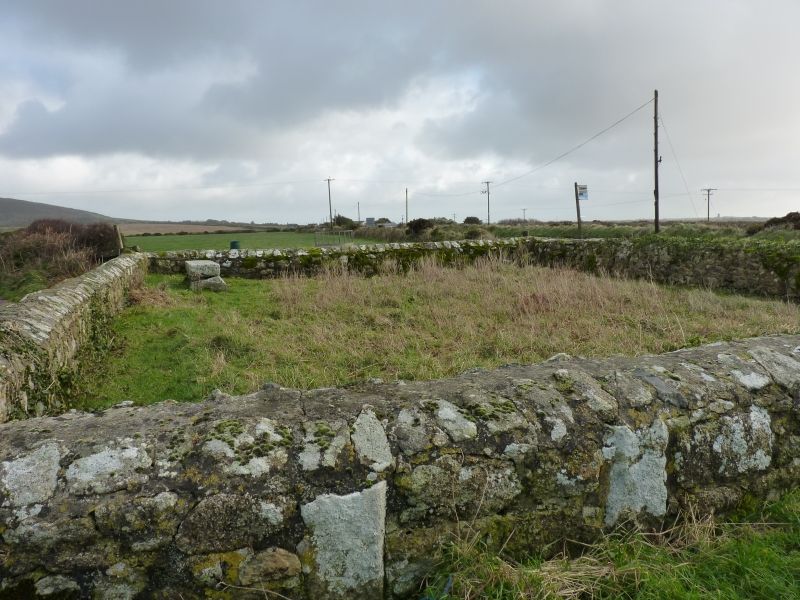
On Blight’s visit to the church at Sennen he mentions the Quaker burial ground on his journey. ‘A wooden post stands by the wall; the surrounding country is open and unsheltered, the graves are entirely covered by thorns and briars; and we know not what could have induced the selection of such a spot for such a purpose, unless those who were buried there wished to be laid beyond the reach of human sympathy.’ It’s still there a small walled enclosure maintained by the local parish council.
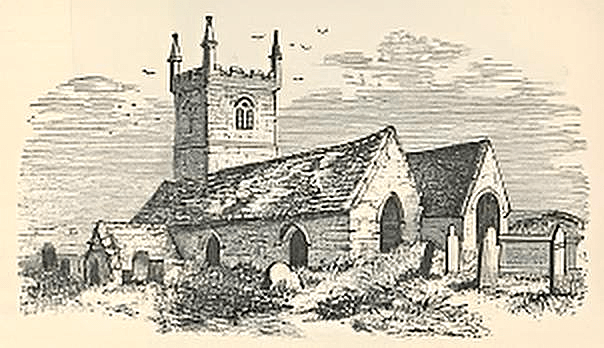
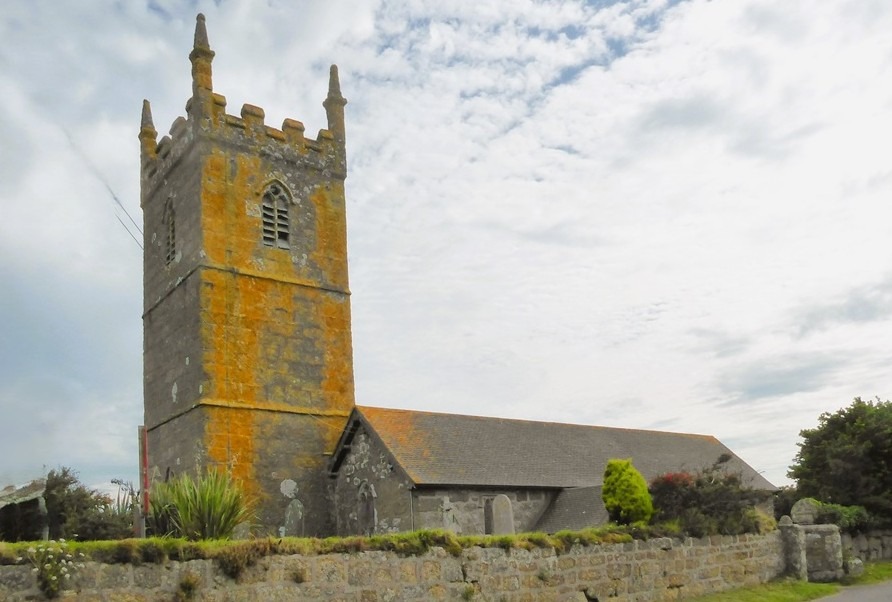
Of the church Blight writes; ’Sennen Church, dedicated to St. Senanus, a holy man of Irish celebrity, is a low weather-beaten structure, and harmonises well with the wild and romantic region in which it stands. Being 390 feet above the level of the sea, it forms a conspicuous object for many miles around’ He continues saying ‘It consists of a nave and chancel, with a side chapel, in which a rude figure of alabaster, belonging to some ancient monument, still remains. Externally, the character of the building has been much marred by the insertion of ugly modem windows, and the interior is in a most dilapidated state, calling loudly for restoration. The objects most worthy of notice, are, the font and an old low-side-window," commonly, but erroneously, called a Lychnoscope.’
Lychnoscopes were used for hearing confessions, providing Communion to lepers and other persons not permitted to enter the church. The church was restored in 1867 not long after Blight’s visit. Blight also mentions the ‘First and Last Inn’ in Sennen churchtown. Established around 1620 this historic Grade II listed inn is happily still operating.
Sennen has a lot to offer for people across a whole range of interests. Whether its walking, visiting local sites and places of interest, surfing and water sports or just enjoying the soft Sennen sands. In spring and early summer, it’s worth a visit before it gets too busy.
Heritage Column