Ertach Kernow - John Norden’s Cornish travels in the Trigg Hundred in 1584
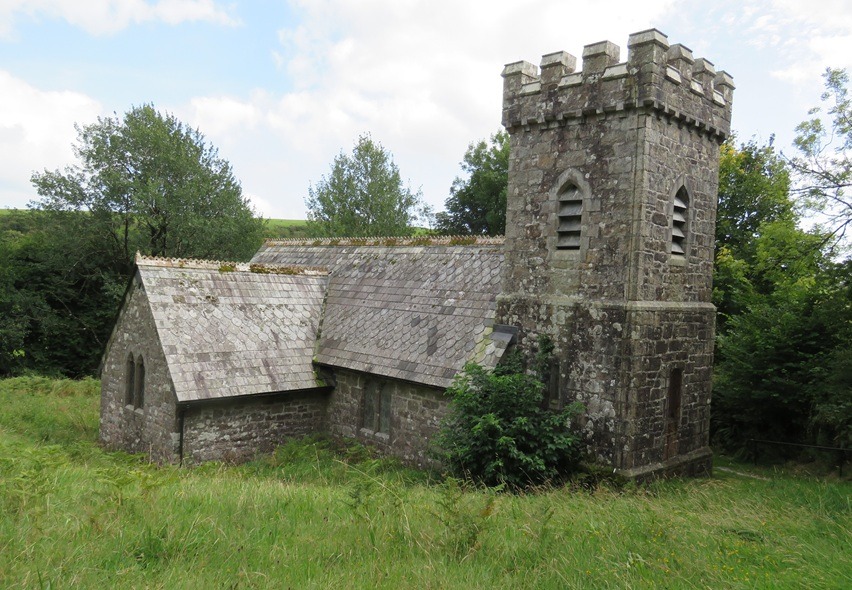
The Cornish maps of John Norden are wonderfully colourful created as a result of his travels around Cornwall in 1584. A quick recap of who John Norden was for those unacquainted with him. His main claim to fame is as a cartographer interested in mapping Britain. He intended to publish a work entitled ‘Speculum Britanniae’ or Mirror of Britain. His idea was to do this with ‘chorographical descriptions’ maps with additional text covering each mapped area. Norden’s work relating to Cornwall wasn’t published until 1728. Norden had split his maps and itinerary into the separate historic hundreds of Cornwall. Already covered in articles over the past years have been the Hundreds of Powder, Penwith and West Wivelshire.
As always click the images for larger view
This article looks at some of Norden’s travels around Triggshire Hundred, or as Norden referred to it as Trigg. Cornwall had already been visited by John Leland in the early 16th century at the behest of Henry VIII. The priest William of Worcester also included Cornwall within his travel itinerary during the late 15th century, his notes were however less extensive. The area covered is described by Norden: Trigg hundred, also called Bodannan hundred, it lyeth between Padstow haven weste and Lesnewth hundred easte. Having Irishe Sea Northe and the hundred of Weste south.’ This gives a clue that it includes the town of Bodmin, one of Cornwall’s early towns of importance. Besides Bodmin there were no other major Cornish town settlements at that time and none developed within this historic hundred. Villages which made up this hundred five hundred years ago still exist, with the old village of Egloshayle being part of Wadebridge civil parish since 1898. Other settlements include Blisland, St Breward, St Endellion, Helland, St Kew, St Mabyn, St Minver, St Teath, Temple and St Tudy along with some smaller hamlets.
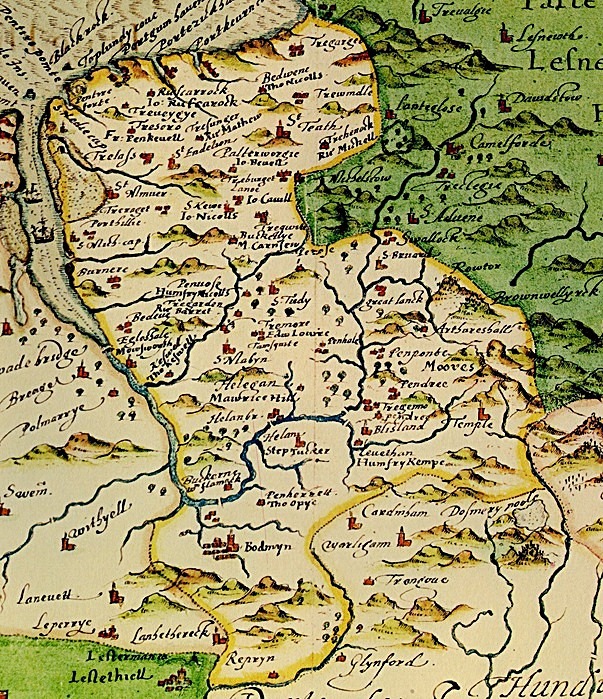

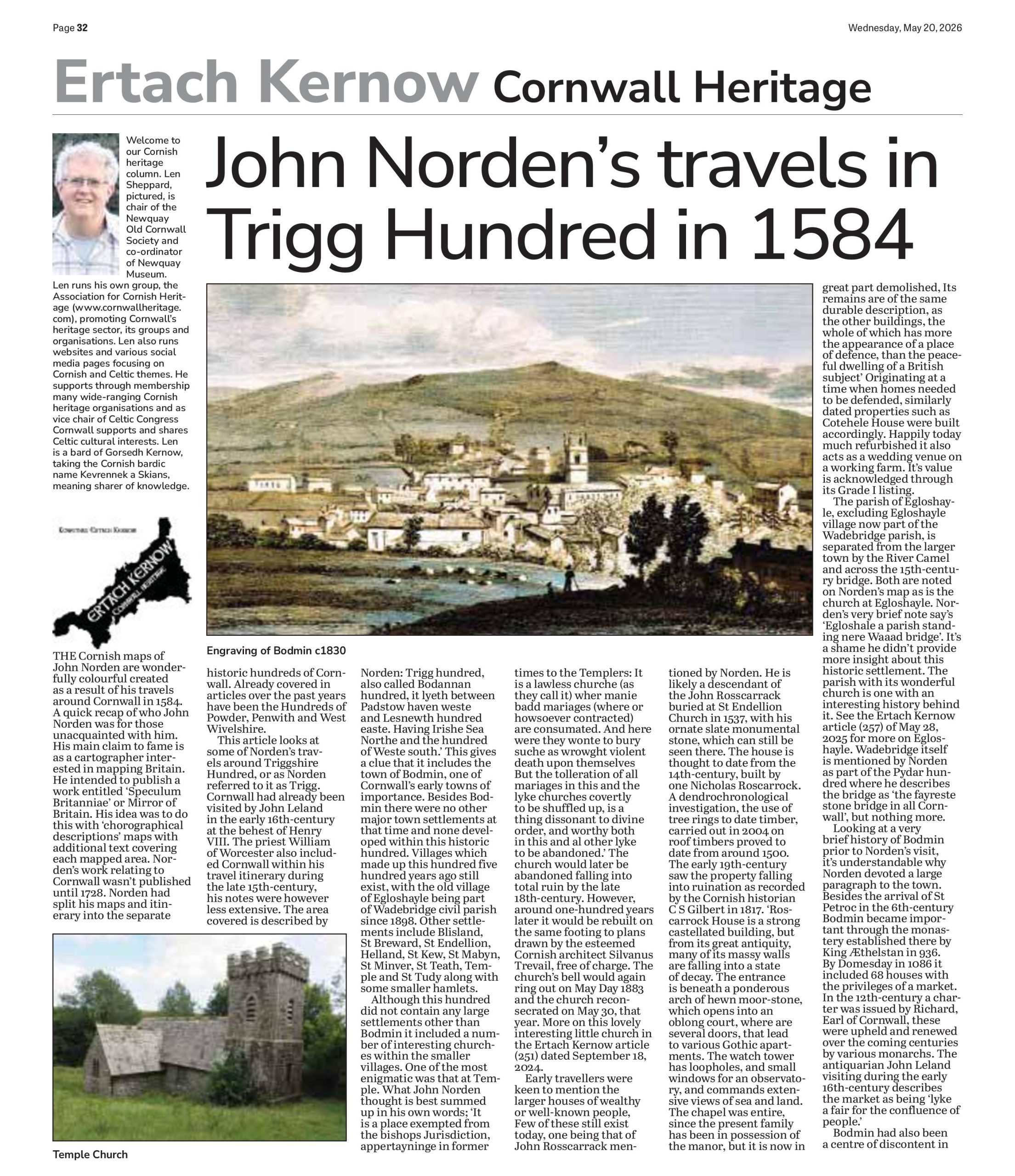
Although this hundred did not contain any large settlements other than Bodmin it included a number of interesting churches within the smaller villages. One of the most enigmatic was that at Temple. What John Norden thought is best summed up in his own words; ‘It is a place exempted from the bishops Jurisdiction, appertayninge in former times to the Templers: It is a lawless churche (as they call it) wher manie badd mariages (where or howsoever contracted) are consumated. And here were they wonte to bury suche as wrowght violent death upon themselves But the tolleration of all mariages in this and the lyke churches covertly to be shuffled up, is a thing dissonant to divine order, and worthy both in this and al other lyke to be abandoned.’ The church would later be abandoned falling into total ruin by the late 18th century. However, around one-hundred years later it would be rebuilt on the same footing to plans drawn by the esteemed Cornish architect Silvanus Trevail, free of charge. The church’s bell would again ring out on May Day 1883 and the church reconsecrated on 30th May that year. More on this lovely interesting little church in the Ertach Kernow article (251) dated 18th September 2024.
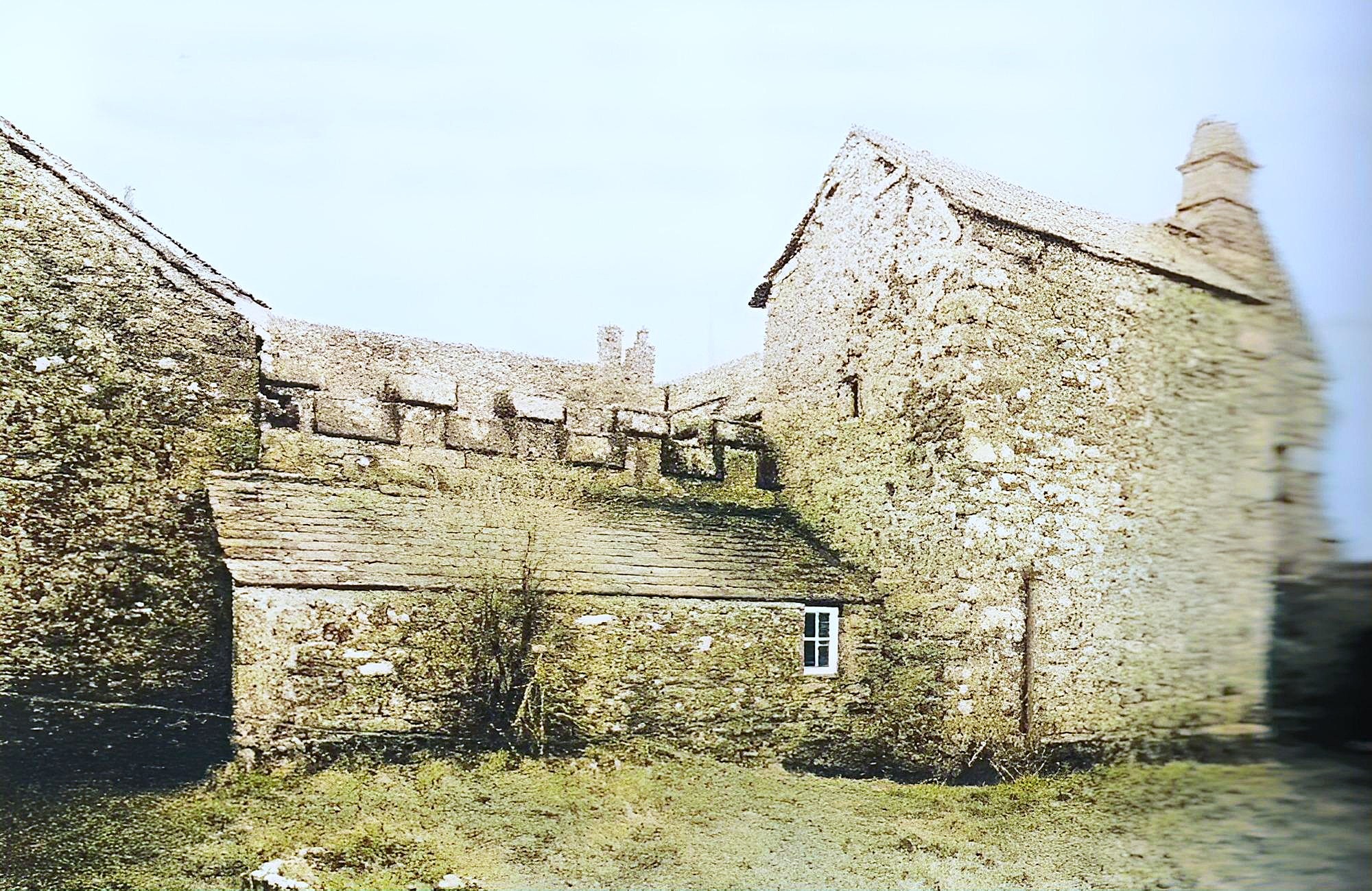
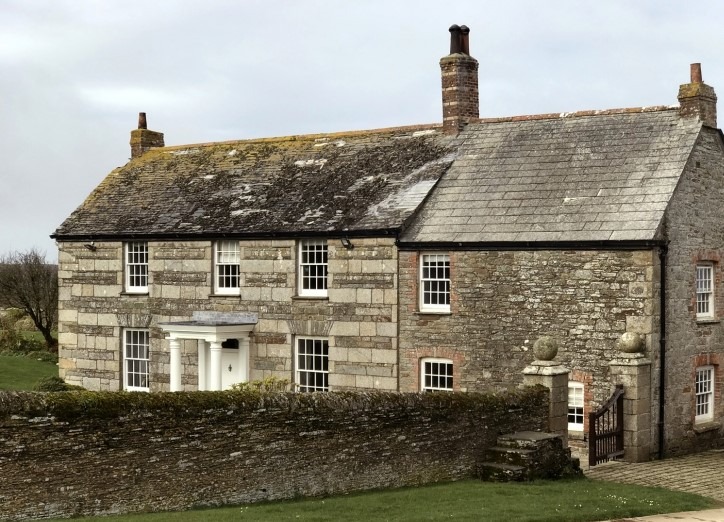
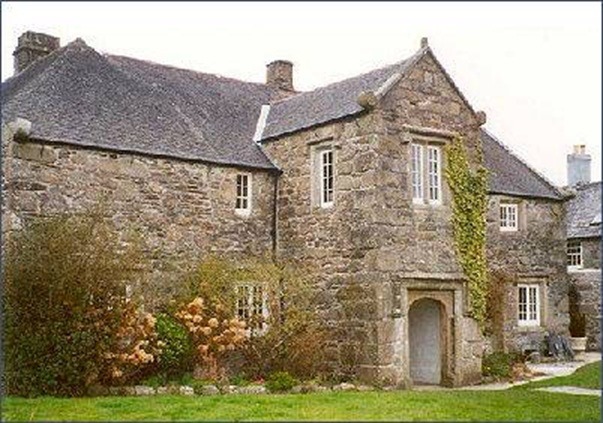
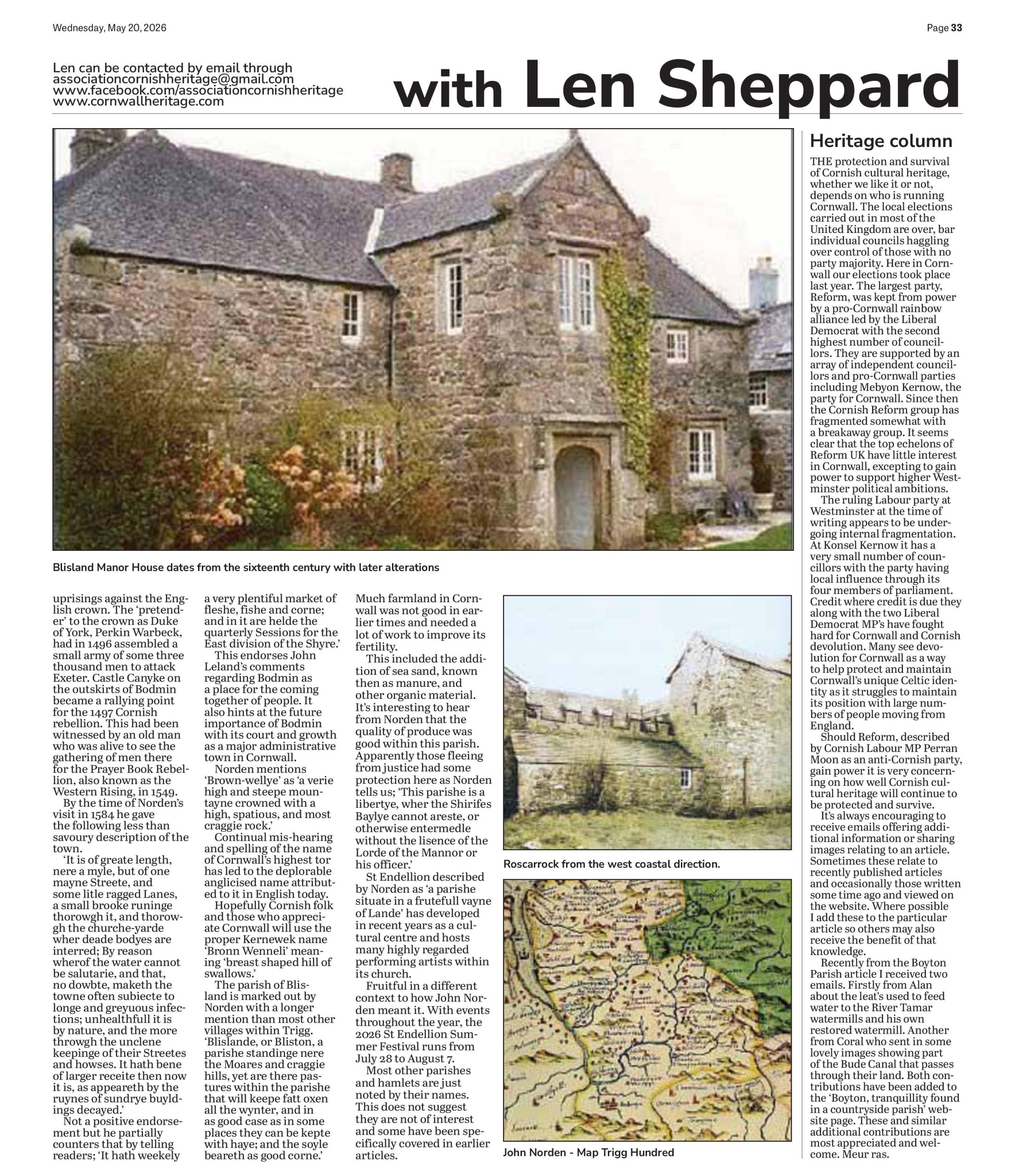
Early travellers were keen to mention the larger houses of wealthy or well-known people, Few of these still exist today, one being that of John Rosscarrack mentioned by Norden. He is likely a descendant of the John Rosscarrack buried at St Endellion Church in 1537, with his ornate slate monumental stone, which can still be seen there. The house is thought to date from the 14th century, built by one Nicholas Roscarrock. A dendrochronological investigation, the use of tree rings to date timber, carried out in 2004 on roof timbers proved to date from around 1500. The early 19th century saw the property falling into ruination as recorded by the Cornish historian C S Gilbert in 1817. ‘Roscarrock House is a strong castellated building, but from its great antiquity, many of its massy walls are falling into a state of decay. The entrance is beneath a ponderous arch of hewn moor-stone, which opens into an oblong court, where are several doors, that lead to various Gothic apartments. The watch tower has loopholes, and small windows for an observatory, and commands extensive views of sea and land. The chapel was entire, since the present family has been in possession of the manor, but it is now in great part demolished, Its remains are of the same durable description, as the other buildings, the whole of which has more the appearance of a place of defence, than the peaceful dwelling of a British subject’ Originating at a time when homes needed to be defended, similarly dated properties such as Cotehele House were built accordingly. Happily today much refurbished it also acts as a wedding venue on a working farm. It’s value is acknowledged through its Grade I listing.

The parish of Egloshayle, excluding Egloshayle village now part of the Wadebridge parish, is separated from the larger town by the River Camel and across the 15th century bridge. Both are noted on Norden’s map as is the church at Egloshayle. Norden’s very brief note say’s ‘Egloshale a parish standing nere Waaad bridge’. It’s a shame he didn’t provide more insight about this historic settlement. The parish with its wonderful church is one with an interesting history behind it. See the Ertach Kernow article (257) of 28th May 2025(opens in new tab)(opens in new tab) for more on Egloshayle. Wadebridge itself is mentioned by Norden as part of the Pydar hundred where he describes the bridge as ‘the fayreste stone bridge in all Cornwall’, but nothing more.
Looking at a very brief history of Bodmin prior to Norden’s visit, it’s understandable why Norden devoted a large paragraph to the town. Besides the arrival of St Petroc in the 6th century Bodmin became important through the monastery established there by King Æthelstan in 936. By Domesday in 1086 it included 68 houses with the privileges of a market. In the 12th century a charter was issued by Richard, Earl of Cornwall, these were upheld and renewed over the coming centuries by various monarchs. The antiquarian John Leland visiting during the early 16th century describes the market as being ‘lyke a fair for the confluence of people.’
Bodmin had also been a centre of discontent in uprisings against the English crown. The ‘pretender’ to the crown as Duke of York, Perkin Warbeck, had in 1496 assembled a small army of some three thousand men to attack Exeter. Castle Canyke on the outskirts of Bodmin became a rallying point for the 1497 Cornish rebellion. This had been witnessed by an old man who was alive to see the gathering of men there for the Prayer Book Rebellion, also known as the Western Rising, in 1549.
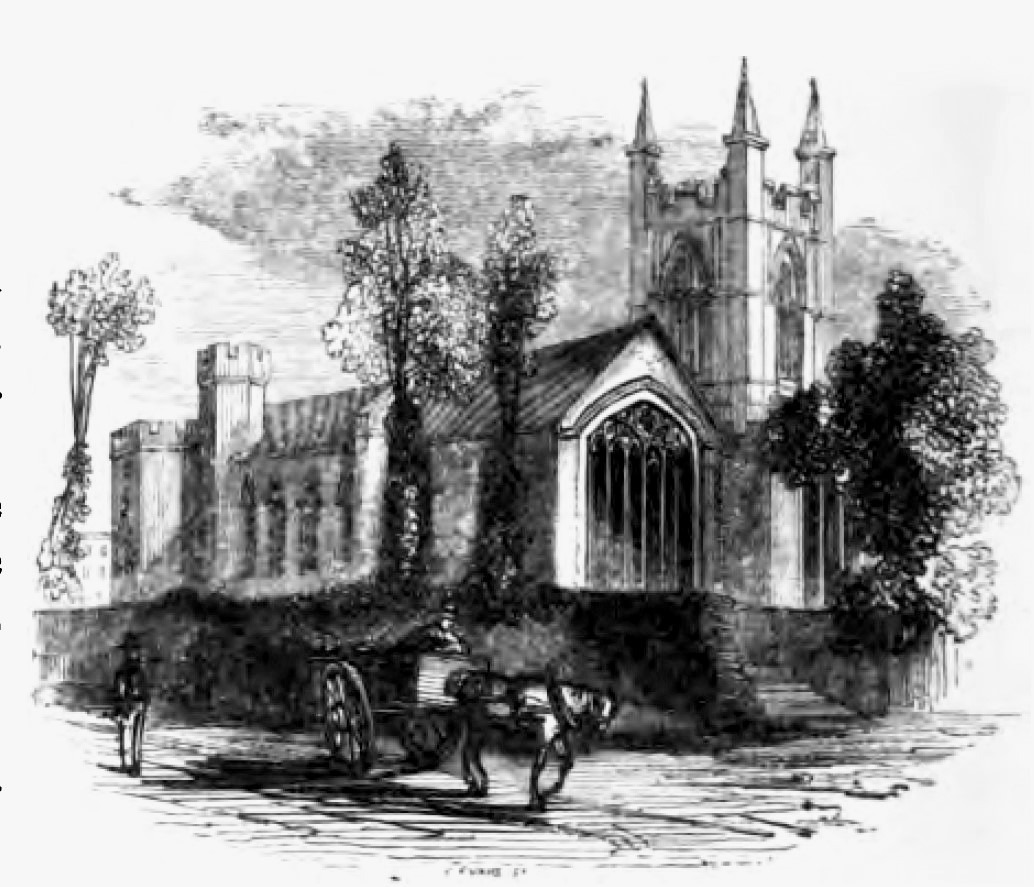
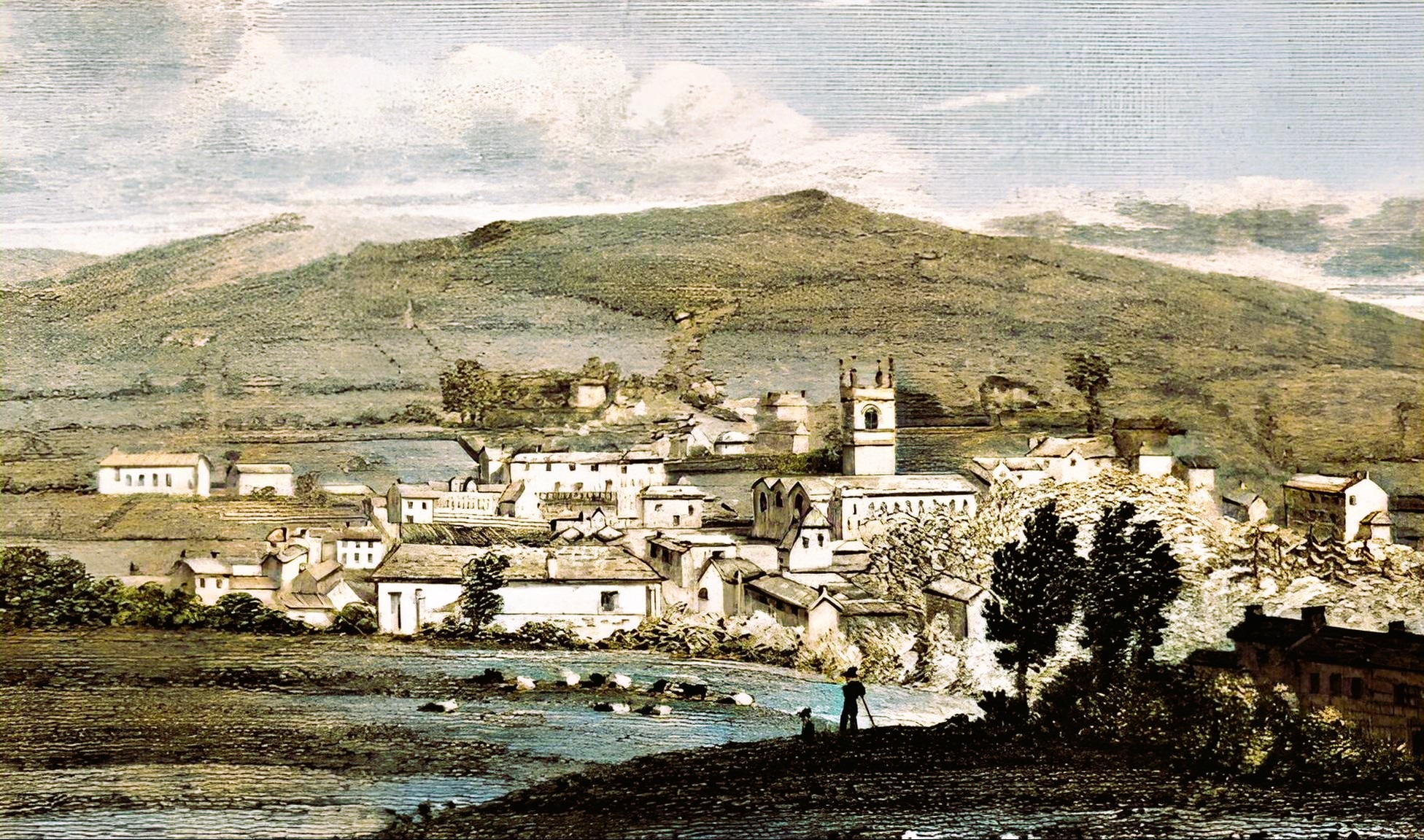
By the time of Norden’s visit in 1584 he gave the following less than savoury description of the town. ‘It is of greate length, nere a myle, but of one mayne Streete, and some litle ragged Lanes, a small brooke runinge thorowgh it, and thorowgh the churche-yarde wher deade bodyes are interred; By reason wherof the water cannot be salutarie, and that, no dowbte, maketh the towne often subiecte to longe and greyuous infections; unhealthfull it is by nature, and the more throwgh the unclene keepinge of their Streetes and howses. It hath bene of larger receite then now it is, as appeareth by the ruynes of sundrye buyldings decayed.’ Not a positive endorsement but he partially counters that by telling readers; ‘It hath weekely a very plentiful market of fleshe, fishe and corne; and in it are helde the quarterly Sessions for the East division of the Shyre.’ This endorses John Leland’s comments regarding Bodmin as a place for the coming together of people. It also hints at the future importance of Bodmin with its court and growth as a major administrative town in Cornwall.
Norden mentions ‘Brown-wellye’ as ‘a verie high and steepe mountayne crowned with a high, spatious, and most craggie rock.’ Continual mis-hearing and spelling of the name of Cornwall’s highest tor has led to the deplorable anglicised name attributed to it in English today. Hopefully Cornish folk and those who appreciate Cornwall will use the proper Kernewek name ‘Bronn Wenneli’ meaning ‘breast shaped hill of swallows.’
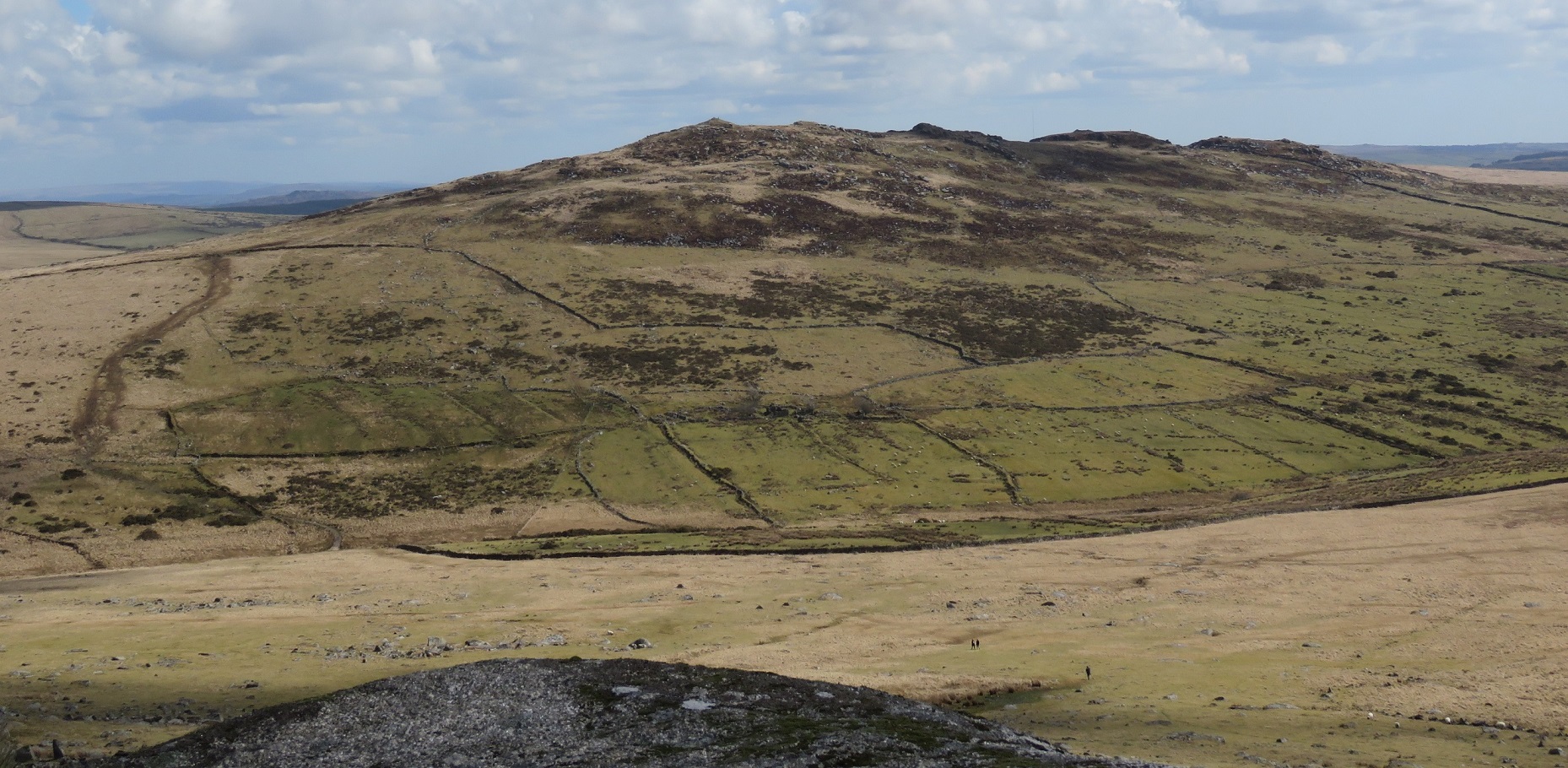
The parish of Blisland is marked out by Norden with a longer mention than most other villages within Trigg. ‘Blislande, or Bliston, a parishe standinge nere the Moares and craggie hills, yet are there pastures within the parishe that will keepe fatt oxen all the wynter, and in as good case as in some places they can be kepte with haye; and the soyle beareth as good corne.’ Much farmland in Cornwall was not good in earlier times and needed a lot of work to improve its fertility. This included the addition of sea sand, known then as manure, and other organic material. It’s interesting to hear from Norden that the quality of produce was good within this parish. Apparently those fleeing from justice had some protection here as Norden tells us; ‘This parishe is a libertye, wher the Shirifes Baylye cannot areste, or otherwise entermedle without the lisence of the Lorde of the Mannor or his officer.’
St Endellion described by Norden as ‘a parishe situate in a frutefull vayne of Lande’ has developed in recent years as a cultural centre and hosts many highly regarded performing artists within its church. Fruitful in a different context to how John Norden meant it. With events throughout the year, the 2026 St Endellion Summer Festival runs from 28th July to 7th August.
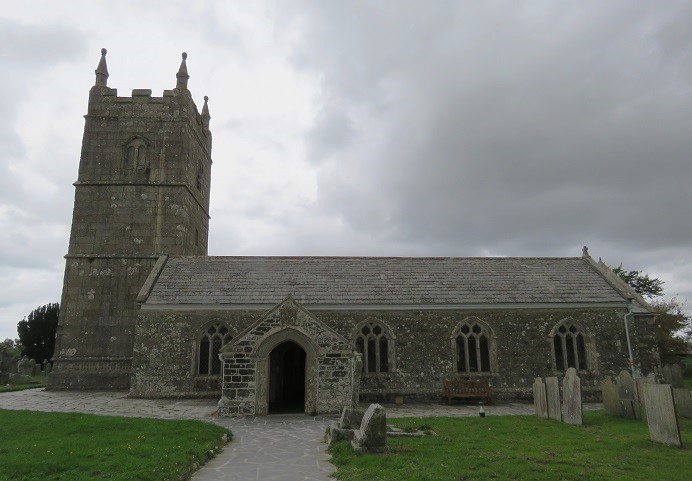
Most other parishes and hamlets are just noted by their names. This does not suggest they are not of interest and some have been specifically covered in earlier articles.
Heritage Column