Ertach Kernow - Cornwall, Delabole to Newquay in the early 20th century
Cornwall has changed much in the last 120 years or so since author Lewis Hind toured Cornwall in 1908. Towns and villages have grown ever larger and a huge influx of people from England have swamped the Cornish folk in some parts of Cornwall. The population of some of the smaller coastal villages and towns have been hollowed out by holiday homes and Airbnb’s which lie empty for many months of the year. Poverty amongst poorer folk still exists as well as high unemployment for numerous young people. Apart from infrastructure and standards of living have things really improved in Cornwall and for many Cornish people?
As always click the images for larger view
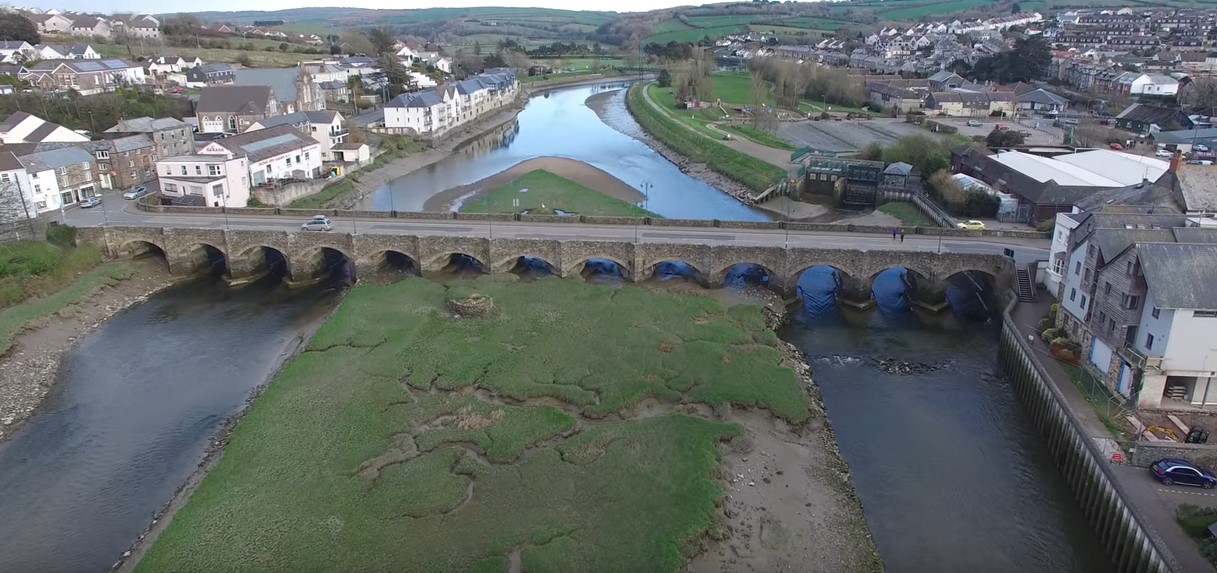
In our last article following Lewis Hind we’d left him travelling through Delabole and viewing the Delabole slate quarry. He found the village ‘grey, desolate, depressing and ugly’ but was fascinated by the quarrying and skill of the workmen there. Lewis was able to take advantage of the now extinct railway line running through to Padstow via Wadebridge. He makes comment of the 15th century bridge spanning the River Camel at Wadebridge and calls it ‘the glory of Wadebridge’ mentioning its seventeen arches. This was long before motor vehicles caused the bridge to be twice widened later in the 20th century. The railway line between Wadebridge and Padstow he says was the second line to be opened in ‘England’, perhaps we would rather say the first in Cornwall. The sand he saw on his journey captivated him, he wrote; ‘nowhere in Cornwall have I seen such sand — gold, grey and yellow, equally lovely at all tides.’ Beyond the sands Lewis mentions Rock a little hamlet rising from the shore. Rock was originally known in 1303 as Penmayn later becoming Blaketorre and anglicised as Black Rock then shortened to Rock. Today it has the dubious distinction of having the most second houses of anywhere else in Cornwall and was included in a BBC4 programme Great British Holidays. It described Rock as being ‘apparently, Britain's St Tropez. Can you imagine anything viler? And continuing ‘a vivid portrait of a ghastly place that isn't a patch on Skye.’
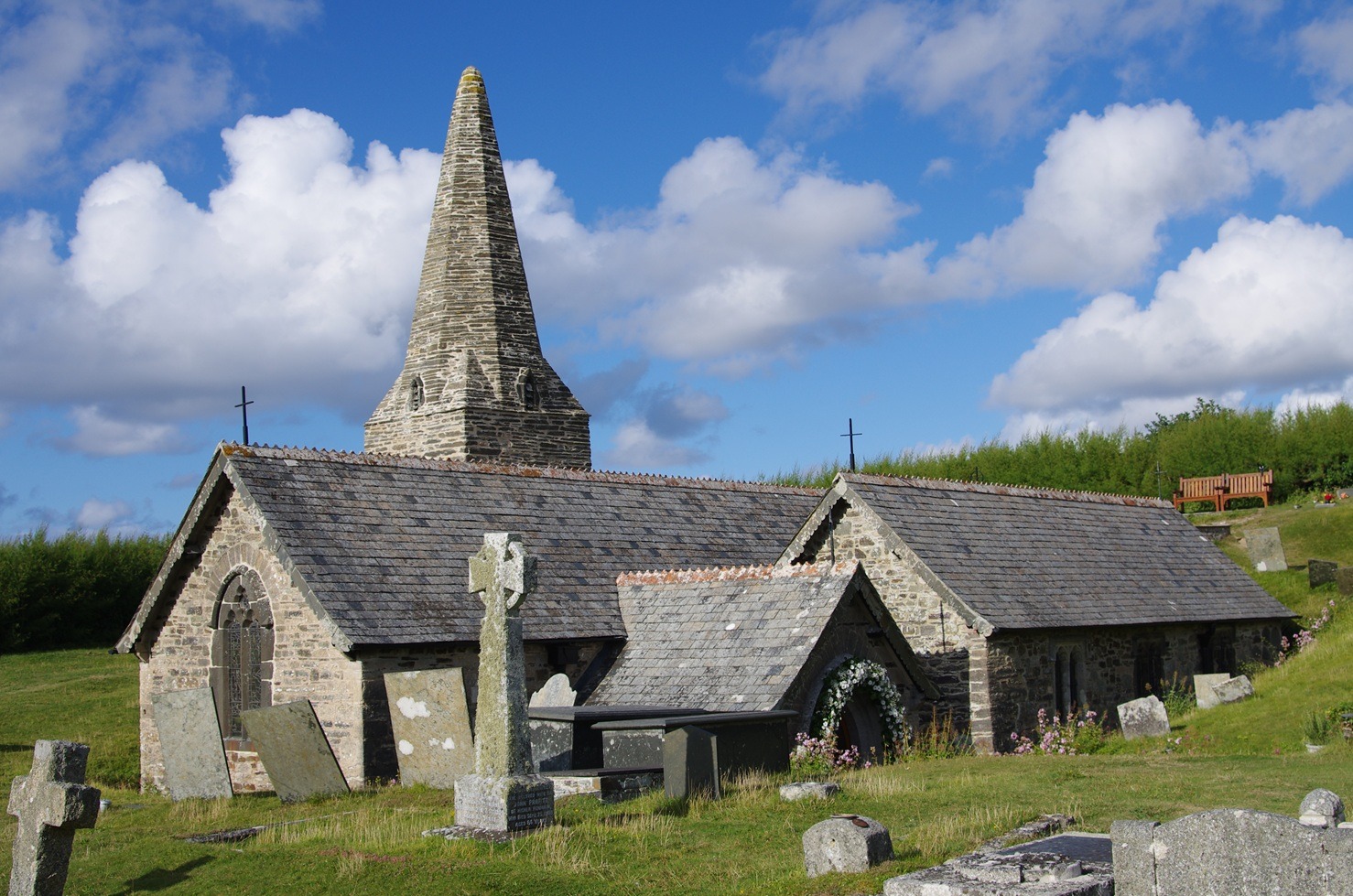
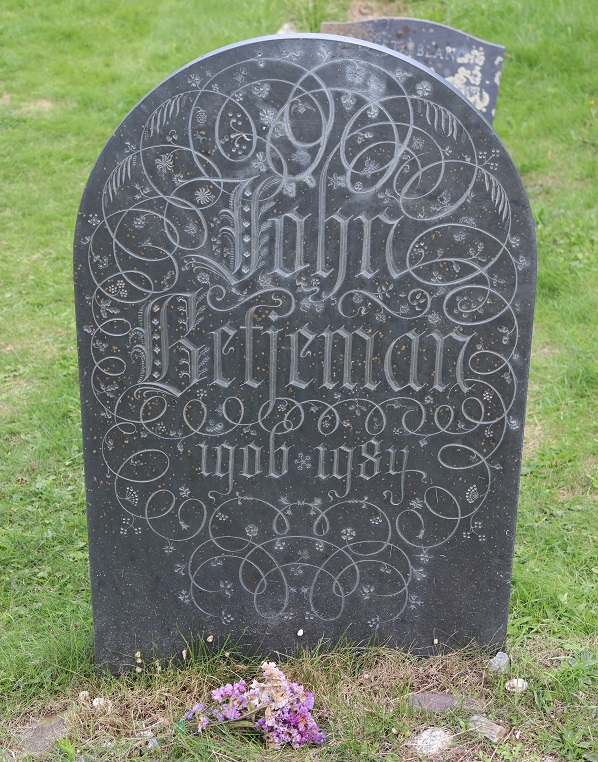
Padstow as Hind writes is a distance from the sea and he mentions the infamous ‘Doombar’ and the dangers crossing it was for vessels. During his visit, there were three ships awaiting the tide so they could continue up to Wadebridge, when it was still a port for shipping below the bridge. These may have been Canadian timber vessels bringing lumber to Cornwall as Hind notes. Hind set off to look for St Enodoc Church, which was rescued from the sands which had almost totally covered it until 1864 when it was excavated and the surrounding sand stabilised. Architectural restoration was also carried out in at that time by J. P. St Aubyn. Today this is a lovely little Grade I church with a pleasant walk to reach it, the churchyard is the resting place of Poet Lauriette Sir John Betjeman. Not far from the church Hind reminds readers that Joseph Polsue, editor of Lakes Parochial History of Cornwall, stated that an early medieval oratory was found on Brea Hill in 1822 when the sands shifted. This was lost again although an early medieval cemetery was later uncovered when quarrying was begun there.
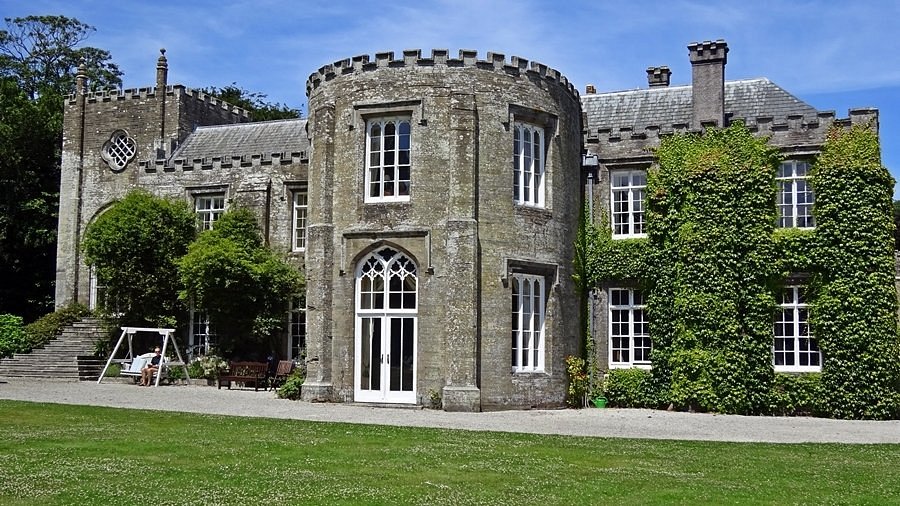
On to Padstow itself where Lewis inspects the ancient seat of the Prideaux family at Prideaux Place built in 1588. He is very complementary of the house, writing; ‘standing high above the town, is as fine a specimen of the castellated mansion as one would wish to see, yet it also looks homelike and comfortable.’ He compared it favourably to the construction of King Arthur's Hotel at Tintagel, suggesting the architect Silvanus Trevail might have used Prideaux place as an example. He tells us that there are family portraits of the Prideaux family by Cornish artist John Opie and also the staircase from Stowe House saved from its destruction. No mention of Padstow can omit the Obby Oss and Lewis delights in including this in his narrative. He finds a willing native of Padstow to take him to Harlyn Bay, which he finds delightful. It was here in 1900 that Mr. Reddie Mallet chose to build a house overlooking the bay. Fortunately for Cornish archaeology whilst excavating, a pre-Roman burial was uncovered. This consisted of a slate kist ‘within was a skeleton with characteristic ornaments and implements of the Neolithic period.’ These were not Neolithic as Lewis Hind had written but Iron Age and further excavations would uncover a total of some one hundred graves.

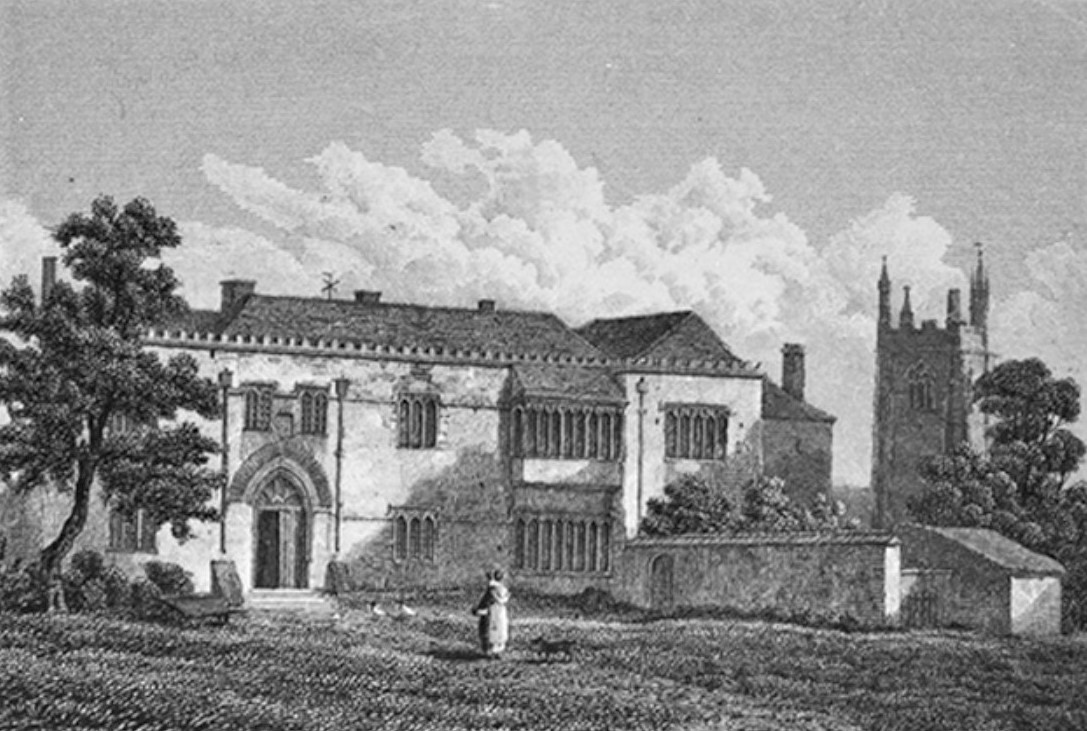
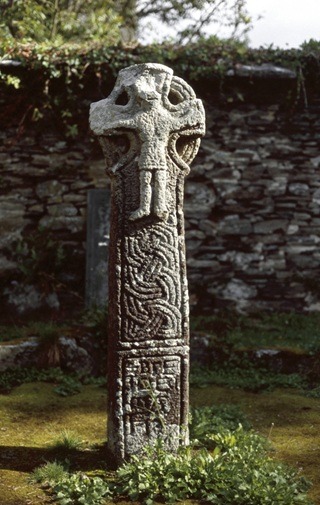
Lewis Hind’s journey continued along the coastal path rounding Trevose Head onto Constantine Bay, Porthcothan and to Bedruthan Steps. Surprisingly and a shame that he makes no mention of the many interesting observations which might have been expected along this path. A warm day encouraged Lewis to walk to St Mawgan and then to Mawgan Porth via the historic house at Lanherne, then a Carmalite nunnery. His readers are reminded that this sisterhood was driven from France to Antwerp by the Revolution, later emigrating to England. The garden of the convent contains a stone cross believed to be from the 10th century and which Hind tells us was originally in the parish of Gwinear. This cross was mentioned by a number of 19th century writers and appears to mention the name of a person called Runhol and is now a protected scheduled monument. There is also the perhaps better known lantern cross in St Mawgan churchyard, which the 19th century writer and archaeological artist J T Blight described as the most elaborate in Cornwall. It’s a shame that Lewis Hind never met Blight who was incarcerated in the mental asylum in Bodmin until his death in 1911 following a breakdown in the mid-1860’s. He drew and described many of Cornwall’s antiquities, some of which sadly no longer exist. Blight did get out from time to time to visit interesting places and can be seen in the photo of the excavations at Harlyn Bay
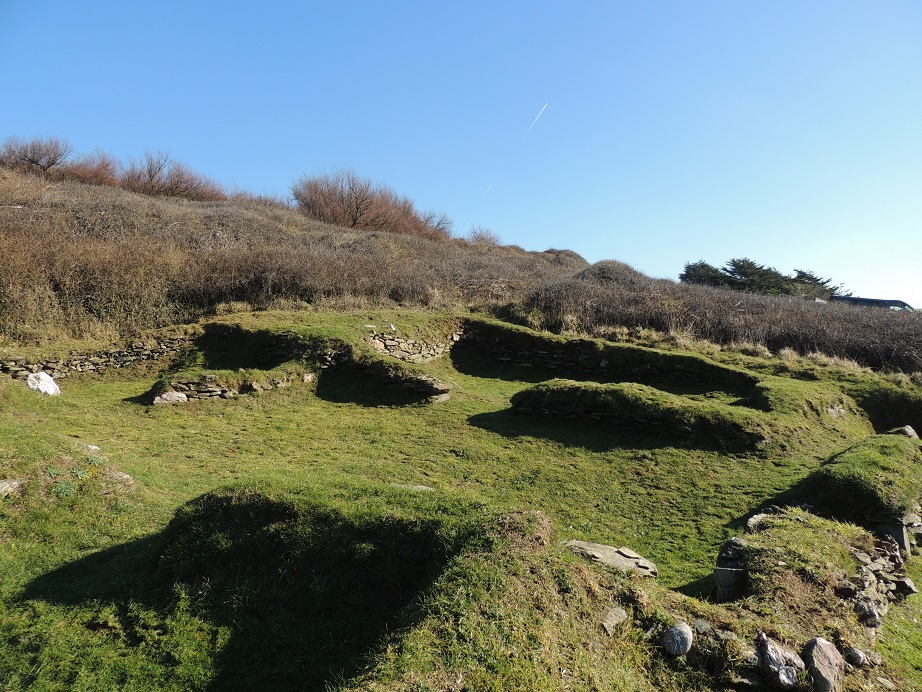
How Mawgan Porth has changed. Now covered with houses including those of wealthy celebrities. During Lewis Hind’s visit in 1908 it consisted of just the coastguard cottages, which still remain. He would have been unaware of the historic 9th century settlement buried by the sand and the nearby cemetery with kist burials. These were uncovered in the 1930’s followed by a more extensive archaeological dig from the late 1940’s. Today this site is cared for by the Newquay Old Cornwall Archaeological Society as well as other historic locations.
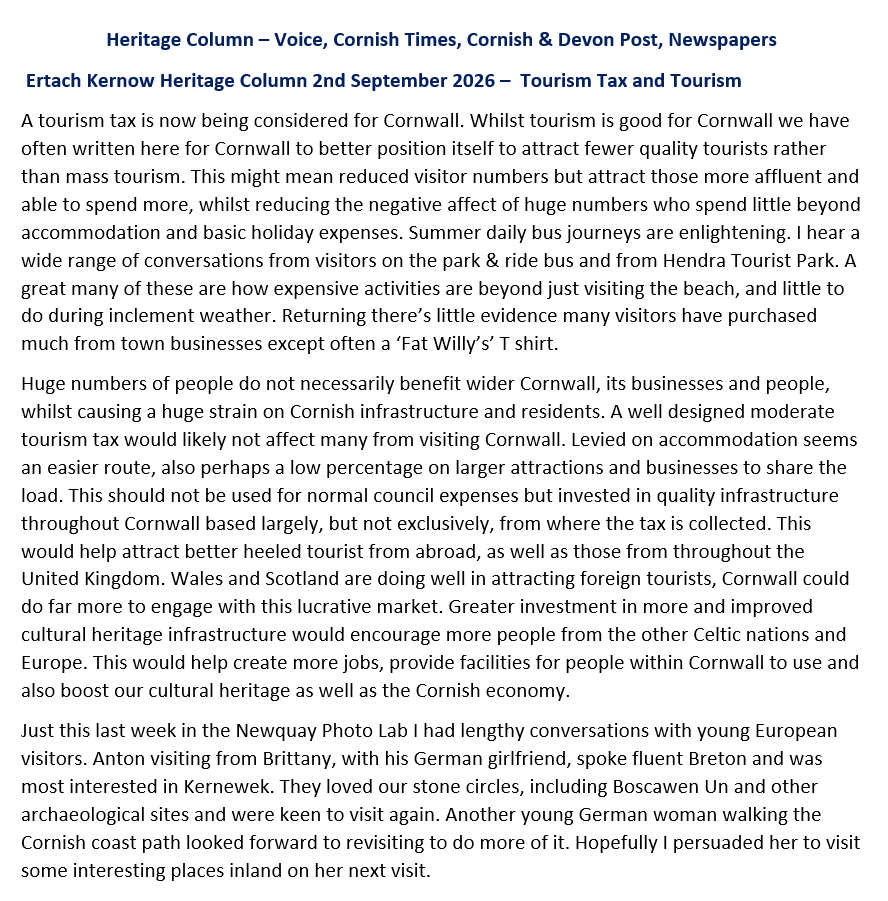
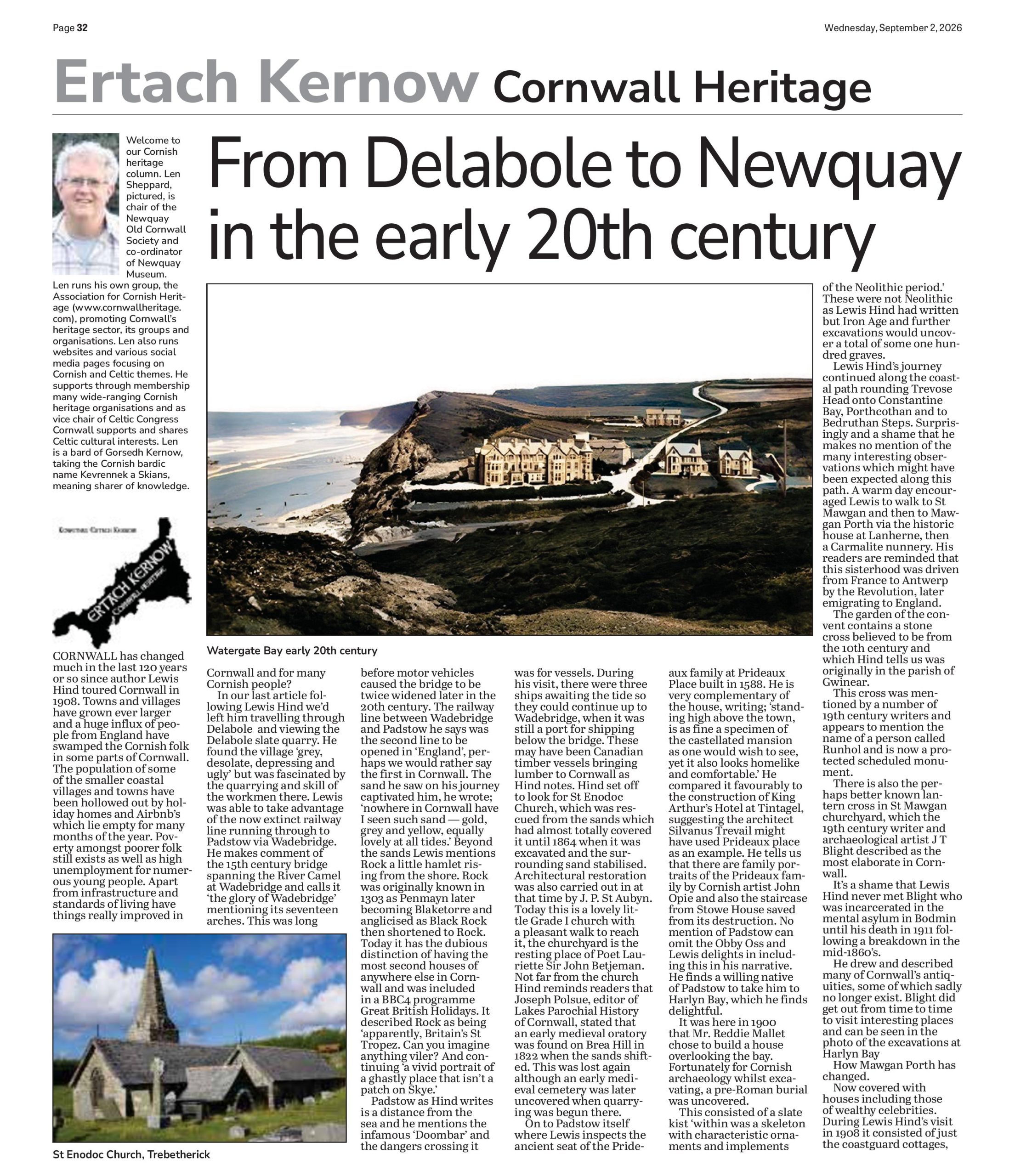
Then it was onward to Newquay. ‘Westward, under Towan Head, I could see the blur that marks the houses of the ugliest and most popular coast-town in Cornwall’ he wrote. Sadly Newquay has done little to improve itself in the following hundred years with the continuation of ghastly poorly constructed buildings feeding the greed of developers. The likes of Sir William Golding and Sir John Betjeman made similar adverse comments about the town during their lifetimes. Descending into Watergate Bay Lewis describes it as a breezy place but with a large hotel where refreshments could be bought, although not yet open for the season. The Watergate Bay Hotel was opened in 1900 so was still fairly new and catering for a different clientele than those in nearby Newquay. Continuing onto St Columb Porth, there he mentions the archaeological finds on Trevelgue Head, once again as at Mawgan Porth unaware that much more would be discovered later in the 20th century. Archaeologist and former soldier Lieutenant Colonel F C Hirst began work at Trevelgue the 1930’s. He had also made some interesting discoveries in Penwith and set up the now regrettably closed Zennor Museum.

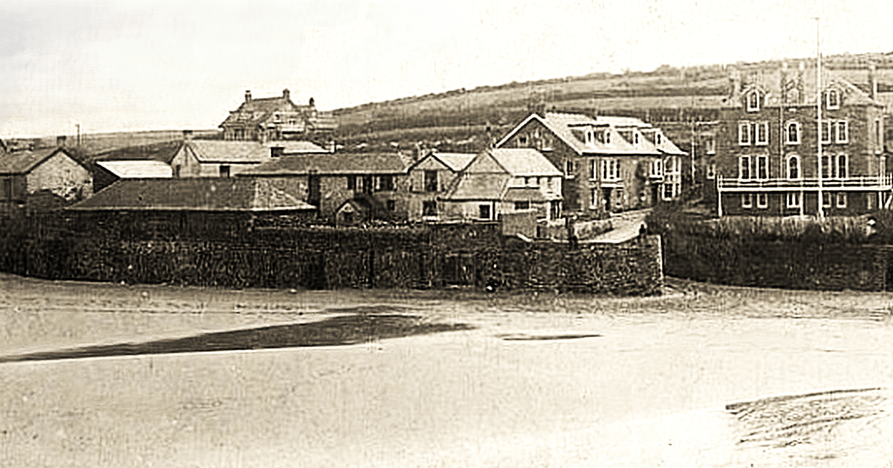
At that time Porth as it is known now had not yet been engulfed by Newquay and Lewis set off from Porth for his evening stopover. He writes; ‘The approach to Newquay by road from St. Columb Porth is dull and uninteresting; but those who are familiar with the district cross the sand and make their way over the headland — a delightful walk. The hour being late I took the road and passed by villas and through streets of lodging-houses to an hotel by the station. I had been to Newquay before and therefore was not disappointed at the aspect of the town. He who arrives at Newquay by train must be prepared for disillusionment.’ The rail connections to Newquay had been extended beyond the original Par to Newquay branch line and now included another via Chacewater to the mainline.
It is likely that Lewis Hind stayed at the Great Western Hotel, the earliest of the larger commercial hotels. By the time of his arrival in 1908 this hotel had already been extended and would undergo a huge transformation in the 1930’s. Three other large hotels included the Atlantic Hotel, Victoria Hotel and Headland Hotel were complete and this quartet still exist today. Of the later three only the Headland remains externally attractive as it was first constructed in 1900. The Victoria, now the Nici, has recently undergone a transformation and much enhanced, although planned construction of even more flats will no doubt mar this areas improvement. Sadly the Atlantic Hotel has been externally adversely altered over the years.
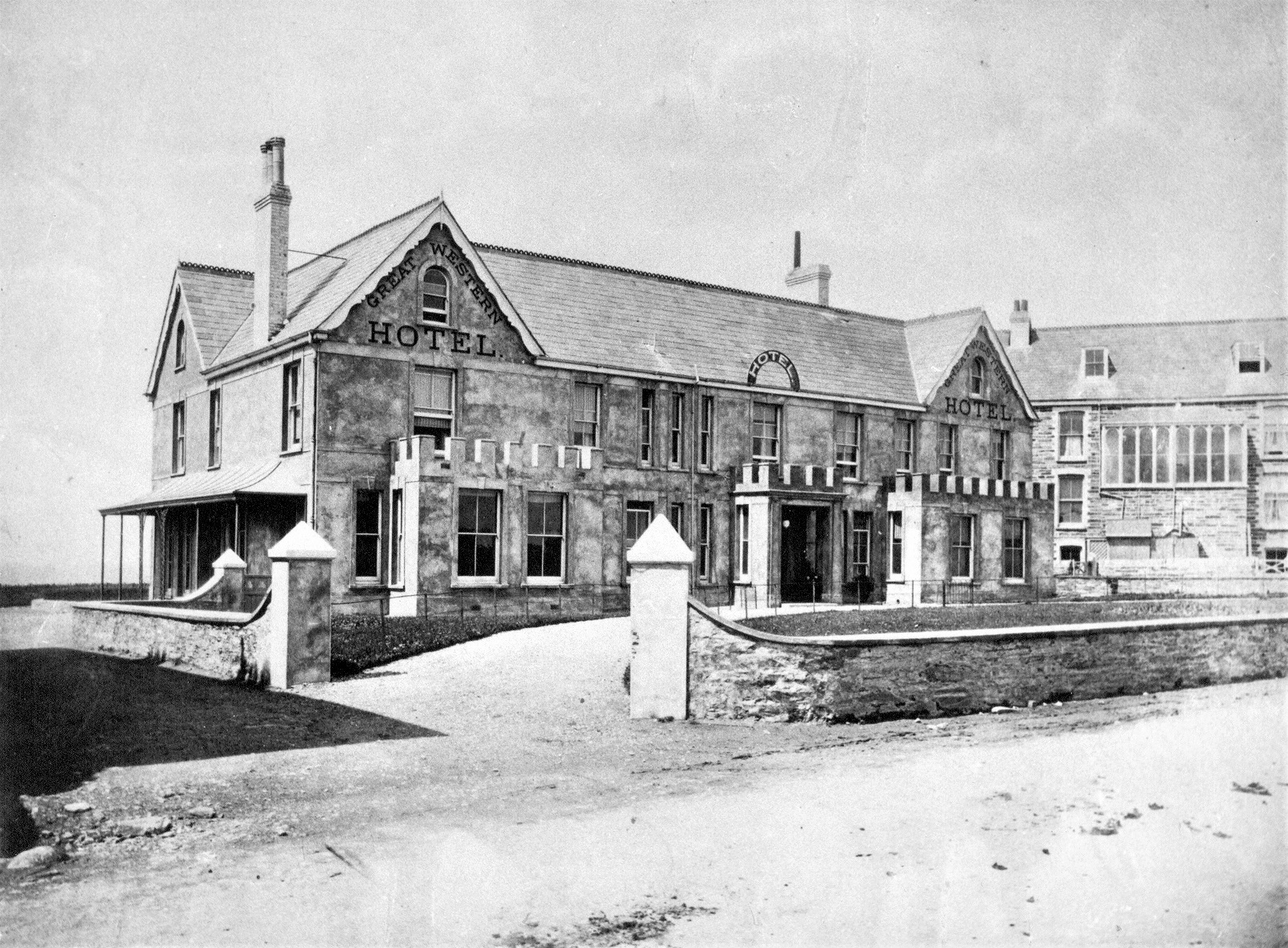
I whatever he thought of Newquay in 1908 he would unlikely think the growth of Newquay could ever reach the levels it has today. Lewis came to Cornwall looking for authentic Cornish life, within Newquay that has now almost gone forever.
Heritage Column