Ertach Kernow - Added protection for our Cornish National Landscape
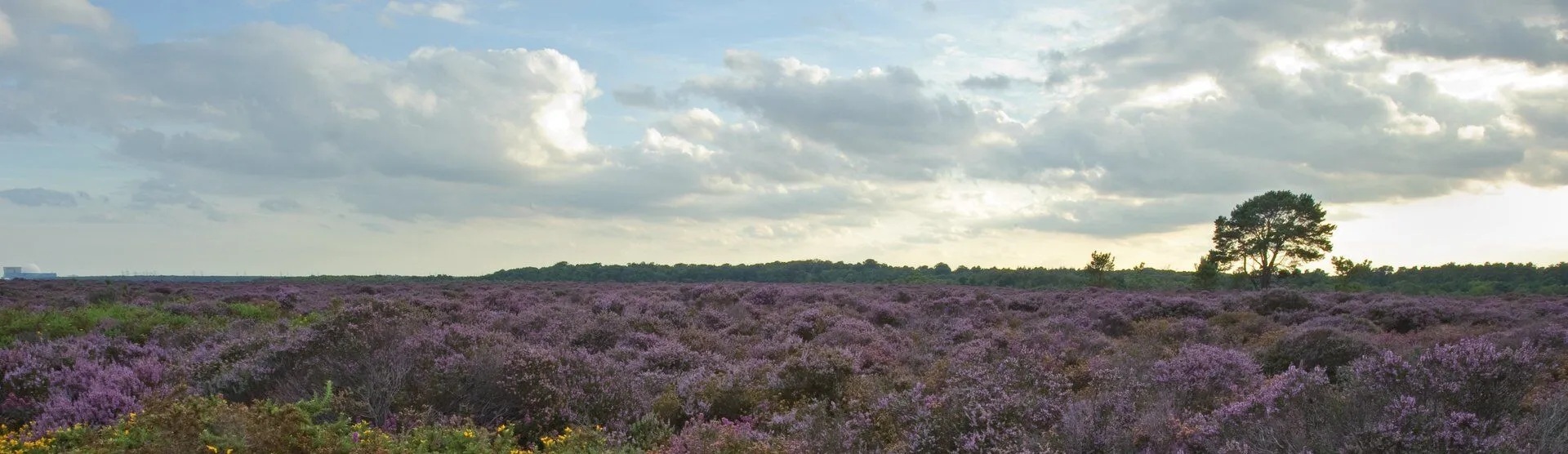
Our Cornish National Landscape has additional parcels of land protected forming a new area designated the Mid-Cornwall Moor Nature Reserve. This project is part of what is known as the ‘King’s Series of National Nature Reserves’ announced by the Conservative government in 2023. Most people are aware of King Charle’s love of nature and the worlds wildlife, natural plant life and rural environments. This was a way to honour that and also bring in a further twenty-five locations over a five year period. Five new national nature reserves will be announced each year until 2028. Our Cornish contribution is the fourteenth.
As always click the images for larger view
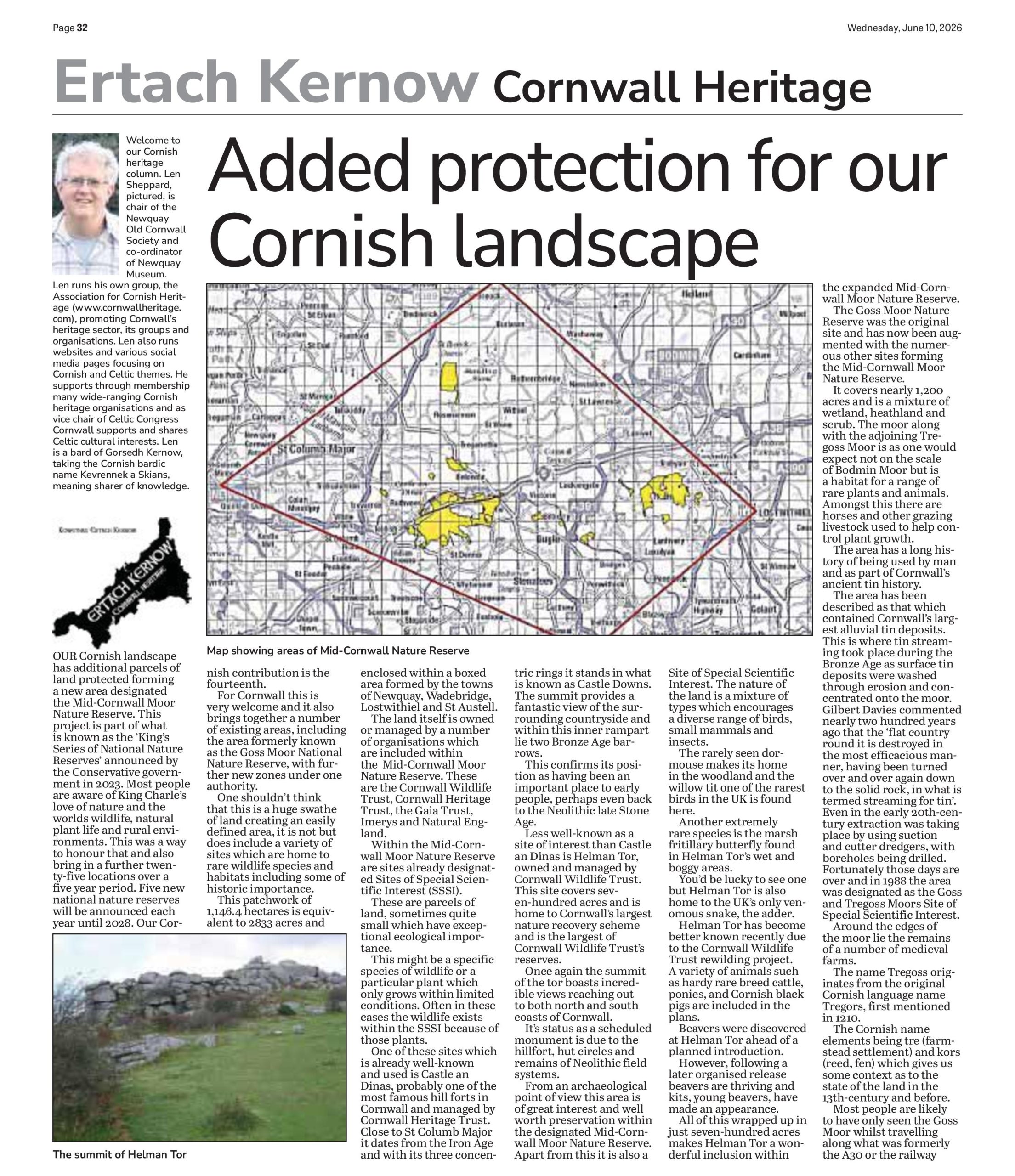
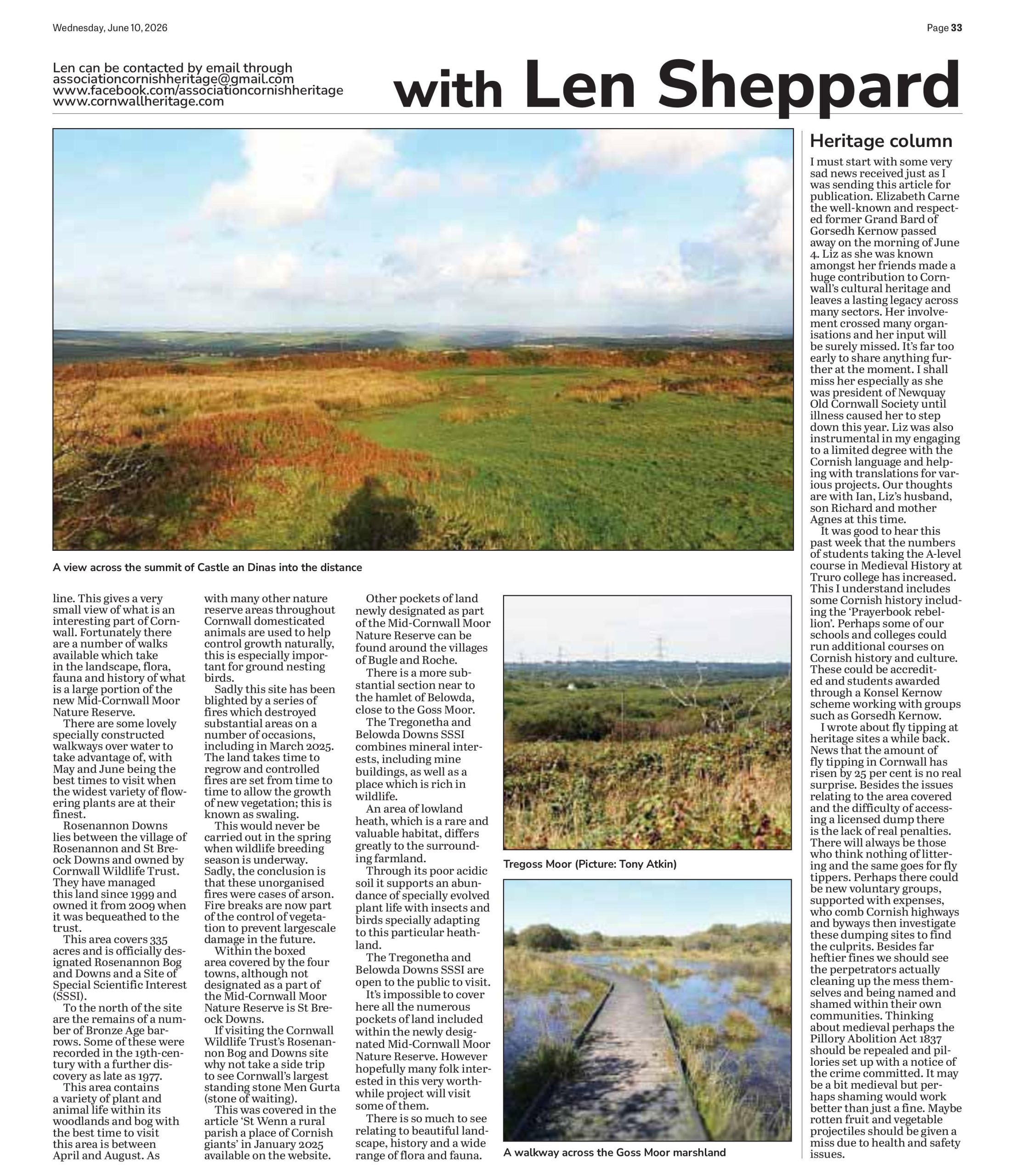
For Cornwall this is very welcome and it also brings together a number of existing areas, including the area formerly known as the Goss Moor Nature Reserve, with further new zones under one Cornish National Landscape authority. One shouldn’t think that this is a huge swathe of land creating an easily defined area, it is not but does include a variety of sites which are home to rare wildlife species and habitats including some of historic importance. This patchwork of 1,146.4 hectares is equivalent to 2833 acres and enclosed within a boxed area formed by the towns of Newquay, Wadebridge, Lostwithiel and St Austell. The land itself is owned or managed by a number of organisations which are included within the Mid-Cornwall Moor Nature Reserve. These are the Cornwall Wildlife Trust, Cornwall Heritage Trust, the Gaia Trust, Imerys and Natural England.
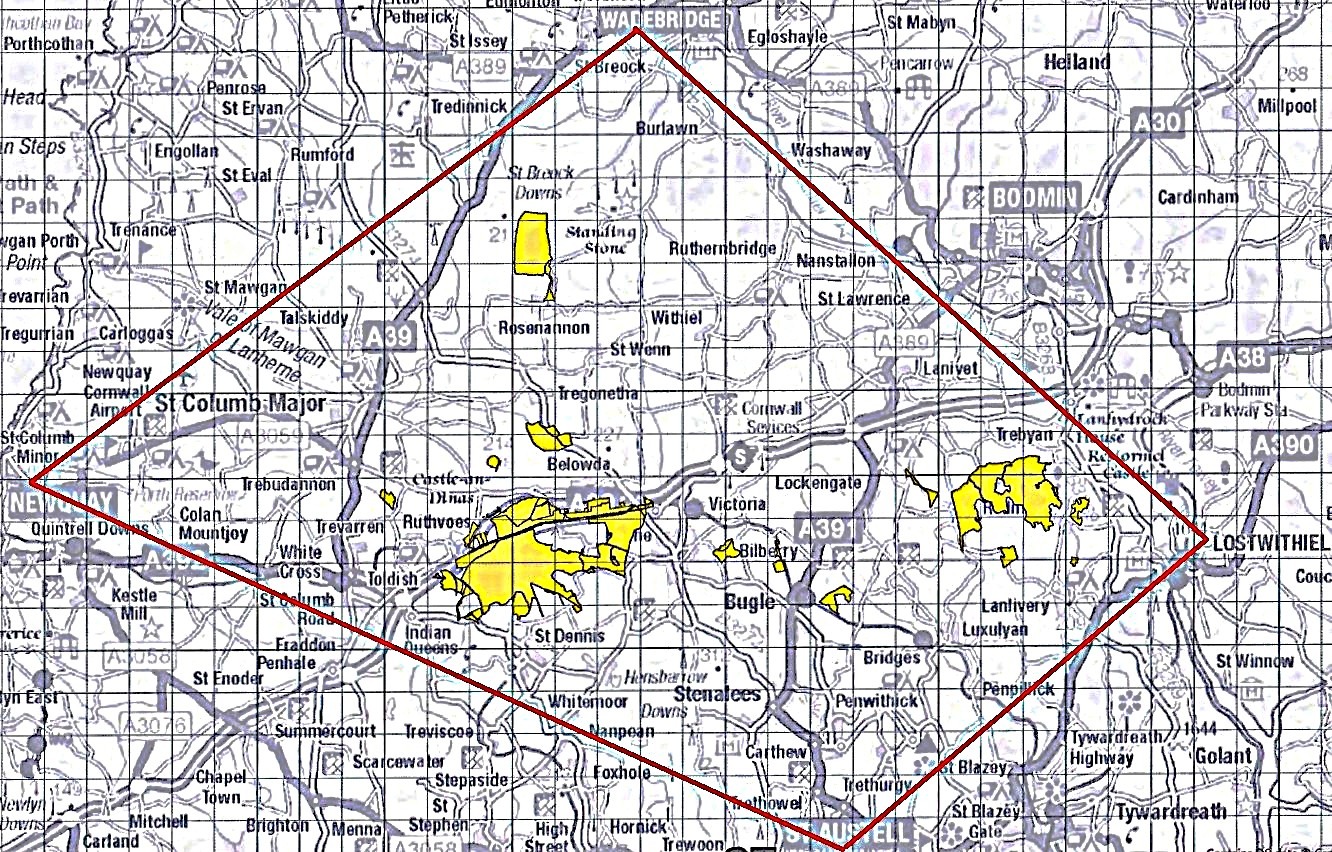
Within the Mid-Cornwall Moor Nature Reserve are sites already designated Sites of Special Scientific Interest (SSSI). These are parcels of land, sometimes quite small which have exceptional ecological importance. This might be a specific species of wildlife or a particular plant which only grows within limited conditions. Often in these cases the wildlife exists within the SSSI because of those plants.

One of these Cornish National Landscape sites which is already well-known and used is Castle an Dinas, probably one of the most famous hill forts in Cornwall and managed by Cornwall Heritage Trust. Close to St Columb Major it dates from the Iron Age and with its three concentric rings it stands in what is known as Castle Downs. The summit provides a fantastic view of the surrounding countryside and within this inner rampart lie two Bronze Age barrows. This confirms its position as having been an important place to early people, perhaps even back to the Neolithic late
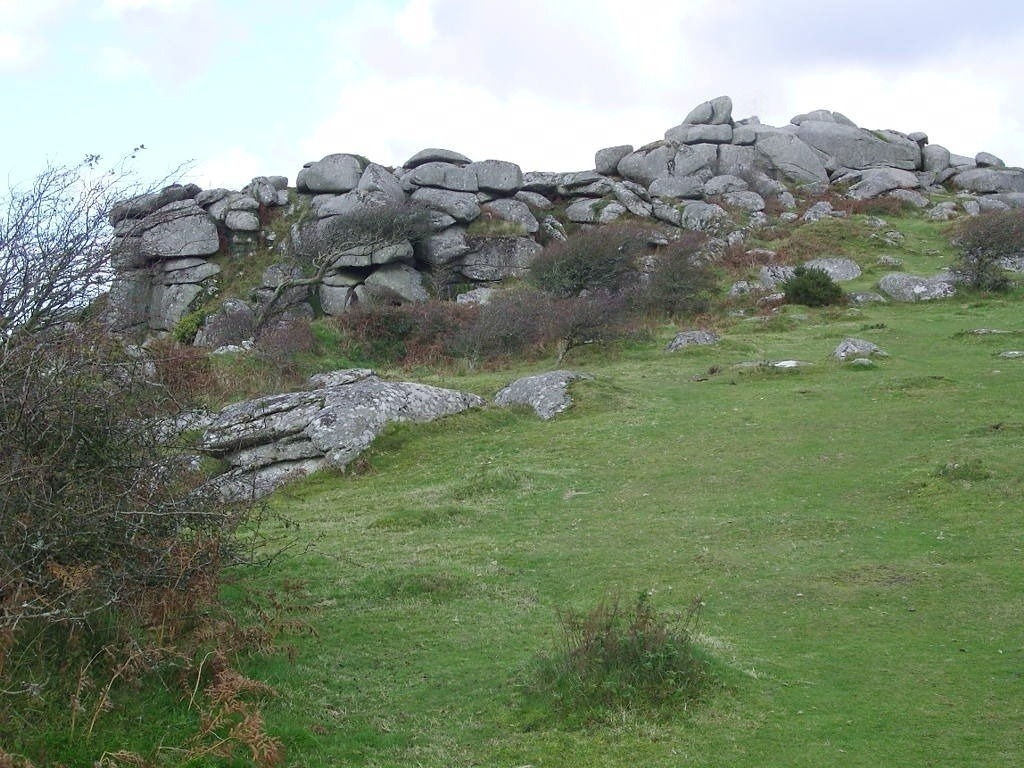
Less well-known as a site of interest than Castle an Dinas is Helman Tor, owned and managed by Cornwall Wildlife Trust. This site covers seven-hundred acres and is home to Cornwall’s largest nature recovery scheme and is the largest of Cornwall Wildlife Trust’s reserves. Once again the summit of the tor boasts incredible views reaching out to both north and south coasts of Cornwall. It’s status as a scheduled monument is due to the hillfort, hut circles and remains of Neolithic field systems. From an archaeological point of view this area is of great interest and well worth preservation within the designated Mid-Cornwall Moor Nature Reserve. Apart from this it is also a Site of Special Scientific Interest. The nature of the land is a mixture of types which encourages a diverse range of birds, small mammals and insects. The rarely seen dormouse makes its home in the woodland and the willow tit one of the rarest birds in the UK is found here. Another extremely rare species is the marsh fritillary butterfly found in Helman Tor’s wet and boggy areas. You’d be lucky to see one but Helman Tor is also home to the UK’s only venomous snake, the adder within the Cornish National Landscape.
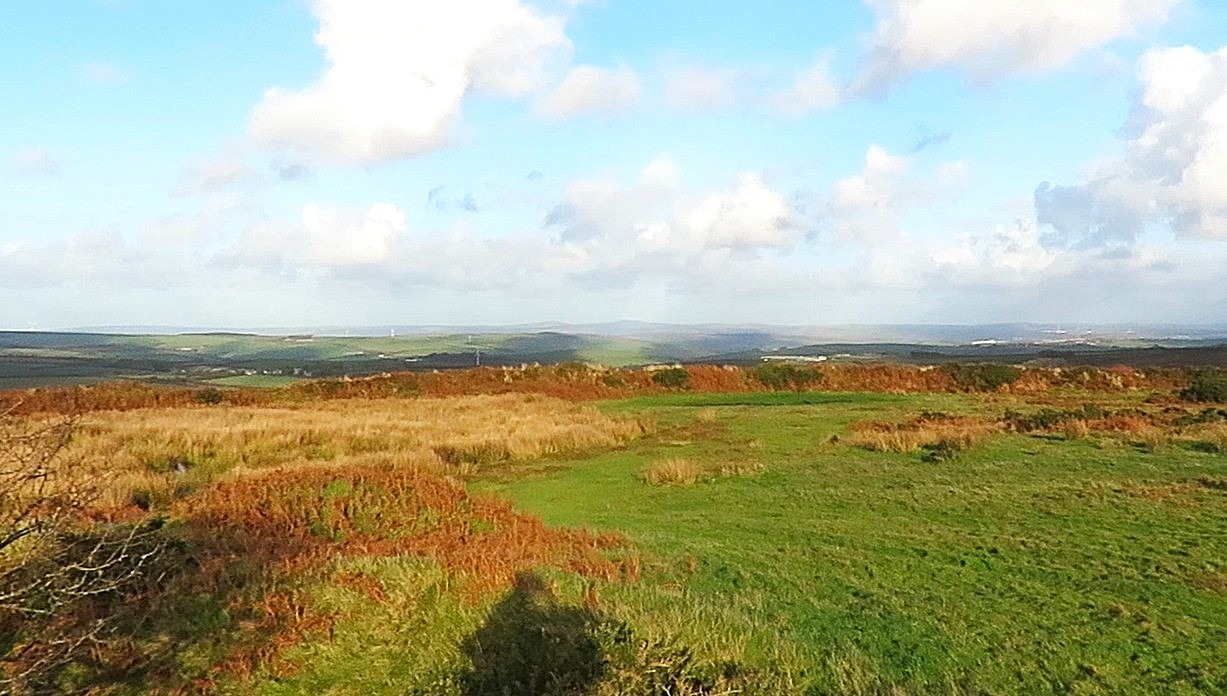
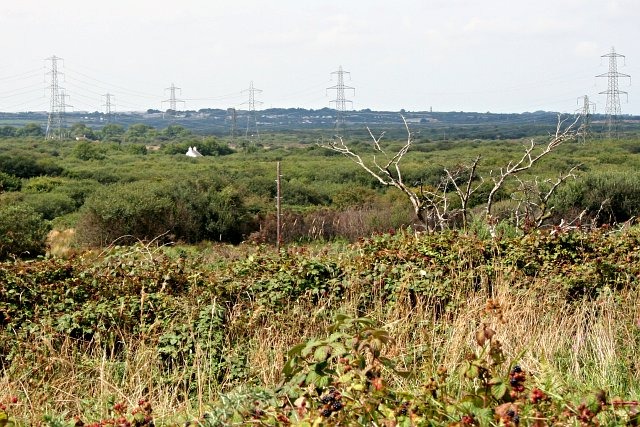
The Goss Moor Nature Reserve was the original site as one of Cornwall's areas of 'Outstanding Natural Beauty' now the 'Cornish National Landscape' authority and has now been augmented with the numerous other sites forming the Mid-Cornwall Moor Nature Reserve. It covers nearly 1,200 acres and is a mixture of wetland, heathland and scrub. The moor along with the adjoining Tregoss Moor is as one would expect not on the scale of Bodmin Moor but is a habitat for a range of rare plants and animals. Amongst this there are horses and other grazing livestock used to help control plant growth. The area has a long history of being used by man and as part of Cornwall’s ancient tin history. The area has been described as that which contained Cornwall’s largest alluvial tin deposits. This is where tin streaming took place during the Bronze Age as surface tin deposits were washed through erosion and concentrated onto the moor. Gilbert Davies commented nearly two hundred years ago that the ‘flat country round it is destroyed in the most efficacious manner, having been turned over and over again down to the solid rock, in what is termed streaming for tin’. Even in the early 20th century extraction was taking place by using suction and cutter dredgers, with boreholes being drilled. Fortunately those days are over and in 1988 the area was designated as the Goss and Tregoss Moors Site of Special Scientific Interest. Around the edges of the moor lie the remains of a number of medieval farms. The name Tregoss originates from the original Cornish language name Tregors, first mentioned in 1210. The Cornish name elements being tre (farmstead settlement) and kors (reed, fen) which gives us some context as to the state of the land in the 13th century and before.
Most people are likely to have only seen the Goss Moor whilst travelling along what was formerly the A30 or the railway line. This gives a very small view of what is an interesting part of the Cornish National landscape. Fortunately there are a number of walks available which take in the landscape, flora, fauna and history of what is a large portion of the new Mid-Cornwall Moor Nature Reserve. There are some lovely specially constructed walkways over water to take advantage of, with May and June being the best times to visit when the widest variety of flowering plants are at their finest.
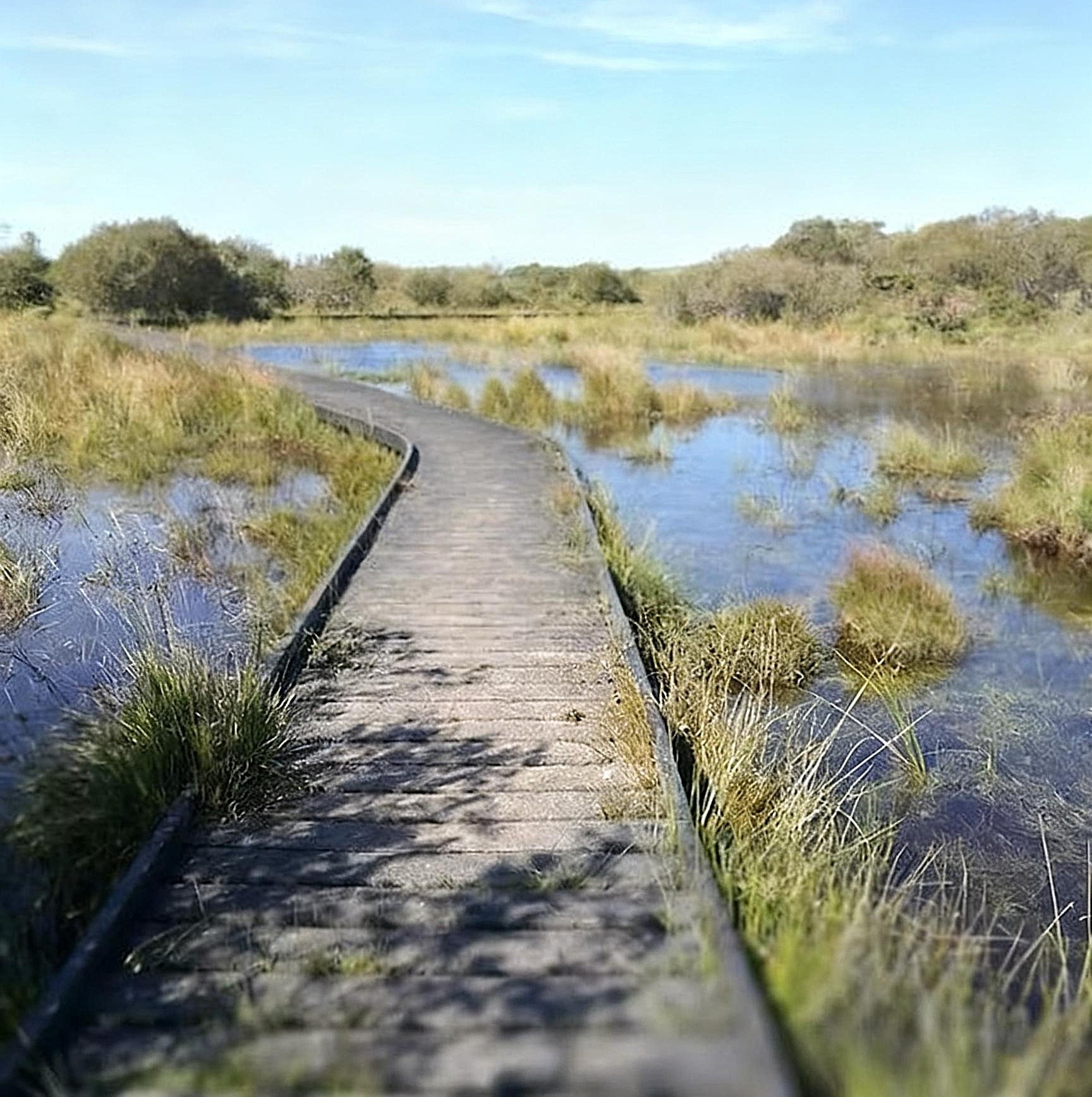


Rosenannon Downs lies between the village of Rosenannon and St Breock Downs and owned by Cornwall Wildlife Trust. They have managed this land since 1999 and owned it from 2009 when it was bequeathed to the trust. This area covers 335 acres and is officially designated Rosenannon Bog and Downs and a Site of Special Scientific Interest (SSSI). To the north of the site are the remains of a number of Bronze Age barrows. Some of these were recorded in the 19th century with a further discovery as late as 1977. This area contains a variety of plant and animal life within its woodlands and bog with the best time to visit this area is between April and August. As with many other nature reserve areas throughout Cornwall domesticated animals are used to help control growth naturally, this is especially important for ground nesting birds.
Unfortunately this site has been blighted by a series of fires which destroyed substantial areas on a number of occasions, including in March 2025. The land takes time to regrow and controlled fires are set from time to time to allow the growth of new vegetation; this is known as swaling. This would never be carried out in the spring when wildlife breeding season is underway. Sadly, the conclusion is that these unorganised fires were cases of arson. Fire breaks are now part of the control of vegetation to prevent largescale damage in the future.
Within the boxed area covered by the four towns, although not designated as a part of the Mid-Cornwall Moor Nature Reserve is St Breock Downs. If visiting the Cornwall Wildlife Trust’s Rosenannon Bog and Downs site why not take a side trip to see Cornwall’s largest standing stone Men Gurta (stone of waiting). This was covered in the article ‘St Wenn a rural parish a place of Cornish giants’ in January 2025(opens in new tab) available on the website.
Other pockets of land newly designated as part of the Mid-Cornwall Moor Nature Reserve within the Cornish National Landscape can be found around the villages of Bugle and Roche. There is a more substantial section near to the hamlet of Belowda, close to the Goss Moor. The Tregonetha & Belowda Downs SSSI combines mineral interests, including mine buildings, as well as a place which is rich in wildlife. An area of lowland heath, which is a rare and valuable habitat, differs greatly to the surrounding farmland. Through its poor acidic soil it supports an abundance of specially evolved plant life with insects and birds specially adapting to this particular heathland. The Tregonetha & Belowda Downs SSSI are open to the public to visit.

It’s impossible to cover here all the numerous pockets of land included within the newly designated Mid-Cornwall Moor Nature Reserve. However hopefully many folk interested in this very worthwhile project will visit some of them. There is so much to see relating to beautiful landscape, history and a wide range of flora and fauna, which are part of the greater Cornish National Landscape authority.
Heritage Column