Ertach Kernow - Historic Cornish wealth provides a legacy today

Cornish tin and copper mining and its various connected industries created a great number of wealthy people in Cornwall, together with their families. Many contributed back to their communities with acts of philanthropy from which we still benefit directly and indirectly today.
As always click the images for larger view
In medieval times tin was taxed by the earls of Cornwall helping make Richard Earl of Cornwall one of the richest men in Europe. Following his death in 1272 his son Edmund benefited from his fathers vast fortune. Today we enjoy some of the fruits of their wealth by being able to visit castles, now owned by the Duchy of Cornwall, administered by English heritage. These include Tintagel, Launceston and Restormel Castles all of which are open to the public. Castles existed at Restormel in Lostwithiel and Launceston before Richard’s time it was he who upgraded and improved Launceston. Richard was granted the castle and town of Lostwithiel by its then owner the Cardinhams’ heiress, Isolda de Tracy in 1268. Both Launceston and Restormel castles are open to the public and administered on behalf of the Duchy of Cornwall by English Heritage.

Richard had also acquired Trematon Castle overlooking the Lynher River in 1270. It remains owned by the Duchy of Cornwall and leased out and although Trematon is not open to the public it is available for rent as an Airbnb. It has beautiful gardens surrounding it and a Georgian house built in 1808 within the historic castle surrounds.
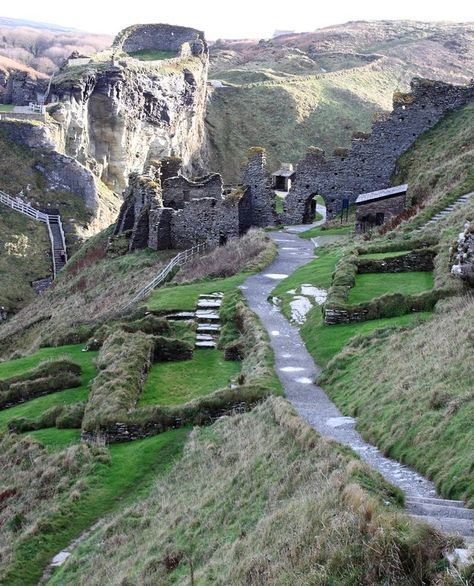
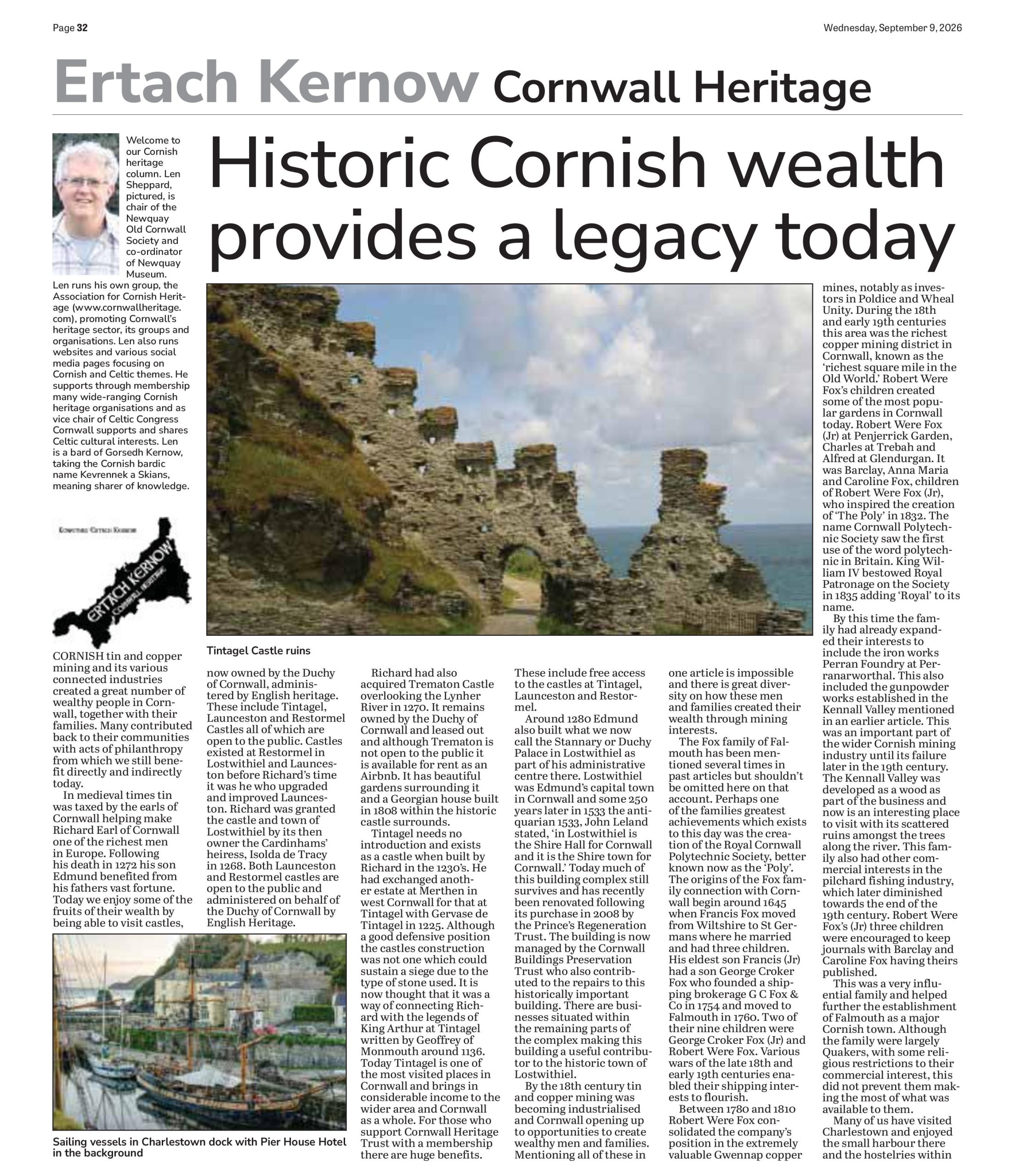
Tintagel needs no introduction and exists as a castle when built by Richard in the 1230’s. He had exchanged another estate at Merthen in west Cornwall for that at Tintagel with Gervase de Tintagel in 1225. Although a good defensive position the castles construction was not one which could sustain a siege due to the type of stone used. It is now thought that it was a way of connecting Richard with the legends of King Arthur at Tintagel written by Geoffrey of Monmouth around 1136. Today Tintagel is one of the most visited places in Cornwall and brings in considerable income to the wider area and Cornwall as a whole. For those who support Cornwall Heritage Trust with a membership there are huge benefits. These include free access to the castles at Tintagel, Launceston and Restormel.
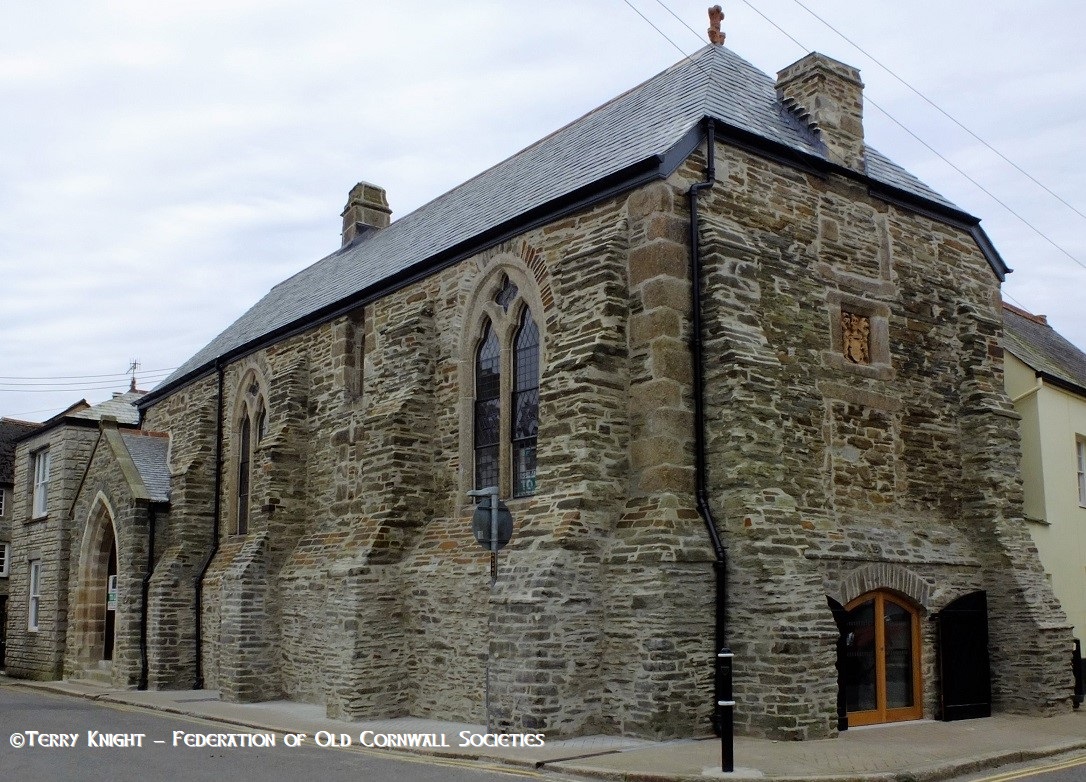
By the 18th century tin and copper mining was becoming industrialised and Cornwall opening up to opportunities to create wealthy men and families. Mentioning all of these in one article is impossible and there is great diversity on how these men and families created their wealth through mining interests.
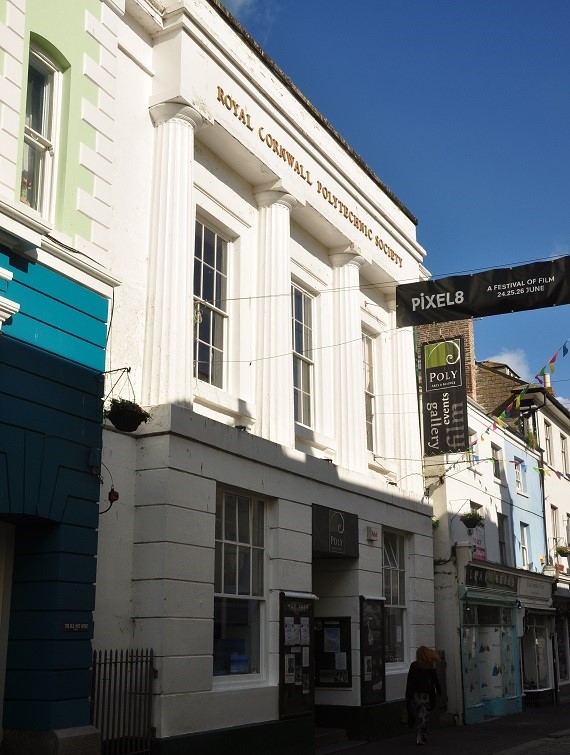
The Fox family of Falmouth has been mentioned several times in past articles but shouldn’t be omitted here on that account. Perhaps one of the families greatest achievements which exists to this day was the creation of the Royal Cornwall Polytechnic Society, better known now as the ‘Poly’. The origins of the Fox family connection with Cornwall begin around 1645 when Francis Fox moved from Wiltshire to St Germans where he married and had three children. His eldest son Francis (Jr) had a son George Croker Fox who founded a shipping brokerage G.C Fox & Co in 1754 and moved to Falmouth in 1760. Two of their nine children were George Croker Fox (Jr) and Robert Were Fox. Various wars of the late 18th and early 19th centuries enabled their shipping interests to flourish
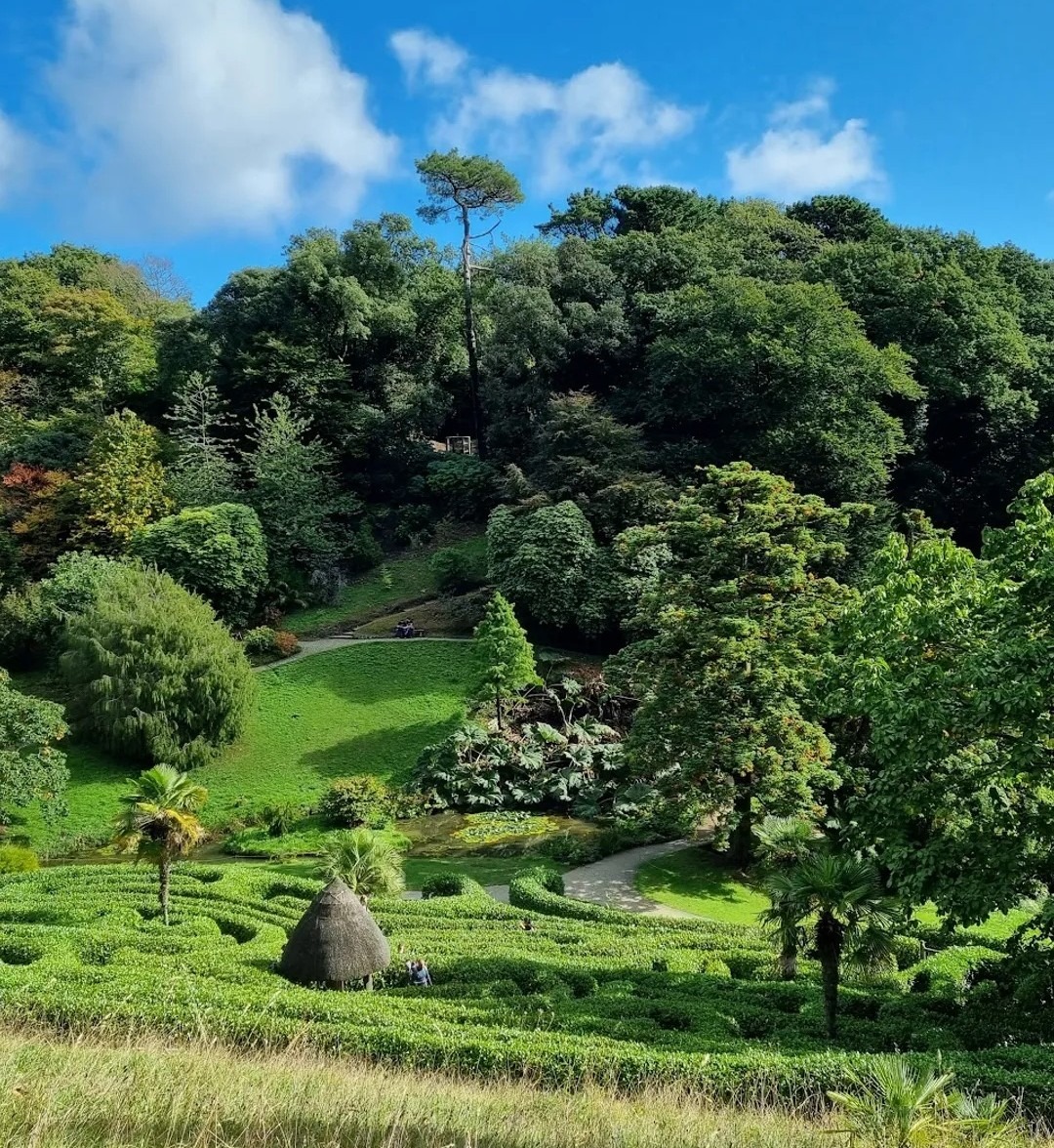
Between 1780 and 1810 Robert Were Fox consolidated the company’s position in the extremely valuable Gwennap copper mines, notably as investors in Poldice and Wheal Unity. During the 18th and early 19th centuries this area was the richest copper mining district in Cornwall, known as the ‘richest square mile in the Old World.’ Robert Were Fox’s children created some of the most popular gardens in Cornwall today. Robert Were Fox (Jr) at Penjerrick Garden, Charles at Trebah and Alfred at Glendurgan. It was Barclay, Anna Maria and Caroline Fox, children of Robert Were Fox (Jr), who inspired the creation of ‘The Poly’ in 1832. The name Cornwall Polytechnic Society saw the first use of the word polytechnic in Britain. King William IV bestowed Royal Patronage on the Society in 1835 adding ‘Royal’ to its name.
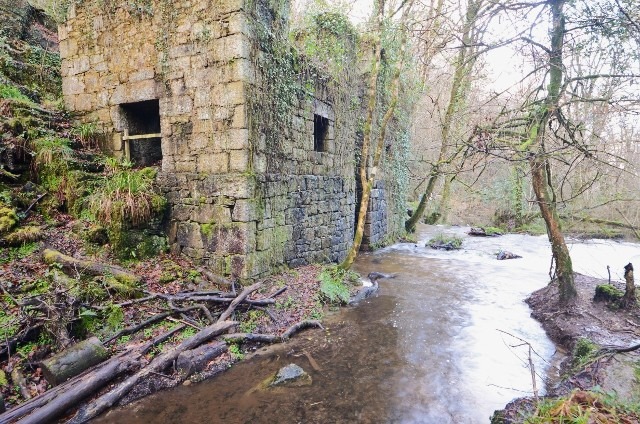
By this time the family had already expanded their interests to include the iron works Perran Foundry at Perranarworthal. This also included the gunpowder works established in the Kennall Valley mentioned in an earlier article. This was an important part of the wider Cornish mining industry until its failure later in the 19th century. The Kennall Valley was developed as a wood as part of the business and now is an interesting place to visit with its scattered ruins amongst the trees along the river. This family also had other commercial interests in the pilchard fishing industry, which later diminished towards the end of the 19th century. Robert Were Fox’s (Jr) three children were encouraged to keep journals with Barclay and Caroline Fox having theirs published.
This was a very influential family and helped further the establishment of Falmouth as a major Cornish town. Although the family were largely Quakers, with some religious restrictions to their commercial interest, this did not prevent them making the most of what was available to them.

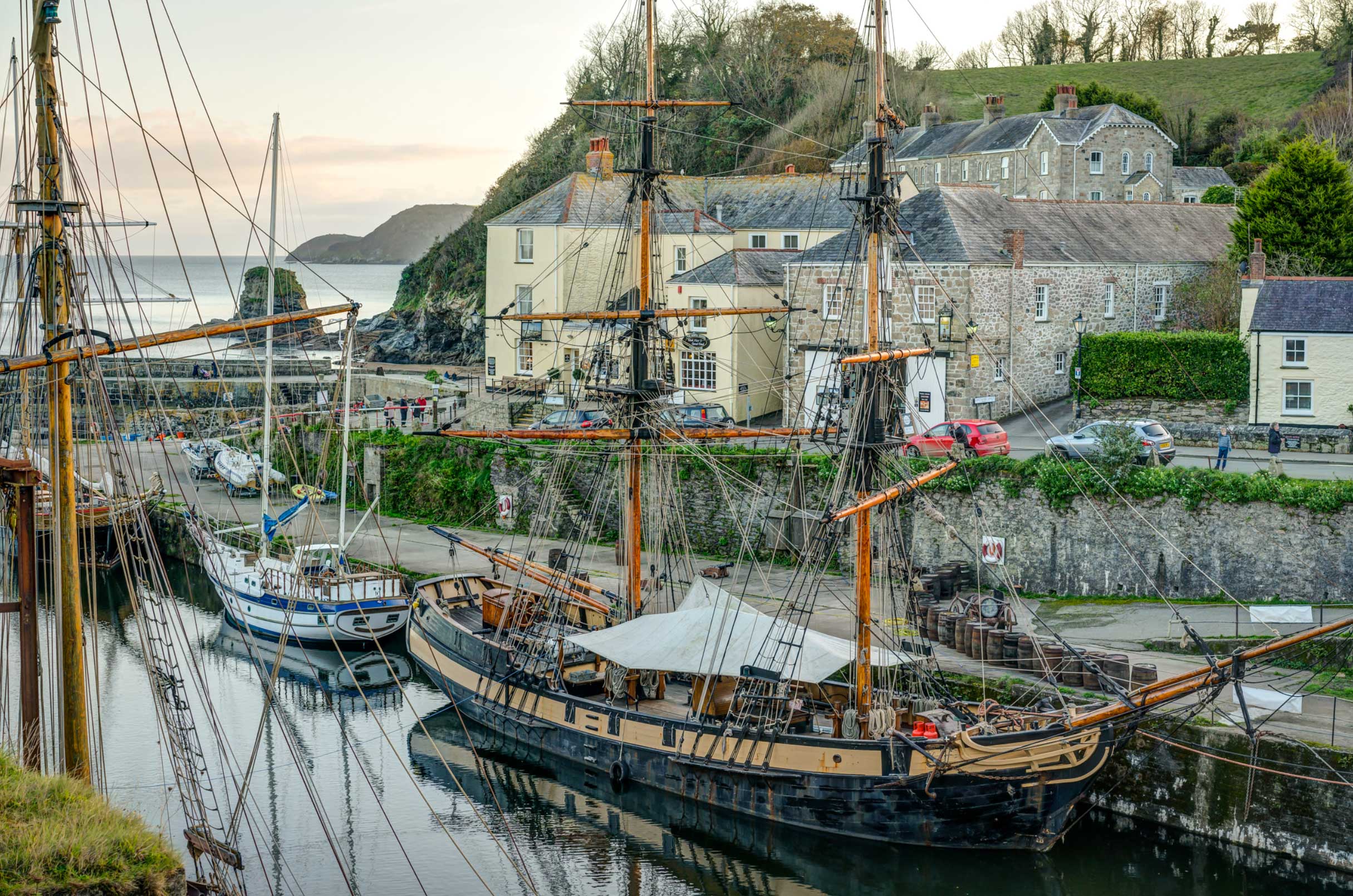
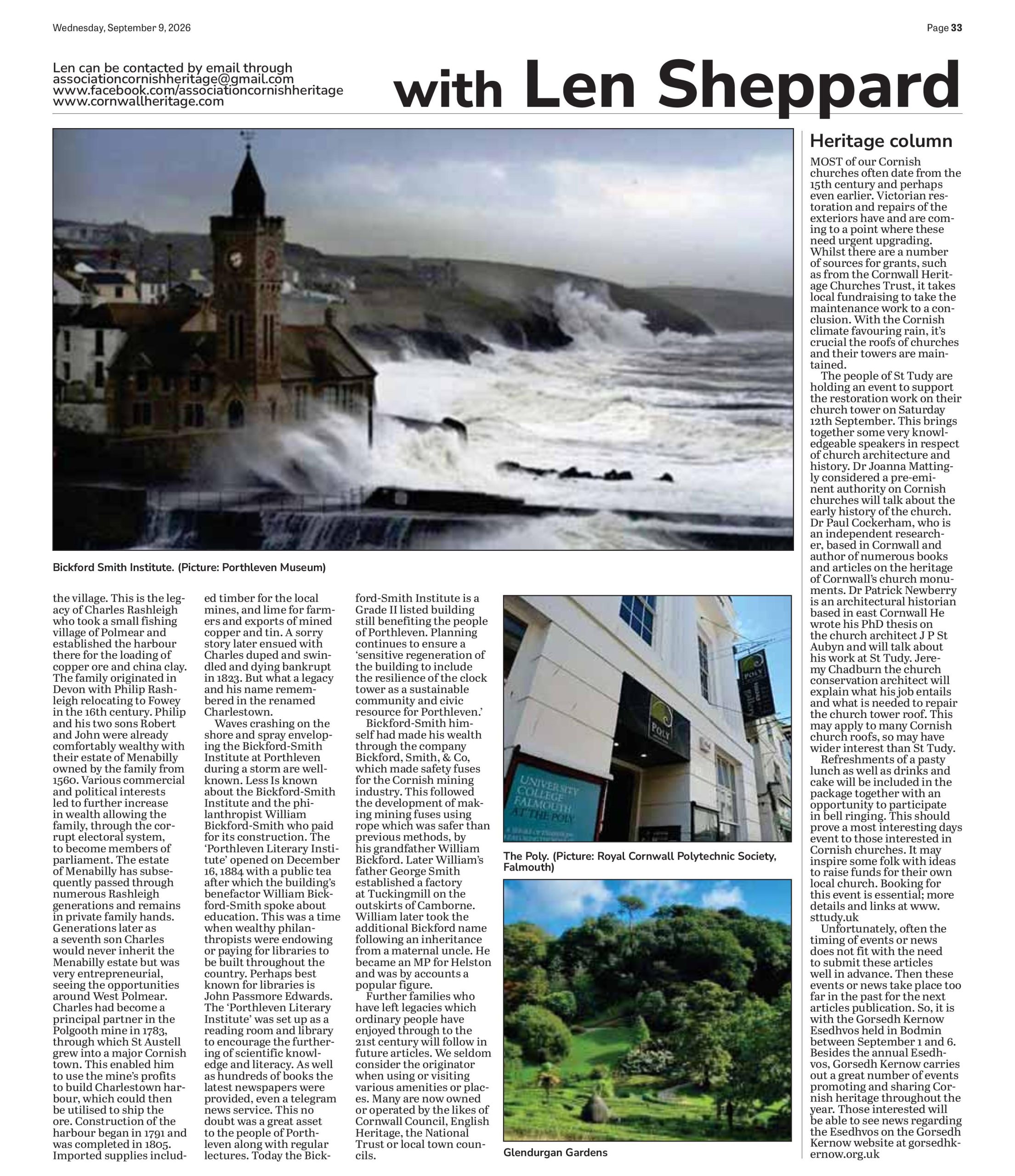
Many of us have visited Charlestown and enjoyed the small harbour there and the hostelries within the village. This is the legacy of Charles Rashleigh who took a small fishing village of Polmear and established the harbour there for the loading of copper ore and china clay. The family originated in Devon with Philip Rashleigh relocating to Fowey in the 16th century. Philip and his two sons Robert and John were already comfortably wealthy with their estate of Menabilly owned by the family from 1560. Various commercial and political interests led to further increase in wealth allowing the family, through the corrupt electoral system, to become members of parliament. The estate of Menabilly has subsequently passed through numerous Rashleigh generations and remains in private family hands. Generations later as a seventh son Charles would never inherit the Menabilly estate but was very entrepreneurial, seeing the opportunities around West Polmear. Charles had become a principal partner in the Polgooth mine in 1783, through which St Austell grew into a major Cornish town. This enabled him to use the mine’s profits to build Charlestown harbour, which could then be utilised to ship the ore. Construction of the harbour began in 1791 and was completed in 1805. Imported supplies included timber for the local mines, and lime for farmers and exports of mined copper and tin. A sorry story later ensued with Charles duped and swindled and dying bankrupt in 1823. But what a legacy and his name remembered in the renamed Charlestown.
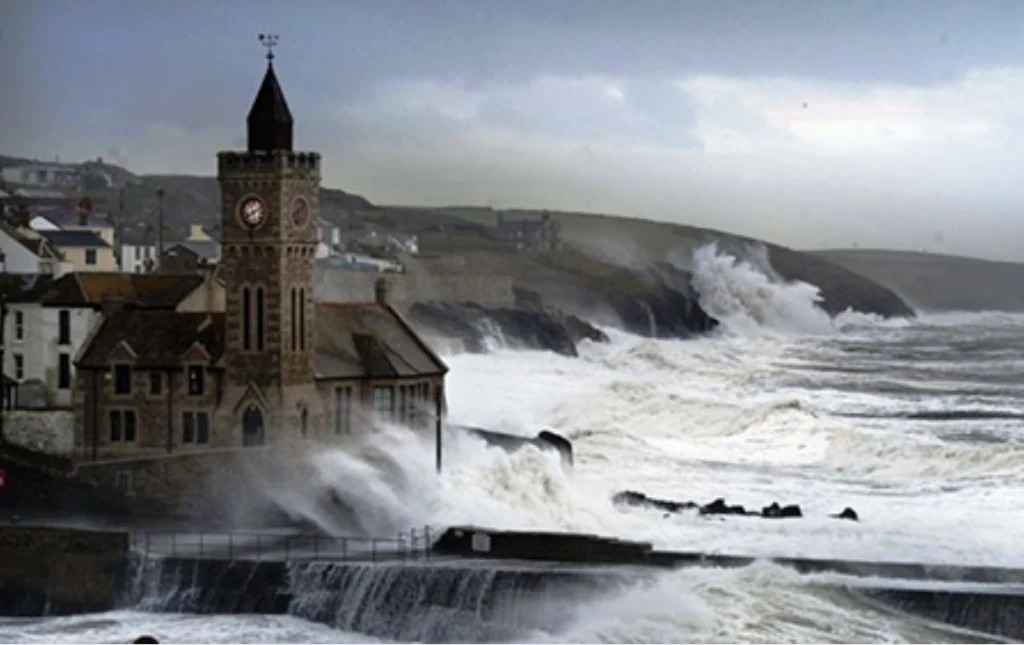
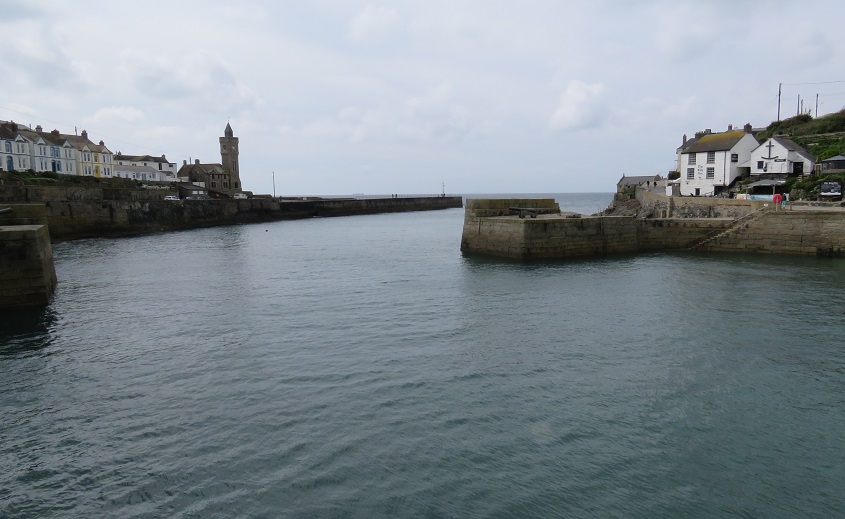
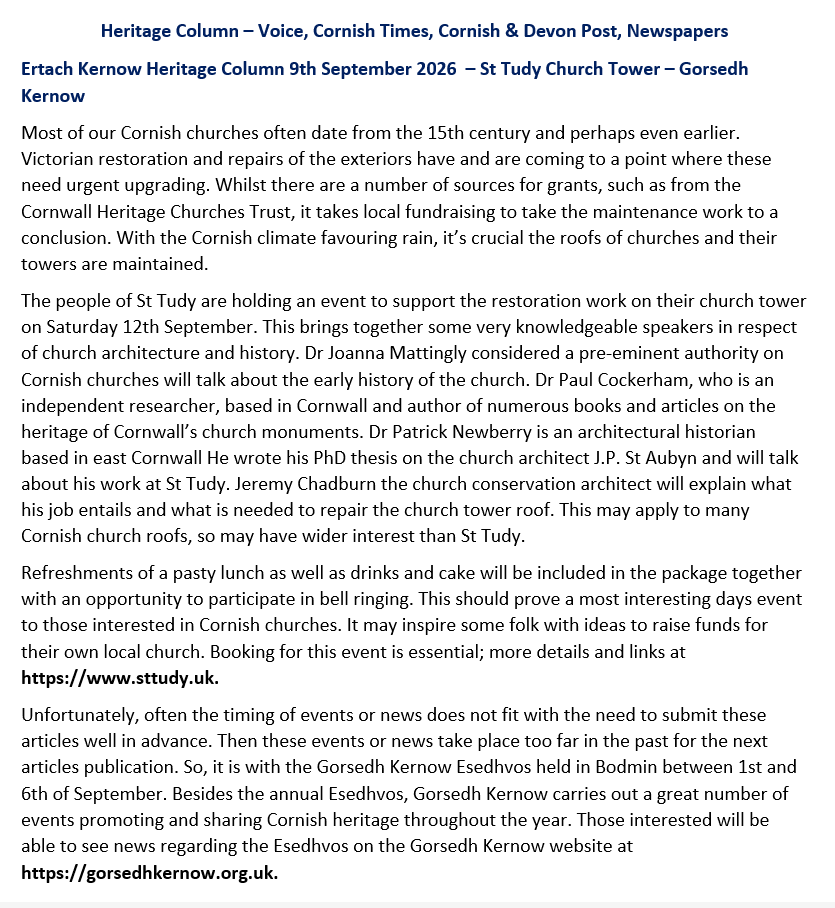
Waves crashing on the shore and spray enveloping the Bickford-Smith Institute at Porthleven during a storm are well-known. Less Is known about the Bickford-Smith Institute and the philanthropist William Bickford-Smith who paid for its construction. The ‘Porthleven Literary Institute’ opened on 16th December 1884 with a public tea after which the building’s benefactor William Bickford-Smith spoke about education. This was a time when wealthy philanthropists were endowing or paying for libraries to be built throughout the country. Perhaps best known for libraries is John Passmore Edwards. The ‘Porthleven Literary Institute’ was set up as a reading room and library to encourage the furthering of scientific knowledge and literacy. As well as hundreds of books the latest newspapers were provided, even a telegram news service. This no doubt was a great asset to the people of Porthleven along with regular lectures. Today the Bickford-Smith Institute is a Grade II listed building still benefiting the people of Porthleven. Planning continues to ensure a ‘sensitive regeneration of the building to include the resilience of the clock tower as a sustainable community and civic resource for Porthleven.’
Bickford-Smith himself had made his wealth through the company Bickford, Smith, & Co. which made safety fuses for the Cornish mining industry. This followed the development of making mining fuses using rope which was safer than previous methods, by his grandfather William Bickford. Later William’s father George Smith established a factory at Tuckingmill on the outskirts of Camborne. William later took the additional Bickford name following an inheritance from a maternal uncle. He became an MP for Helston and was by accounts a popular figure.
Further families who have left legacies which ordinary people have enjoyed through to the 21st century will follow in future articles. We seldom consider the originator when using or visiting various amenities or places. Many are now owned or operated by the likes of Cornwall Council, English Heritage, the National Trust or local town councils.
Heritage Column
Heritage in the News online links: