Ertach Kernow - Modern Paganism on the rise within Cornwall
Cornwall with its numerous churches and chapels was once a place where Christianity was ingrained within the population as seen elsewhere in Britain; Celtic paganism is now on the rise. The 2021 census shows how things have changed with just 45% of people stating Christianity and 46% having no religion. Besides those that would not say, there are another fifty-four other religions recorded. Far behind the Christians were the Buddhists and surprisingly in third place were the Pagans. There are some of the other even smaller religions who would fall under the category of pagans in its broadest terms, including those classifying themselves as heathens and druids.
As always click the images for larger view
Broadly speaking Paganism has been described as encompassing various spiritual paths, often rooted in ancient polytheistic traditions, celebrating nature with its cycles, sometimes involving the worship of multiple deities. For some two thousand years paganism has been linked to the term ‘false gods’. It has been used by Christians as a derogatory term for non-Abrahamic faiths. Abraham is the figure central to both Christianity and to the other Abrahamic religions of Judaism and Islam.
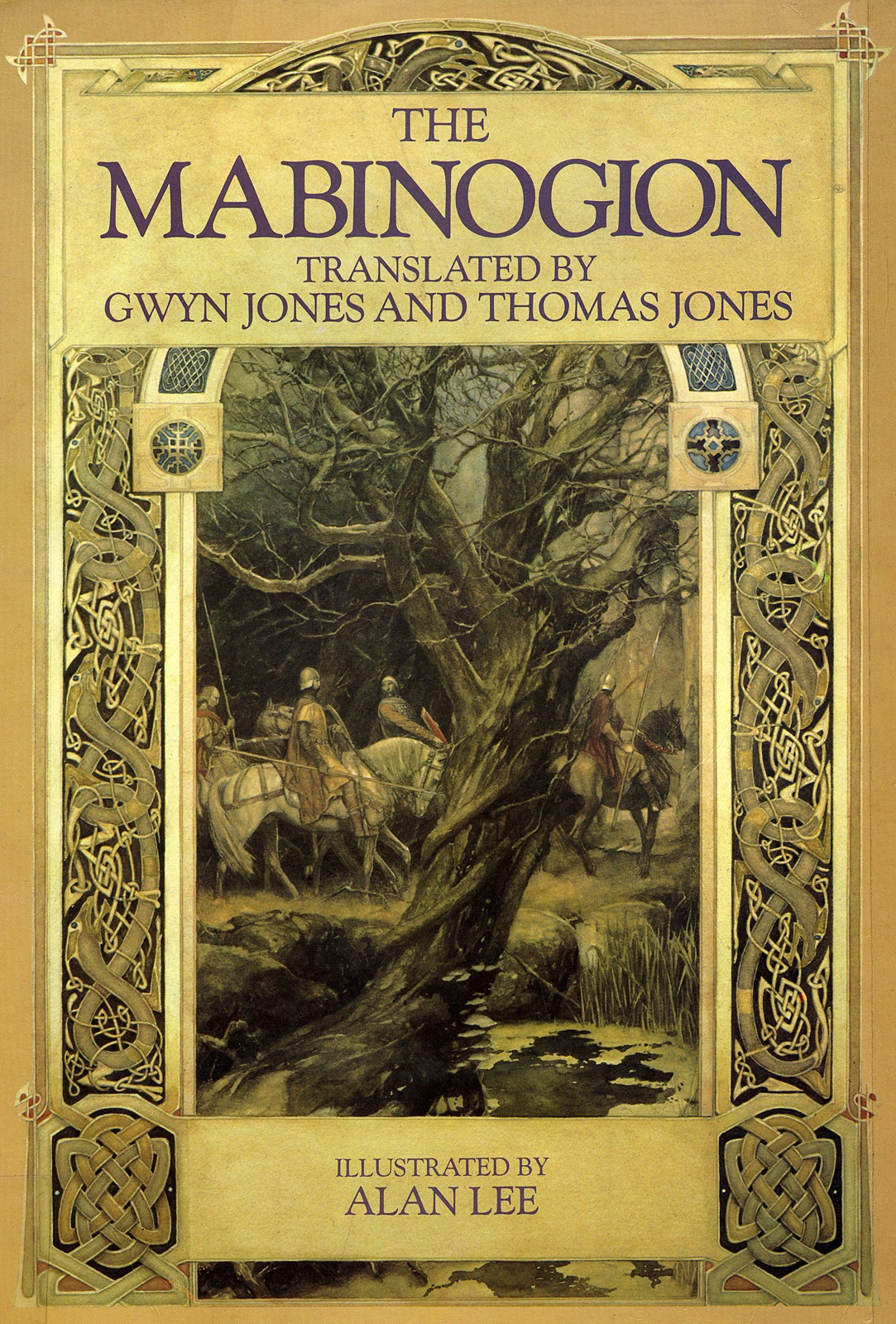
Britain as a whole prior to the Roman invasion was Celtic, spilt into various tribal divisions. Within the larger units there would have been smaller groupings. The Roman administrative unit of Dumnonia included the Cornish tribes. This seemingly continued for some time after the Romans left, under the influence of a higher king, with many petty kings and tribal leaders. Whilst no Cornish records exist evidence can be found in the writings of Roman historians. As would be expected these are biased against the Celtic peoples of Britain making them appear as uncivilised barbarians in the eyes of their Roman conquerors. What else we know comes from medieval literature based on earlier Welsh and Irish text such as the Mabinogion and Lebor Gabála Érenn. Those from Ireland are particularly interesting as these are considered less corrupted by foreign influences.
The Celtic pagan religions differed greatly from that of the Anglo-Saxon pagan beliefs. The arrival of the Germanic tribes the Angles, Saxons, Jutes, and Frisians saw their form of religion emerging across much of England from the 5th century. This was based on a hierarchical structured pantheon of deities such as Woden / Odin, Thunor / Thor and other ‘gods’, today we associate these with Norse mythology. Certainly Anglo-Saxon paganism was less regionalised, these deities along with some English created ‘gods’ such as Seaxneat, Hengist and Horsa covering far wider geographical areas. Ancient Celtic paganism was largely based around the natural world with a mother earth goddess and various other gods with regional variations to their names. Local deities attached to certain natural aspects of the land would also have been worshiped and offerings made to them.
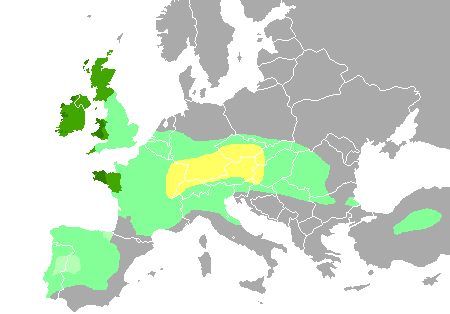
Celtic Paganism spread across Europe with the expansion of Celtic tribes and in Britain likely early on, especially in Cornwall, during the Bronze Age. Tin trading for the production of bronze would have encouraged imports and exports and with that came people with their beliefs from overseas. Celtic religion probably reached its high point during the Iron Age. The arrival of Romans gradually transforming it through introduction and merging with Roman deities. Cornwall’s communities, somewhat isolated, likely held on to their earlier beliefs during the Roman period due to limited interaction except for trading. Following the withdrawal of the legions around 410CE the earlier Celtic beliefs would have re-emerged as the people continued following the natural cycle of the seasons.


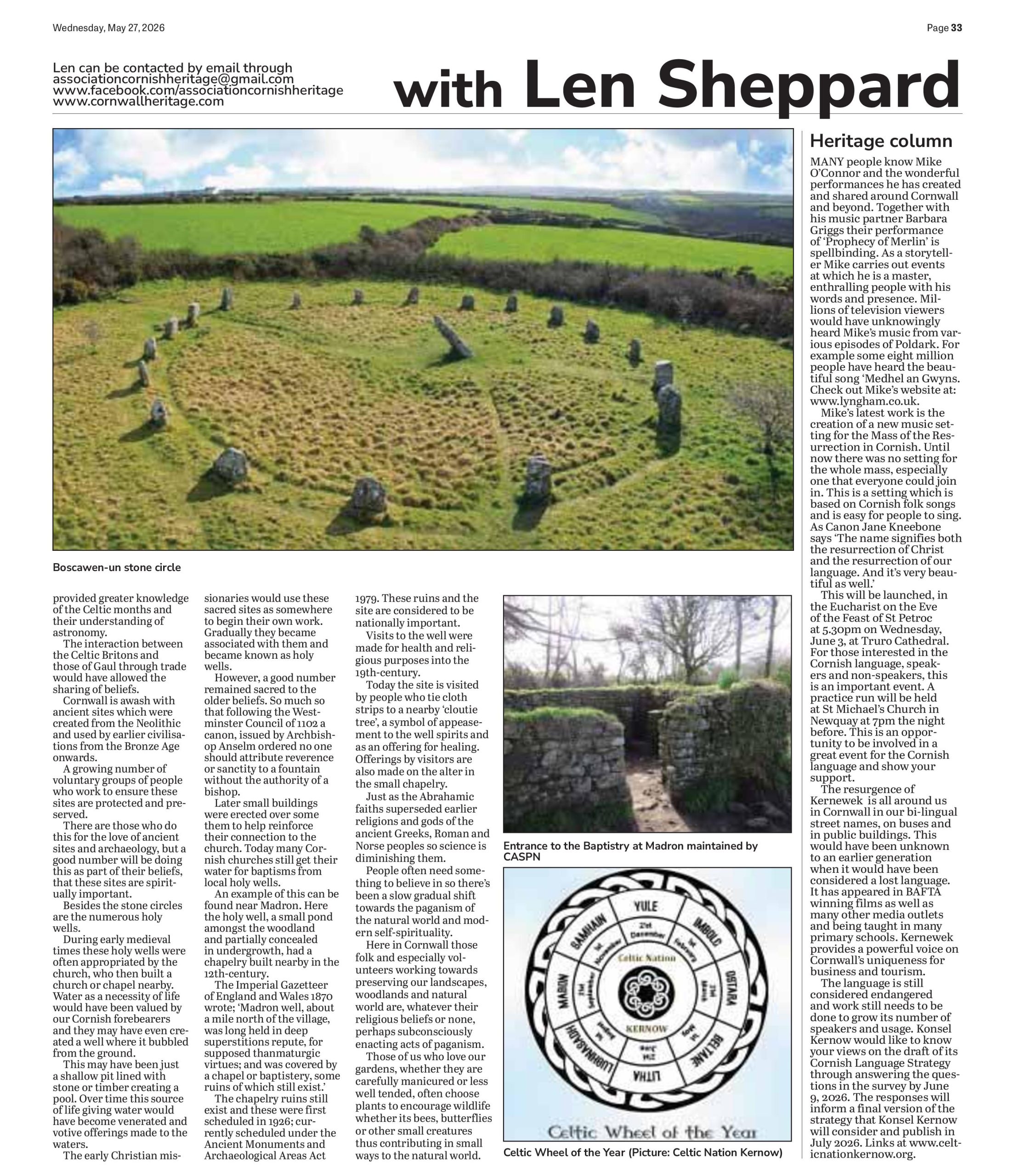
The Celtic year is a calendar based on ancient feasts days celebrating their connections with the natural cycle. The four major days were Samhain, Imbolc, Beltane, and Lughnasadh celebrated at the midpoint between each solstice and equinox. Like many other ancient civilisations the ‘Insular Celts’, those now making up the Anglo-Celtic Isles and Brittany, had a calendar based on the cycles of the moon. The four major festival dates were known as fire festivals with a further four on the dates of the equinox and solstice. It is now acknowledged that many pre-Celtic constructions had ways of identifying mid-winter and mid-summer. One the most well-known perhaps is Stonehenge and English Heritage explaining; ‘on the summer solstice, the sun rises behind the Heel Stone in the north-east part of the horizon and its first rays shine into the heart of Stonehenge. On the winter solstice, the sun sets to the south-west of the stone circle.’
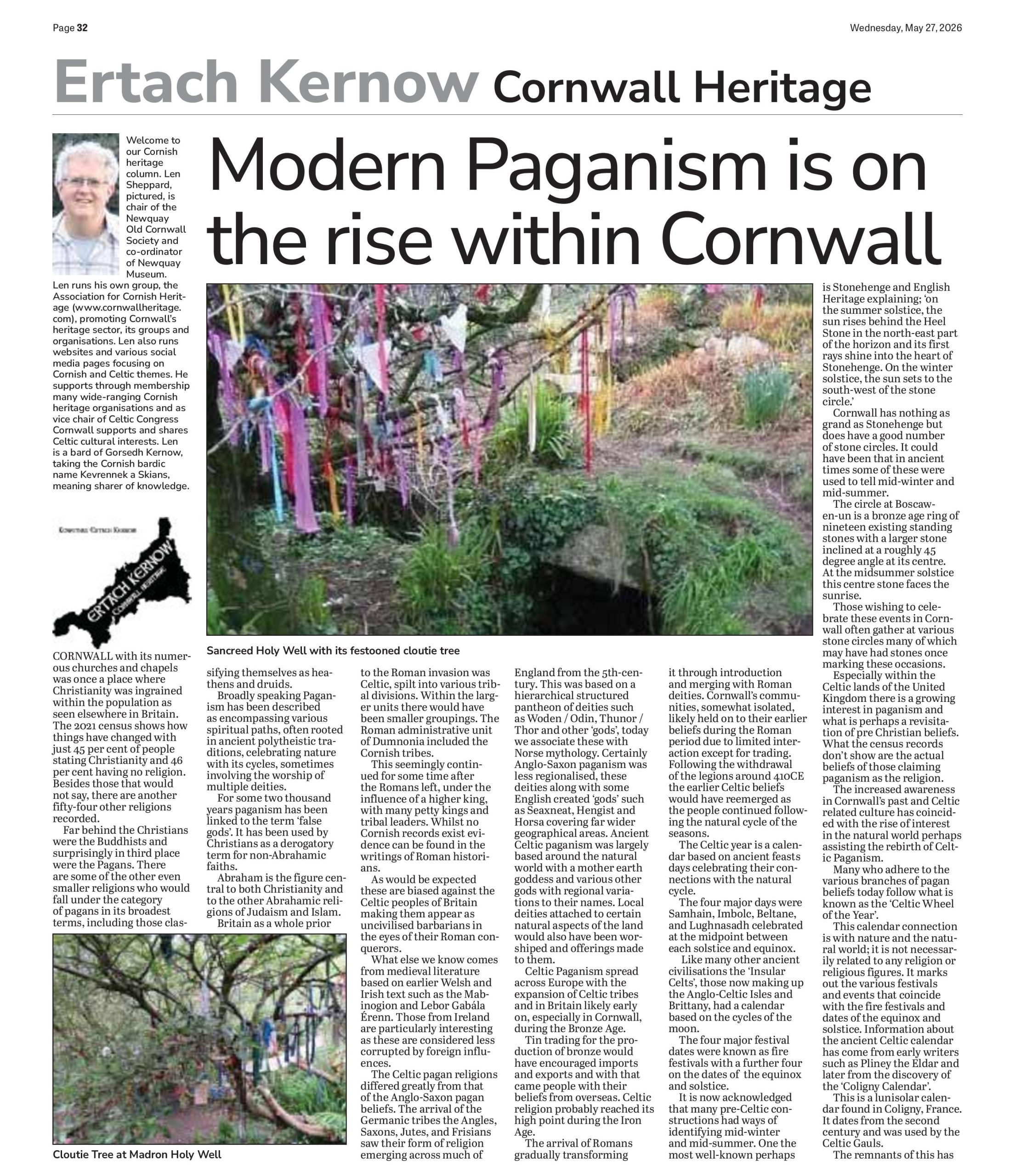
Cornwall has nothing as grand as Stonehenge but does have a good number of stone circles. It could have been that in ancient times some of these were used to tell mid-winter and mid-summer. The circle at Boscawen-un is a bronze age ring of nineteen existing standing stones with a larger stone inclined at a roughly 45 degree angle at its centre. At the midsummer solstice this centre stone faces the sunrise. Those wishing to celebrate these events in Cornwall often gather at various stone circles many of which may have had stones once marking these occasions.
Especially within the Celtic lands of the United Kingdom there is a growing interest in paganism and what is perhaps a revisitation of pre Christian beliefs. What the census records don’t show are the actual beliefs of those claiming paganism as the religion. The increased awareness in Cornwall’s past and Celtic related culture has coincided with the rise of interest in the natural world perhaps assisting the rebirth of Celtic Paganism.
Many who adhere to the various branches of pagan beliefs today follow what is known as the ‘Celtic Wheel of the Year’. This calendar connection is with nature and the natural world; it is not necessarily related to any religion or religious figures. It marks out the various festivals and events that coincide with the fire festivals and dates of the equinox and solstice. Information about the ancient Celtic calendar has come from early writers such as Pliney the Eldar and later from the discovery of the ‘Coligny Calendar’. This is a lunisolar calendar found in Coligny, France. It dates from the second-century and was used by the Celtic Gauls. The remnants of this has provided greater knowledge of the Celtic months and their understanding of astronomy. The interaction between the Celtic Britons and those of Gaul through trade would have allowed the sharing of beliefs.

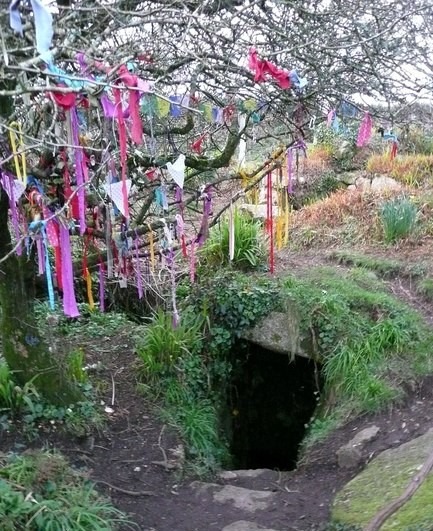
Cornwall is awash with ancient sites which were created from the Neolithic and used by earlier civilisations from the Bronze Age onwards. A growing number of voluntary groups of people who work to ensure these sites are protected and preserved. There are those who do this for the love of ancient sites and archaeology, but a good number will be doing this as part of their beliefs, that these sites are spiritually important. Besides the stone circles are the numerous holy wells. During early medieval times these holy wells were often appropriated by the church, who then built a church or chapel nearby. Water as a necessity of life would have been valued by our Cornish forebearers and they may have even created a well where it bubbled from the ground. This may have been just a shallow pit lined with stone or timber creating a pool. Over time this source of life giving water would have become venerated and votive offerings made to the waters. The early Christian missionaries would use these sacred sites as somewhere to begin their own work. Gradually they became associated with them and became known as holy wells. However, a good number remained sacred to the older beliefs. So much so that following the Westminster Council of 1102 a canon, issued by Archbishop Anselm ordered no one should attribute reverence or sanctity to a fountain without the authority of a bishop. Later small buildings were erected over some them to help reinforce their connection to the church. Today many Cornish churches still get their water for baptisms from local holy wells.
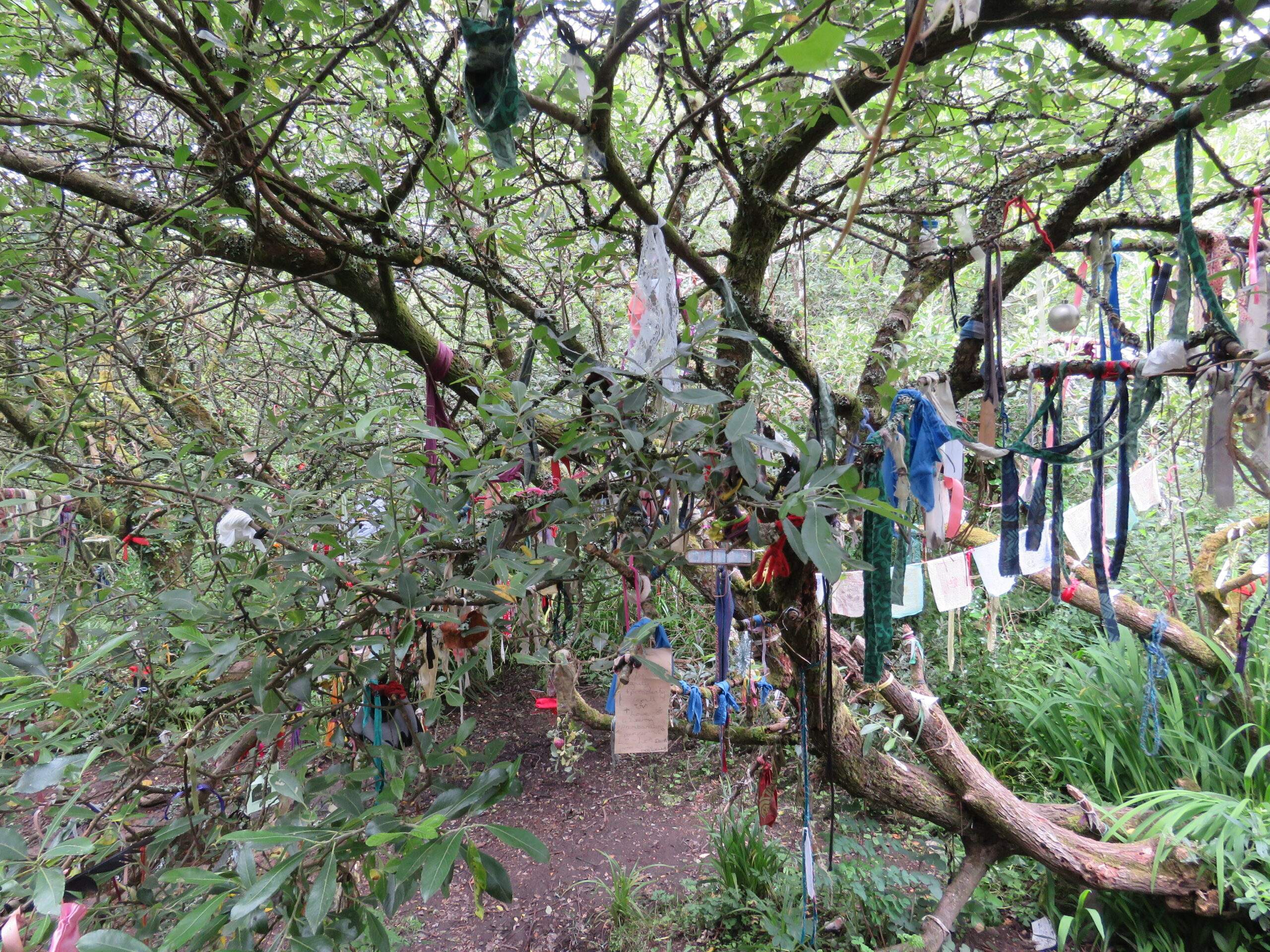
An example of this can be found near Madron. Here the holy well, a small pond amongst the woodland and partially concealed in undergrowth, had a chapelry built nearby in the 12th century. The Imperial Gazetteer of England & Wales 1870 wrote; ‘Madron well, about a mile north of the village, was long held in deep superstitions repute, for supposed thanmaturgic virtues; and was covered by a chapel or baptistery, some ruins of which still exist.’ The chapelry ruins still exist and these were first scheduled in 1926; currently scheduled under the Ancient Monuments and Archaeological Areas Act 1979. These ruins and the site are considered to be nationally important. Visits to the well were made for health and religious purposes into the 19th century. Today the site is visited by people who tie cloth strips to a nearby ‘cloutie tree’, a symbol of appeasement to the well spirits and as an offering for healing. Offerings by visitors are also made on the alter in the small chapelry.
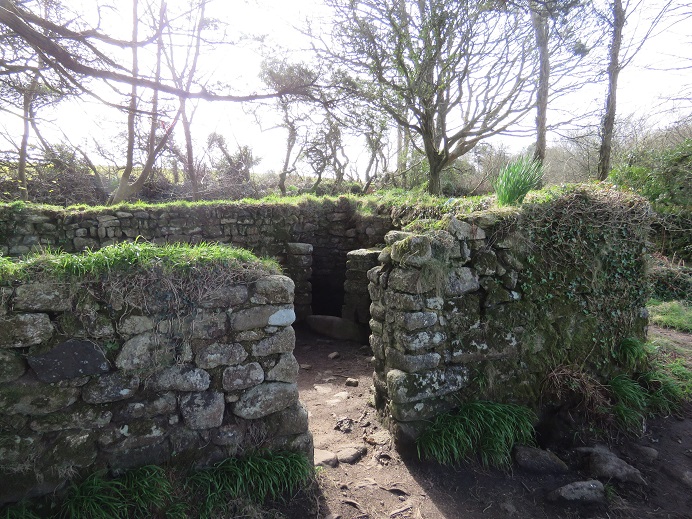
Just as the Abrahamic faiths superseded earlier religions and gods of the ancient Greeks, Roman and Norse peoples so science is diminishing them. People often need something to believe in so there’s been a slow gradual shift towards the paganism of the natural world and modern self-spirituality. Here in Cornwall those folk and especially volunteers working towards preserving our landscapes, woodlands and natural world are, whatever their religious beliefs or none, perhaps subconsciously enacting acts of paganism. Those of us who love our gardens, whether they are carefully manicured or less well tended, often choose plants to encourage wildlife whether its bees, butterflies or other small creatures thus contributing in small ways to the natural world.
Heritage Column