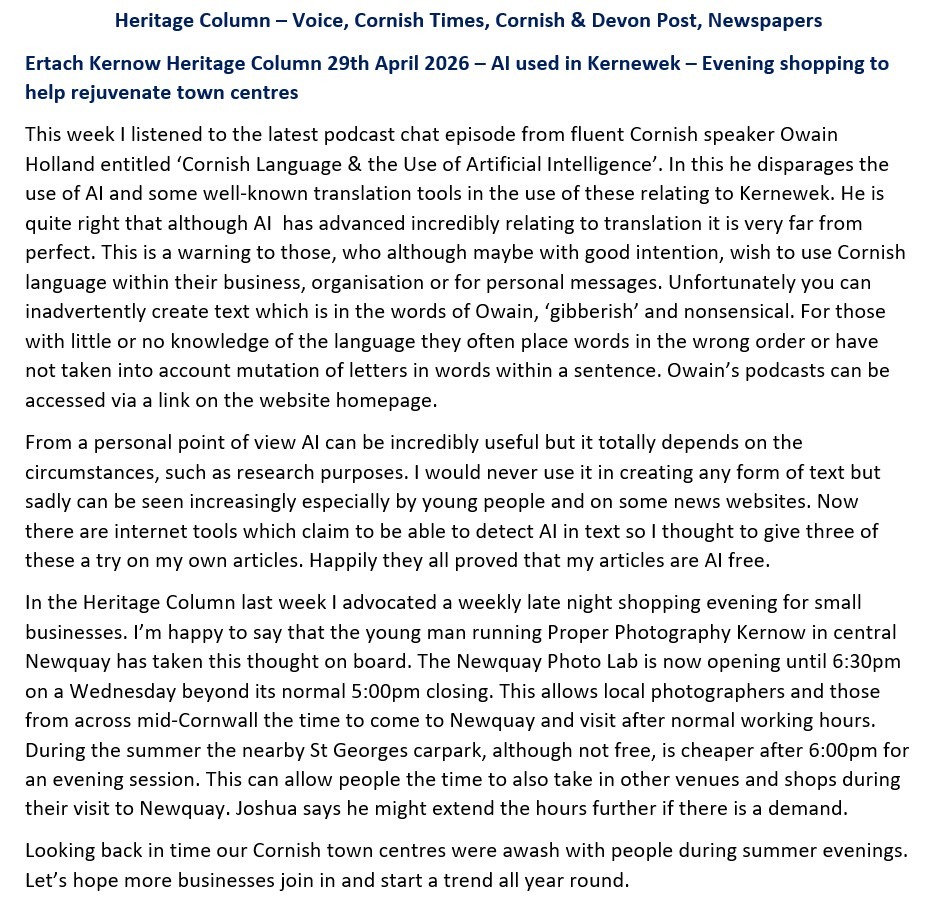
Ertach Kernow - Boyton, tranquillity in a countryside parish
The Cornish parish of Boyton is borders England with a small part historically extending into Devon. Boyton is perhaps one of several River Tamar side parishes that are far from well-known as you move west in Cornwall. I must confess that until a few years ago I’d never heard of it until family history research revealed that a three times great grandfather had worked there as a miller.
As always click the images for larger view
Today Boyton is a middling sized rural parish of about 4,216 acres with a population at the last census of 521 people. It has never been highly populated and has always been largely a farming community. There is no evidence of mining but at one time manganese mines were worked although discontinued before 1870. Besides the churchtown village of Boyton the other communities include the hamlets of Bennacott, Curry Lane, North Beer and West Curry along with a number of farmsteads scattered throughout the parish. Within the parish of Boyton lay the hamlet of Northcott, which was on the Devon side of the River Tamar. Changes in the border and parish boundaries now see Northcott as its own parish in Devon. Northcott’s inclusion is through its historic connections to Boyton as a Cornish parish.
The Cornish name for Boyton is Trevoya based on a likely owners name from its historic past ‘Boya’ with the prefix ‘Tre’ for farmstead or settlement. Saxon influence in the eastern part of Cornwall has seen ‘ton’ derived from ‘tun’ applied to many Cornish town names. This meant fenced homestead or farmstead usually with the name of the owner as the prefix. Boyton’s prehistoric remains are scant with just a small number of ancient barrows and later Iron Age enclosures and evidence of field remains. As a historic settlement Boyton manor was mentioned in Domesday as Boitone, lying amongst the smallest forty percent of manors by size with just eight households.
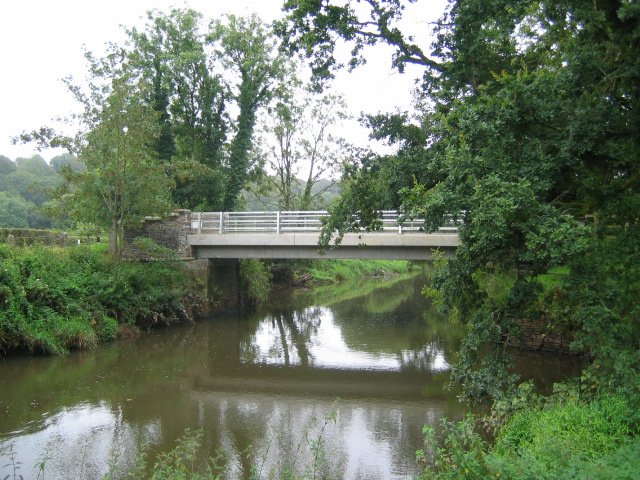
The River Tamar has yet to widen or have sufficient traffic require a grander bridge crossing as found elsewhere. The site of the present bridge is that of an earlier wooden structure which existed until at least 1668. This was a timber on masonry foundations first constructed around 1614. This part of Boyton was included in Devon at that time and records show that the Devonshire justices refused to maintain at that date. Unlike the remaining larger medieval stone bridges nothing of historical significance or interest exists at the Boyton crossing. A more robust stone bridge was constructed but this too was replaced in 1875. This late 19th century bridge was a later described as a ‘Large wrought iron riveted beam and trough bridge with cast iron uprights to square wrought iron railings. The structure sits on dressed granite ashlar abutments. The railings are extended by short granite rubble parapets, which show signs of multiple rebuilds.’ Traffic had by 2005 required this bridge to be replaced and a 12 metre concrete slab bridge was set in place.
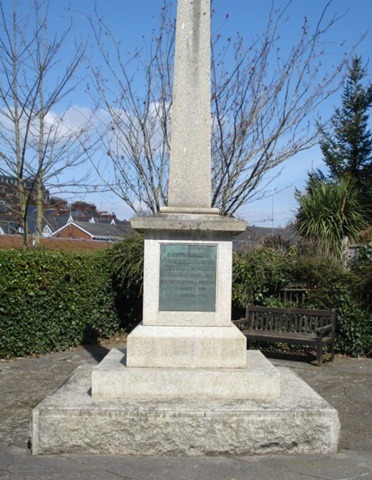
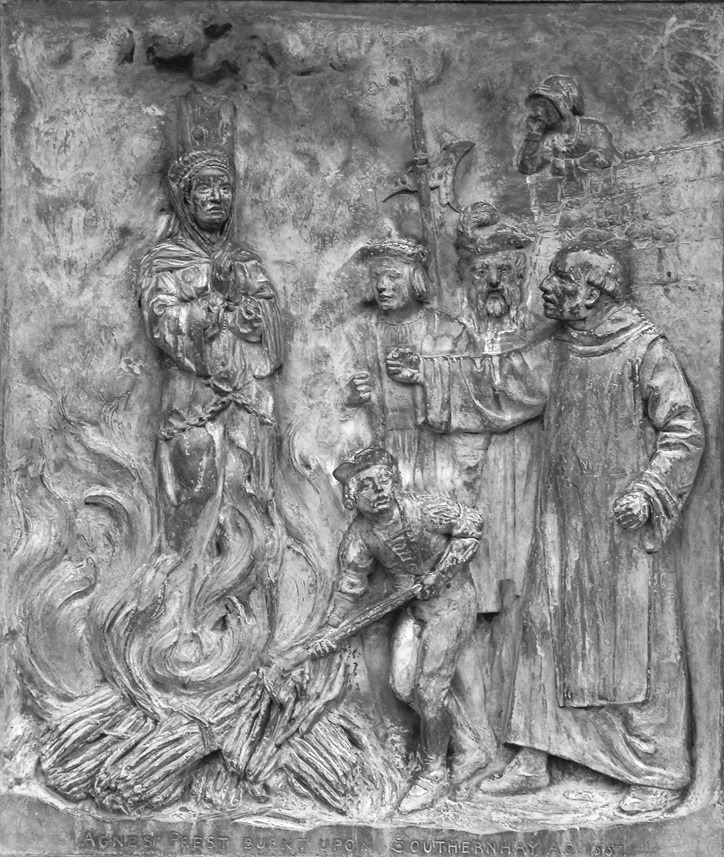
Said to be a native of the hamlet of Northcott in Boyton parish was a woman named Agnes Prest. Few would know of Agnes Prest today but she is included in the ‘Book of Martyrs’ by James Fox published in 1563. The English Reformation had taken place following Henry VIII’s break with Rome and had continued under the reign of his son Edward VI. On his death the throne of England was taken by Mary Tudor who reigned for five years during which she attempted to turn back the Reformation. This period saw around 300 religious dissenters burnt at the stake in a frenzy of persecutions.
Agnes Prest was raised in the Roman faith later converting to become a protestant. She had married an passionate Catholic with their children being raised as Catholics. Despite every attempt to bring her back into the Roman Catholic fold Agnes refused. People were required to attend Mass, to be held in every church throughout the country, which Agnes refused to do. Agnes described as a cheerful, patient, sober and hardworking woman she was also resolute and would not associate herself with idolaters, which included her family. She knew the bible by heart although uneducated and this would play against her as she may have not understood the nuances of phrases used within it when interrogated. Over time she was incarcerated in prison, freed and again imprisoned for refusing to convert to the Roman Catholic faith and eventually accused of heresy was found guilty. Taken outside the walls of Exeter to a place known as Southernhay, Agnes was tied to a stake and burnt to death. The Exeter Protestant Martyrs’ Memorial to her and another was erected in 1909 saying of her ‘Agnes Prest who suffered on Southernhay, A.D. 1557, for refusing to accept the doctrine of transubstantiation. Faithful unto Death.’ A copy of her entry in the ‘Book of Martyrs’ is on the website blog.
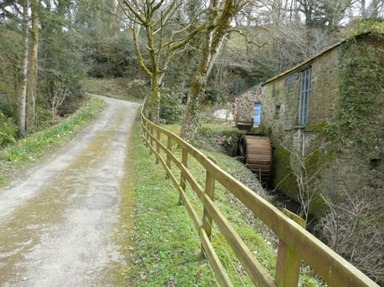
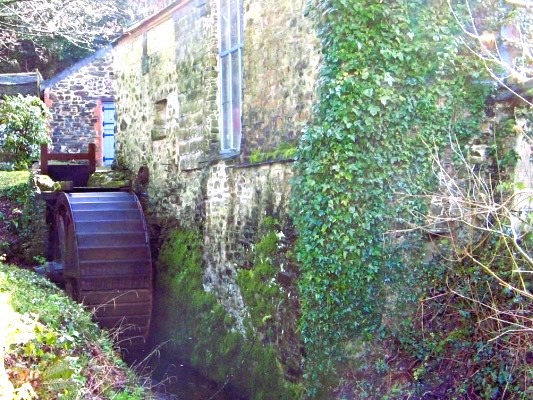
My interest was piqued by the existence of Northcott Mill, later renamed Boyton Mill, due to my three times great grandfather Abraham living in Boyton parish and working there. It seems from the history of the mill that Abraham worked and lived here with his family until 1807. Today this former mill offers self-catering holidays in idyllic settings of garden and grounds. It still has a water wheel which replaced any that would have existed from Abraham’s time. Two granite mill stones from an earlier period to those installed during the late 19th century can still be seen. Although largely rebuilt around 1808 there remains some of the earlier 17th century building. Perhaps it was Abraham who started the rebuilding between 1800 and 1807 when living at Northcott Mill to accommodate his growing family.
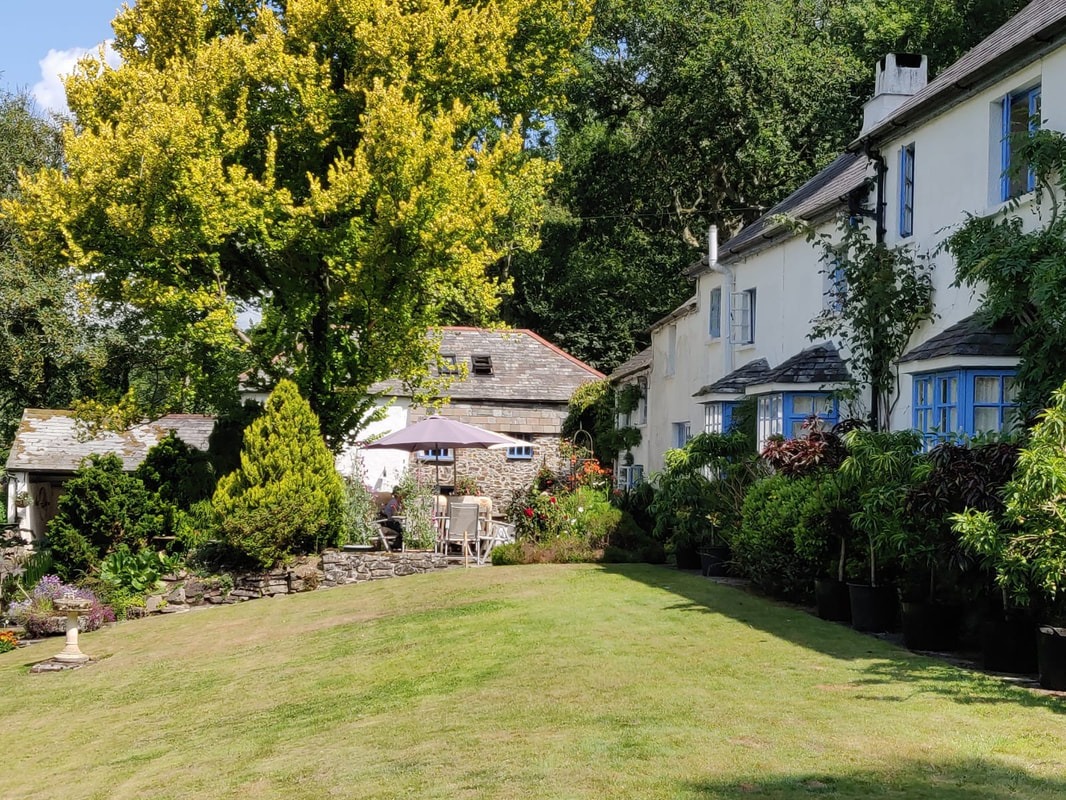
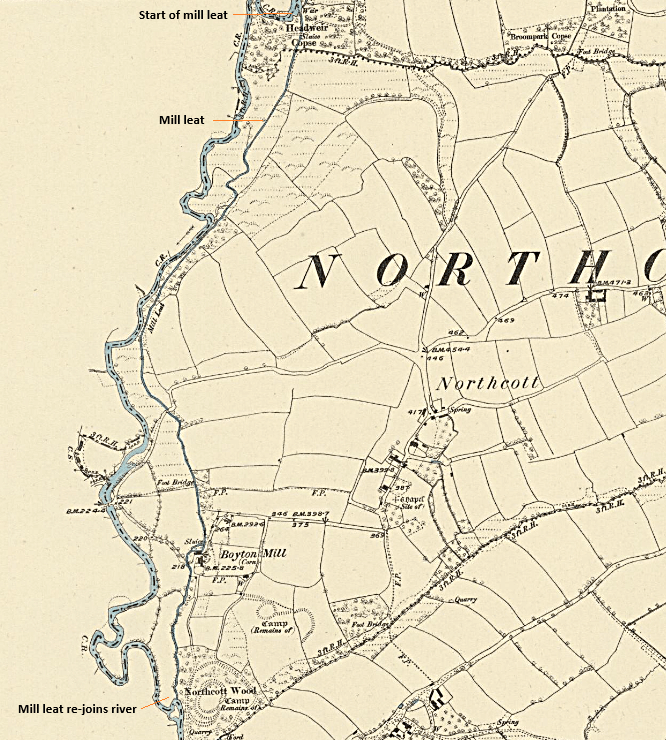
The former manorial estate on which Boyton mill stands has a long history first mentioned in Domesday. Mills have always been an important part of the history of manors with rules laid down that corn grown within a manor was to be milled at the manorial mill. A mill had existed on this site since the 13th century and was powered by a water wheel from the nearby River Tamar. A leat to carry the water is shown clearly on the 1883 Ordnance Survey map, what is interesting is the length of it at about a mile long. Starting at a weir to the north it runs almost parallel to the River Tamar through a sluice to the mill and away to join the river south of the mill. Boyton Mill is only about three hundred yards from the river so there must have been a good reason to construct the very long leat, perhaps to provide greater power from a more vigorous part of the river.
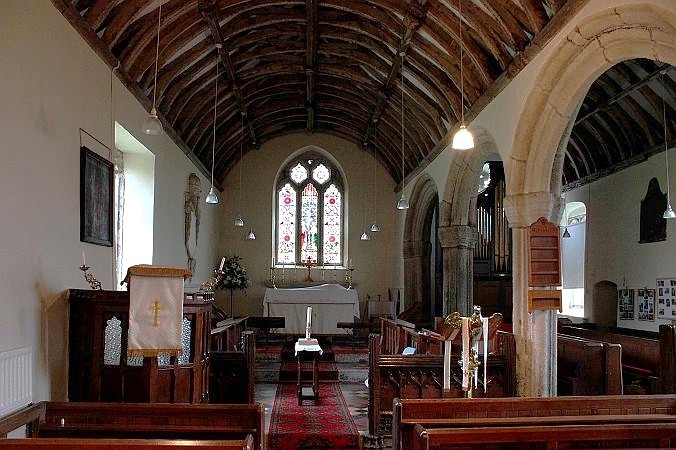
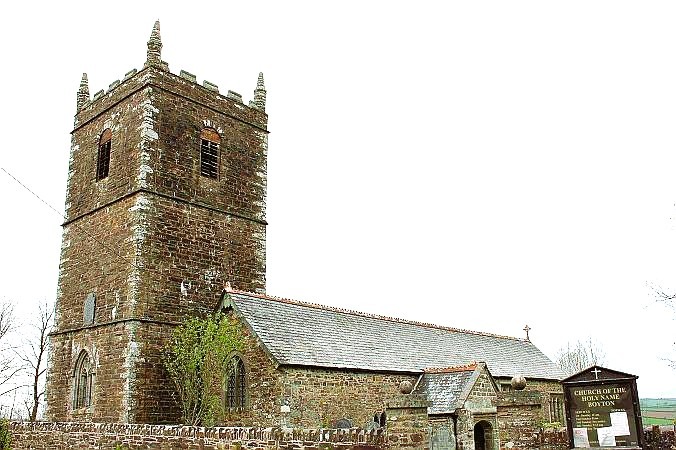
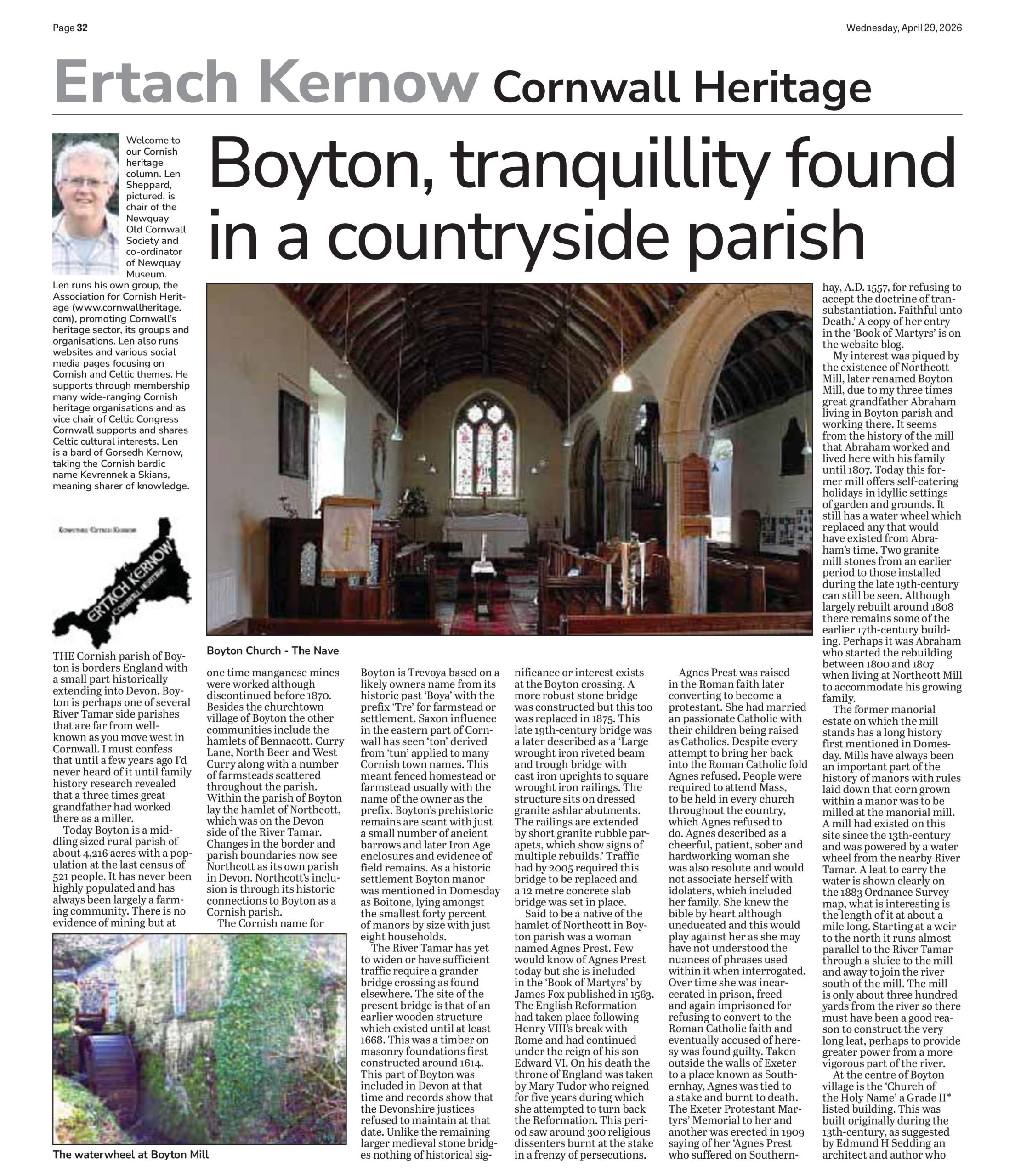
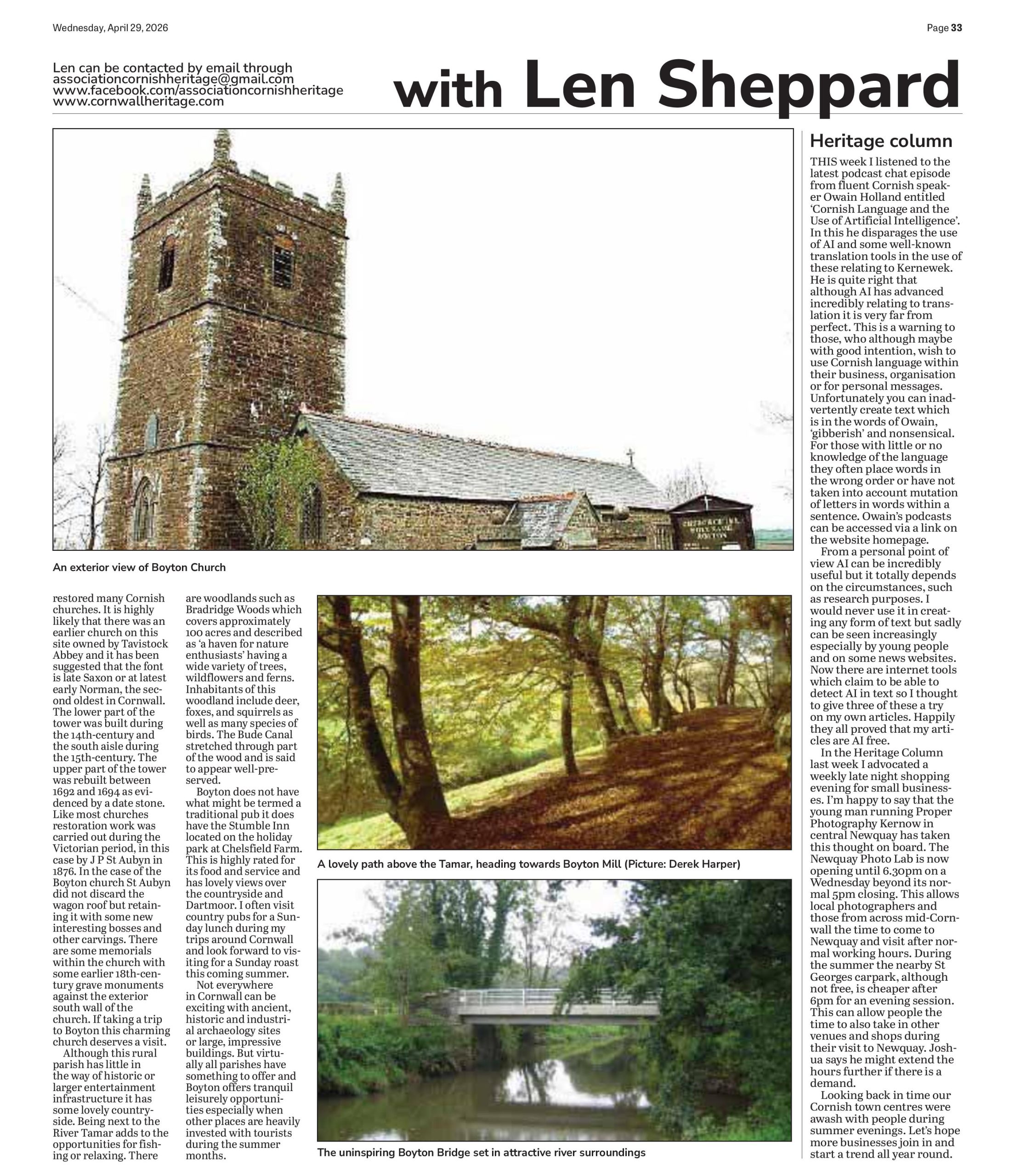
At the centre of Boyton village is the ‘Church of the Holy Name’ a Grade II* listed building. This was built originally during the 13th century, as suggested by Edmund H Sedding an architect and author who restored many Cornish churches. It is highly likely that there was an earlier church on this site owned by Tavistock Abbey and it has been suggested that the font is late Saxon or at latest early Norman, the second oldest in Cornwall. The lower part of the tower was built during the 14th century and the south aisle during the 15th century. The upper part of the tower was rebuilt between 1692 and 1694 as evidenced by a date stone. Like most churches restoration work was carried out during the Victorian period, in this case by J P St Aubyn in 1876. In the case of the Boyton church St Aubyn did not discard the wagon roof but retaining it with some new interesting bosses and other carvings. There are some memorials within the church with some earlier 18th century grave monuments against the exterior south wall of the church. If taking a trip to Boyton this charming church deserves a visit.
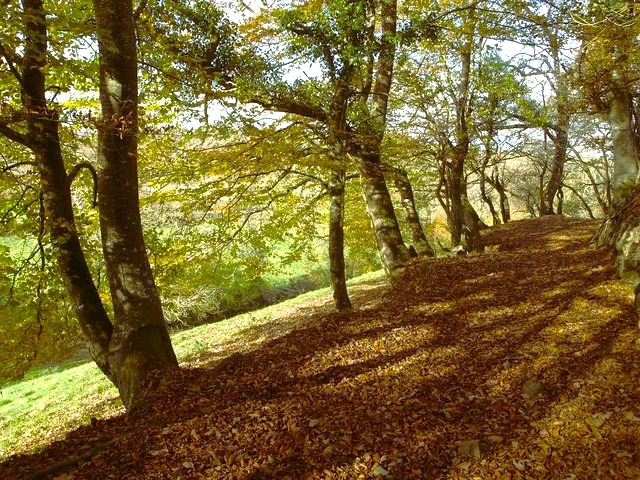
Although this rural parish has little in the way of historic or larger entertainment infrastructure it has some lovely countryside. Being next to the River Tamar adds to the opportunities for fishing or relaxing. There are woodlands such as Bradridge Woods which covers approximately 100 acres and described as ‘a haven for nature enthusiasts’ having a wide variety of trees, wildflowers and ferns. Inhabitants of this woodland include deer, foxes, and squirrels as well as many species of birds. The Bude Canal stretched through part of the wood and is said to appear well-preserved.
Boyton does not have what might be termed a traditional pub it does have the Stumble Inn located on the holiday park at Chelsfield Farm. This is highly rated for its food and service and has lovely views over the countryside and Dartmoor. I often visit country pubs for a Sunday lunch during my trips around Cornwall and look forward to visiting for a Sunday roast this coming summer.
Not everywhere in Cornwall can be exciting with ancient, historic and industrial archaeology sites or large, impressive buildings. But virtually all parishes have something to offer and Boyton offers tranquil leisurely opportunities especially when other places are heavily invested with tourists during the summer months.
Ertach Kernow is thankful to Mrs Coral Dinner who sent us some images of part of the Bude Canal which passes through their land
![Boyton Water [1 Courtesy of Coral Dinner]](https://www.cornwallheritage.com/wp-content/uploads/2026/05/Boyton-Water-1-Courtesy-of-Coral-Dinner.png "Boyton Water [1 Courtesy of Coral Dinner]")
![Boyton Water [2 Courtesy of Coral Dinner]](https://www.cornwallheritage.com/wp-content/uploads/2026/05/Boyton-Water-2-Courtesy-of-Coral-Dinner.png "Boyton Water [2 Courtesy of Coral Dinner]")
![Boyton Water [3 Courtesy of Coral Dinner]](https://www.cornwallheritage.com/wp-content/uploads/2026/05/Boyton-Water-3-Courtesy-of-Coral-Dinner.png "Boyton Water [3 Courtesy of Coral Dinner]")
Received from Alan Beat owner of The Bridge Mill at Bridgerule. We thank him for his interest and for sending this additional information about watermills relating to the River Tamar.
I’ve just read your column in the Post newspaper about Boyton and your puzzlement over the leat bringing water to the wheel being a mile long. I live at the mill in Bridgerule just a few miles upstream of Boyton, and our leat was also over one mile in length. This is due to a combination of geography and efficiency.
First, efficiency. Water wheels are most efficient when overshot, water entering at the top of the wheel to fill buckets and provide power through gravity acting on one side of the wheel as buckets empty at the bottom. They are least efficient when undershot, water flowing against paddles at the base of the wheel. Most of the time there is not enough flow in the upper Tamar to power an undershot wheel to grind flour - but there is enough for an overshot wheel to function.
Second, geography. The Tamar valley here drops roughly 12 feet for every mile in length. An overshot wheel needs to be about 8 feet in diameter to generate enough power for grinding flour, and water is discharged from the wheel at river level where the mill is sited - so the leat has to discharge 8 feet above that level, at the top of the wheel. To do that, it has to take water from the river at least 2/3 of a mile upstream (8/12) and in practice more than that, to itself have a slight fall over its length.
My Bridgerule mill is recorded in the Domesday survey and it’s astonishing to think of Saxon people understanding and constructing such a leat with hand tools. I have restored the mill to working order.
Heritage Column